
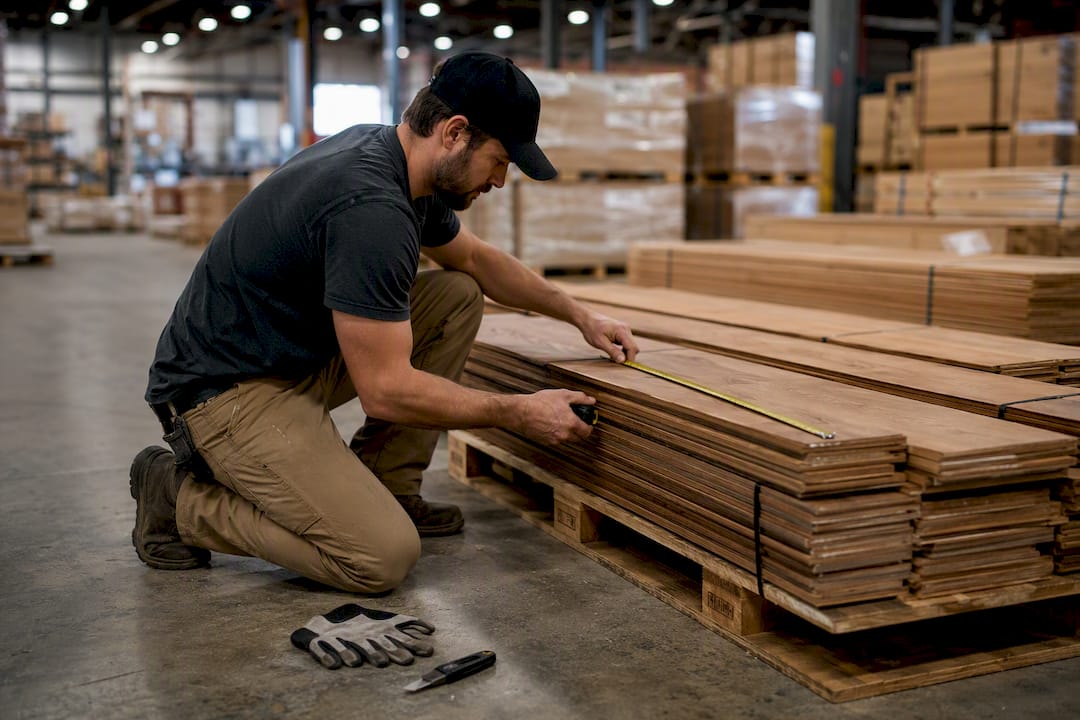
In flooring, a minimum order quantity (MOQ) is the smallest amount a supplier will sell in one order, usually expressed in square feet, cartons, bundles, or a dollar threshold. Hit the number and you buy at the supplier’s list price. Fall short and you either round up to a full box, pay a break-pack fee, or get told to come back when your project is bigger.
MOQs exist because manufacturers set them to cover production and shipping costs, not to make your life harder. They still hit your bottom line in three ways: per-unit price, material waste, and how long you wait for delivery.
- Quality Hardwoods of Michigan, Inc has spent over 40 years helping contractors and homeowners navigate exactly this math, from single-room jobs to multi-unit builds.
- Even a dictionary definition confirms the split: MOQ can mean a minimum number of pieces or a minimum order value, and flooring suppliers use both depending on the product.
Key Takeaways
Minimum order quantity determines your per-unit price, storage burden, and lead time on any flooring purchase, and calculating your real need before ordering avoids both shortages and costly overbuying.
| Point | Details |
|---|---|
| MOQ format varies | Suppliers state minimums as unit counts, square footage, box coverage, or dollar value. |
| Higher MOQ often means lower price | Manufacturers spread fixed setup costs across more units, rewarding bigger orders with better per-unit pricing. |
| Waste allowance changes your true need | Add 5 to 10% for straight-lay LVP or laminate and 8 to 15% for patterned hardwood before comparing to MOQ. |
| Overbuying ties up cash | Meeting an MOQ for a discount can cost more in storage and tied-up capital than the savings are worth. |
| Break-packs and staged delivery exist | Ask suppliers about splitting cartons, combining jobs, or staggered shipments before accepting a bigger order than you need. |
Table of Contents
- Why Flooring Suppliers Set Minimum Order Quantities
- How MOQ Affects Your Budget, Storage, and Waste
- How to Calculate a Flooring Order That Respects MOQ
- Types of MOQ You’ll See in Flooring Terms
- Negotiating Around a Flooring Supplier’s MOQ
- A Practical Ordering Checklist From Quality Hardwoods of Michigan
- What the MOQ Conversation Usually Gets Wrong
- Sources
- FAQ
Why Flooring Suppliers Set Minimum Order Quantities
Suppliers don’t pick MOQ numbers out of thin air. Three forces drive them, and understanding each one tells you where you have room to negotiate and where you don’t.
- Fixed production and setup costs. Milling a run of white oak plank, staining a batch, or kiln-drying lumber all involve setup time that costs the same whether you order 50 square feet or 5,000. Spreading that fixed cost across more units is exactly why manufacturers link MOQs to production runs and offer better per-unit pricing at higher volumes.
- Packaging and case-pack economics. Hardwood ships in bundles, LVP and laminate ship in cartons, and pallets have fixed capacity. A carton might cover 24 square feet. Order 22 square feet and you’re still buying the whole carton. That case-pack rounding is often the real MOQ you run into, even when a supplier never states a formal minimum.
- Upstream vendor and container minimums. Michigan distributors don’t manufacture the wood or vinyl themselves. They buy from mills and importers who have their own minimums, often tied to full container loads. Import regulations and shipping logistics add another layer: a distributor waiting on a partial container from overseas can’t always break that shipment into smaller lots without losing money on freight.
Those three pressures explain why MOQ size varies so much by material. Solid hardwood, especially wide-plank or exotic species, tends to carry higher minimums because milling runs are smaller and setup costs per species are steep. Vinyl plank, produced on high-volume continuous lines, usually has lower and more flexible minimums. Laminate sits in between, with case-pack rounding mattering more than any stated dollar floor.
Shopify’s breakdown of MOQ frames this as a straightforward trade: suppliers accept smaller margins per unit on big orders because the fixed cost of tooling and packaging gets absorbed faster. For a flooring buyer, that means the supplier isn’t arbitrarily punishing small orders. They’re pricing in the real cost of running a shorter production batch or breaking apart a full carton.
How MOQ Affects Your Budget, Storage, and Waste
Meeting a supplier’s MOQ almost always lowers your per-square-foot price. It also almost always raises your holding costs, and that trade-off is where a lot of contractors get burned on their first few bulk orders.
Here’s the tension in plain terms: a distributor offers $4.25 per square foot at 500 square feet but $4.75 per square foot below that threshold. Buy the 500 and save $0.50 per foot, or roughly $250 across the order. Sounds like an easy win until you count what it costs to store, insure, and finance material sitting in a garage for three months.
- Cash flow gets tied up. Every dollar spent on flooring sitting in storage is a dollar not available for payroll, other jobs, or new tools. QuickBooks makes the distinction between a supplier’s MOQ and your own economic order quantity, the amount that actually minimizes your total cost once storage and capital are factored in. Buying to hit a discount tier isn’t automatically the cheaper move.
- Storage space isn’t free. A pallet of hardwood takes up real square footage in a shop or trailer, and moisture-sensitive material needs climate control, not a damp garage corner.
- Waste allowance compounds the problem. Diagonal patterns, herringbone, and wide-plank installs often call for a 15% cut-loss allowance versus 5% for a simple straight-lay LVP job. Order to satisfy MOQ without accounting for pattern waste and you’ll either come up short or end up with even more leftover material than planned.
- Lead time shifts your schedule. If you’re short of the MOQ and waiting on a second job to combine orders, that delay can push your install date back by weeks depending on the material and supplier.
Pro Tip: Before chasing a volume discount, calculate the carrying cost of the extra material for the number of months you expect it to sit unused. If that cost eats more than half the discount, the smaller order is usually the better deal.
The waste side deserves its own gut check. A contractor ordering 900 square feet of oak plank to clear an MOQ discount, but only needing 720 square feet for the actual job, isn’t saving money. They’re pre-paying for inventory they may never install. Our guide on reducing waste on flooring jobs covers how to track leftover material so it doesn’t just become dead stock.
How to Calculate a Flooring Order That Respects MOQ
Getting from “I have a 200-square-foot room” to “here’s what I’m ordering” takes four steps, and skipping any one of them is how contractors end up either short a box or stuck with three unopened cartons.
- Measure the room and add a waste percentage. Straight-lay LVP or laminate generally needs a 5 to 10% allowance. Hardwood, especially with diagonal or herringbone patterns, needs 8 to 15%. Our flooring quantity calculation guide walks through pattern-specific percentages in more detail.
- Convert total area to boxes using box coverage. Divide your adjusted square footage by the coverage per box or bundle, then round up. You never round down on flooring. A partial box is a full box you have to buy anyway.
- Check the supplier’s case-pack rounding. Some products round to whole cartons only; others sell in mixed pallet increments. This is where your “needed” quantity and your “orderable” quantity often diverge.
- Compare against the supplier’s stated MOQ. If your rounded total is below the minimum, either bump the order size, combine it with another job, or ask about a break-pack option, covered in the next section.
| Step | Calculation | Result |
|---|---|---|
| Room area | Measured length x width | 200 sq ft |
| Add waste allowance | 200 with waste percentage applied | 220 sq ft needed |
| Box coverage | Standard bundle covers 22 sq ft | 220 / 22 = 10 bundles |
| Supplier MOQ | Distributor requires 200 sq ft minimum | adjusted square footage clears the MOQ |
| Per-unit price impact | $5.50/sq ft below MOQ vs. $4.95/sq ft at or above | Order qualifies for $4.95/sq ft |
In this example, the 200-square-foot minimum works in the buyer’s favor because the actual need, once waste is added, lands comfortably above it. The math gets tighter on a small powder room or closet job, where 40 or 60 square feet of actual need might fall well under a 150 or 200-square-foot hardwood minimum. That’s the scenario where you need the negotiation tactics below, not a bigger calculator.
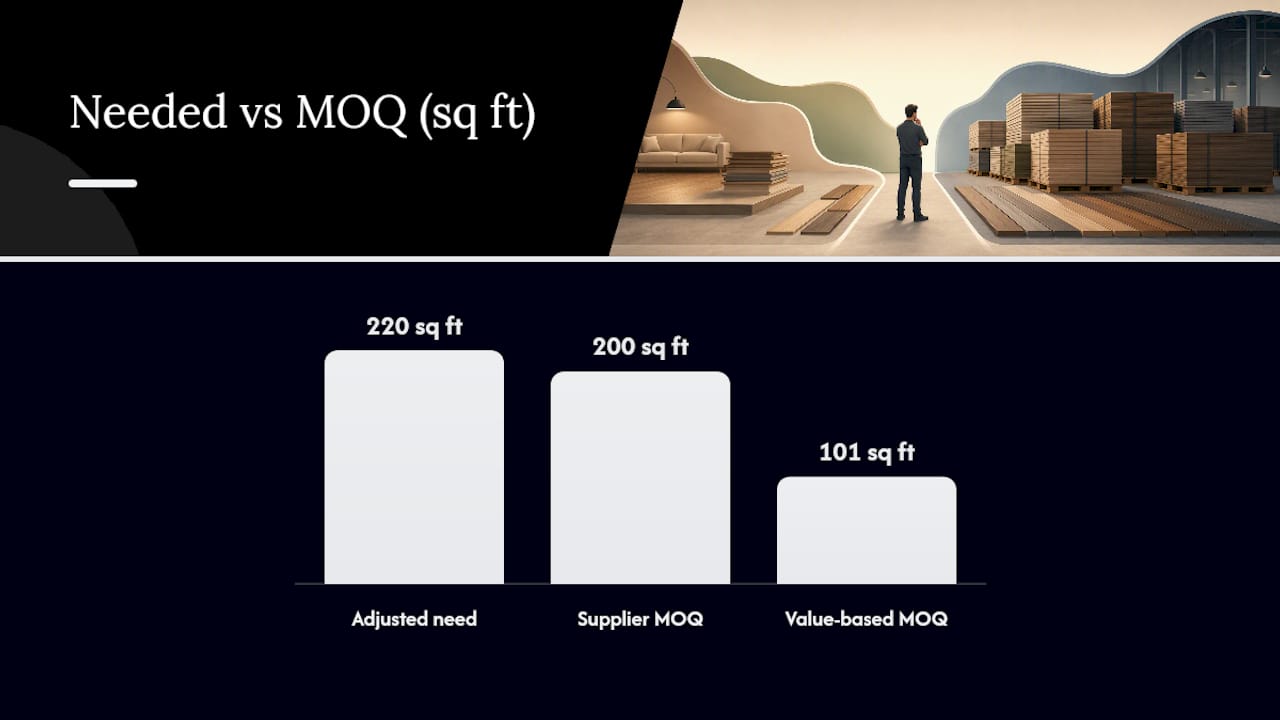
Shopify’s value-based MOQ formula, minimum order value divided by price per unit, works the same way for flooring sold by dollar threshold rather than square footage. A $500 minimum at $4.95 per square foot means you need at least 101 square feet to place the order at all, regardless of what your room actually measures.
Types of MOQ You’ll See in Flooring Terms
Not every supplier states minimums the same way, and misreading the format is a common reason contractors get an order rejected or repriced at checkout.
- Unit-based minimums. Stated as a piece count or square footage, like “minimum order of 200 square feet.” This is the most common format for hardwood and is the one you’ll see most often on wide-plank or specialty species. One wide-plank supplier’s product page lists exactly this kind of 200-square-foot floor, a useful reminder that even a stated minimum often just reflects standard bundle rounding rather than an arbitrary cutoff.
- Value-based minimums. Stated as a dollar figure, like “minimum order of $500.” Common with smaller distributors and accessory lines, stains, finishes, and abrasives included, where per-item margins are thin enough that a small dollar order isn’t worth processing.
- Box or coverage minimums. Not always labeled as an MOQ at all, but functionally identical. A carton covering 24 square feet with no stated minimum still forces you to buy in 24-square-foot increments. LVP and laminate typically fall in the 100 to 200-square-foot practical minimum once you factor in standard carton sizes, even without a formal policy.
- Tile-specific box constraints. Tile is boxed by piece count per carton, and irregular sizes (like a 12x24 plank tile) sometimes ship in odd-numbered cartons that don’t divide evenly into common room dimensions, creating leftover material almost by design.
Reading a supplier’s terms correctly matters here. “Sold by carton” means box coverage sets your real minimum. “Sold by bundle” is the hardwood equivalent. “Minimum 200 sq ft” is a stated unit-based floor. “Minimum $300 order” is value-based and has nothing to do with square footage at all, which is why a small accent-strip order can trip a dollar minimum even at a tiny total area.
Negotiating Around a Flooring Supplier’s MOQ
An MOQ isn’t always a hard wall. Distributors would rather work with you than lose the sale entirely, and several tactics can close the gap between what you need and what the minimum requires.
- Ask about break-packs. Some suppliers will split a carton or bundle for a modest fee, often a few dollars per box. It’s a reasonable ask for a repeat customer or a job that’s just short of the threshold.
- Combine orders across jobs. If you’re a contractor running two small jobs in the same material, ask your supplier whether combining them into one order clears the minimum and unlocks the better per-unit price.
- Accept the smaller-order price. Sometimes paying the higher per-unit rate on a small order beats waiting weeks for a second job to materialize, especially if your client’s install date is fixed.
- Buy from stocked SKUs or clearance. Distributors often carry pre-cut clearance lots or discontinued runs in smaller quantities specifically because larger buyers passed on them. This sidesteps the MOQ question entirely.
- Request a sample order first. For homeowners or retailers testing a new species or vinyl pattern before committing, a sample order at a slightly higher unit cost avoids overcommitting to a full MOQ before you know the product works for the space.
Pro Tip: When you’re a few square feet short of a minimum, call before you order online. A phone conversation with a distributor’s sales desk often surfaces options, staged delivery, a break-pack fee, a small stocked lot, that never show up on a website’s order form.
QuickBooks’ framing of EOQ versus MOQ is useful leverage in these conversations too. If you can show a supplier you understand the real cost of overbuying, you’re negotiating from a stronger position than a buyer who just accepts the stated minimum as fixed.
A Practical Ordering Checklist From Quality Hardwoods of Michigan
Over 40 years of supplying contractors, builders, and homeowners across Michigan, Quality Hardwoods of Michigan, Inc has seen every version of the MOQ mismatch: the job that’s 30 square feet short, the contractor juggling two sites needing the same species, the homeowner who wants one small closet finished to match an existing floor. The showroom exists partly to solve exactly this kind of math in person before an order gets placed.
Before you call or place an order, have these ready:
- Exact room measurements, in square feet, for every area getting flooring.
- Your waste percentage based on pattern (straight-lay vs. diagonal vs. herringbone).
- The box or bundle coverage for the specific product you want.
- Your target ship date and your install date, especially if there’s any flexibility.
- Whether this is a standalone job or one that could combine with another order to clear a supplier minimum.
When a contractor’s rounded order lands just under a case-pack threshold, Quality Hardwoods of Michigan, Inc’s guidance on bulk purchasing hardwood flooring covers how staged deliveries and repeat-customer accommodations often solve the gap without forcing an oversized purchase. That’s the practical reality behind most flooring MOQs: they’re a starting point for a conversation, not a rigid gate.
| Situation | Recommended approach |
|---|---|
| Order is close to MOQ | Round up to the next full box or bundle rather than requesting a break-pack. |
| Order is well under MOQ | Ask about combining with another job or a staged delivery schedule. |
| Job has a fixed install date | Confirm lead time against the MOQ before committing to a ship date. |
| Testing a new product line | Request a sample order instead of committing to the full minimum. |
Ready to size up an order, whether it’s a full hardwood floor for new construction or a single-room LVP refresh? Quality Hardwoods of Michigan, Inc’s team can run the box math with you and flag where an MOQ might affect your timeline before you commit. Browse hardwood flooring options for new construction or explore luxury vinyl plank flooring if your project calls for a material with more flexible minimums.
What the MOQ Conversation Usually Gets Wrong
Most explanations of minimum order quantity treat it as a pure numbers problem: hit the threshold, unlock the discount, move on. That framing misses the actual decision contractors face, which is a trade-off between price and flexibility, not a math puzzle with one right answer.
The conventional advice, “buy more to save more”, ignores carrying cost almost entirely. A distributor’s volume discount is real, but it’s priced from the supplier’s side of the ledger, not yours. Nobody factors your garage space or your cash flow into their pricing tier.
What actually matters is sequencing: measure first, calculate your real need with waste included, then compare that number to the MOQ, not the other way around. Buyers who start with “what discount can I get” instead of “what do I actually need” are the ones sitting on unused bundles six months later. The gap between a stated minimum and your real requirement is usually smaller than it looks once waste allowance is calculated correctly, and closing that gap through a phone call almost always beats overbuying to hit a discount tier.
Sources
- Minimum Order Quantity (MOQ): Formula, Tips, & Benefits — Netsuite
- Minimum Order Quantity — QuickBooks (Intuit)
- How do MOQs impact importers’ access to best prices? — CloudsFlooring
- Minimum order quantity — Cambridge Dictionary
FAQ
What does minimum order quantity mean in flooring?
It’s the smallest amount of material, expressed in square feet, cartons, bundles, or a dollar total, that a supplier requires you to purchase in a single order.
Is a low or high MOQ better for a flooring buyer?
Neither is universally better: a low MOQ gives flexibility for small jobs, while a high MOQ usually comes with better per-unit pricing but ties up more cash and storage space.
What are the disadvantages of MOQ?
The main downsides are overbuying to hit a threshold, tied-up cash in stored inventory, and potential delays if you’re waiting to combine orders to reach the minimum.
How do you calculate minimum order quantity for a flooring job?
Measure the room, add a waste percentage suited to the material and pattern, convert that total to whole boxes or bundles using the product’s coverage rate, then compare the rounded total against the supplier’s stated minimum.
Recommended
- How to Calculate Flooring Material Quantities Accurately — Quality Hardwoods of Michigan
- Why Subfloor Preparation Matters for Flooring Quality — Quality Hardwoods of Michigan
- Bulk Purchasing Hardwood Flooring Benefits for Contractors — Quality Hardwoods of Michigan
- Flooring Grade Distinctions: What Retail Buyers Must Know — Quality Hardwoods of Michigan