

Flooring grade controls how your store looks, where it sits on the price curve, and how customers read your brand the moment they walk in. Get the grade wrong and you are either overpaying for visual uniformity you do not need, or signaling neglect with a floor that shows every scuff by week three. Here is what procurement teams need to know before placing an order.
- Appearance and brand perception: Grade sorts boards by visual character — knots, color variation, sapwood, mineral streaks — so the grade you choose sets the visual tone of the entire sales floor.
- Pricing and margin effects: Cleaner grades cost more because mills discard more lumber to produce them; that selection yield premium flows directly into your cost per square foot.
- Maintenance and operational impact: Higher-character grades can mask everyday scuffs better in some settings; ultra-clean grades in high-traffic zones show wear faster and demand more frequent maintenance cycles.
Pro Tip: Before requesting a quote, ask your supplier for full-width sample boards in the species and grade you are considering, then lay them under your actual store lighting. Color-matched renderings and small chips routinely mislead buyers.
The first thing to check when sourcing: confirm the species, the grade language the mill uses, and the wear-layer or finish specification — in that order.

Table of Contents
- Why flooring grade distinctions matter for retail procurement
- What each grade looks like — and where retailers use it
- How grade shapes customer perception and store operations
- How grade moves price and why it affects your margins
- How to choose the right grade for your retail store
- Finish and maintenance choices that determine retail longevity
- Mistakes retail buyers make when choosing flooring grade
- Key Takeaways
- The grade decision most retail buyers get backwards
- Quality Hardwoods of Michigan, Inc can help you get grade right the first time
- Useful sources for retail flooring procurement
- FAQ
Why flooring grade distinctions matter for retail procurement
Grading is a classification system for appearance, not a structural report card. A No. 2 Common oak board and a Clear oak board are cut from the same tree and carry the same load. What differs is how the board looks: the number of knots, how much color shifts across the face, whether sapwood appears at the edges, and whether mineral streaks run through the grain.
The NWFA grading standard for unfinished hardwood is the closest thing the U.S. industry has to a universal reference, but it is not universally adopted. Many mills use their own naming conventions, and the same label — “Select,” for example — can mean different things from one supplier to the next. That inconsistency is the single biggest procurement trap for retail buyers.
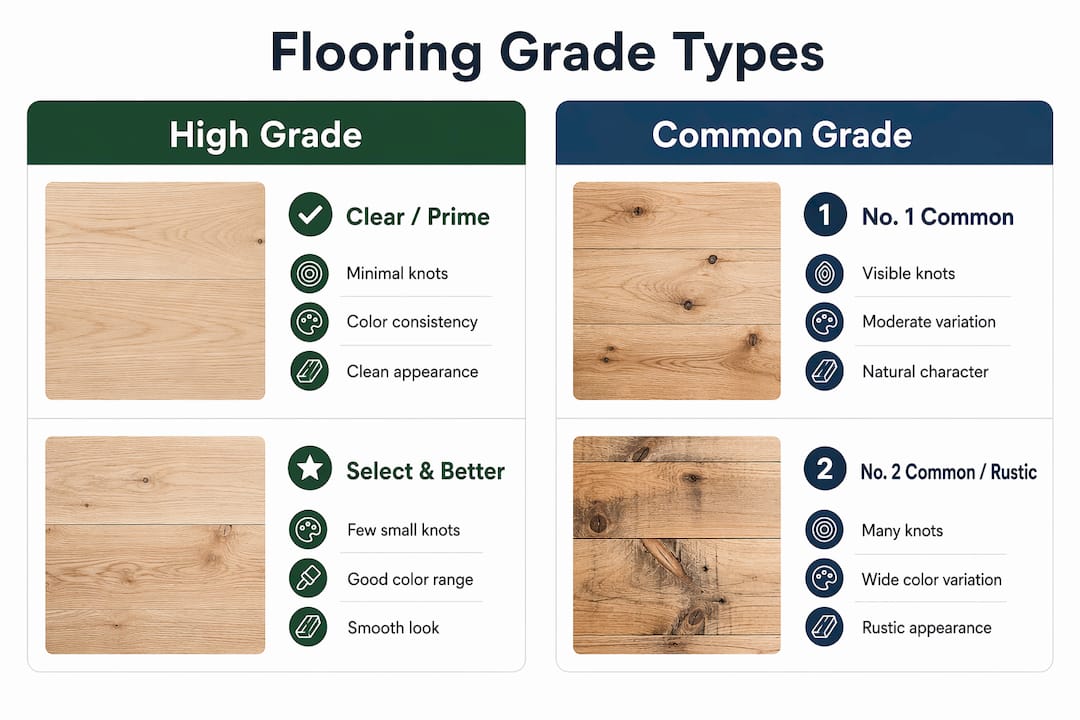
Common grade categories you will encounter:
- Clear / Prime: Virtually no knots, minimal color variation, tight grain. The most uniform look.
- Select & Better: Allows slight color variation and very small character marks. Still reads as clean and consistent.
- No. 1 Common / Natural: Knots, color shifts, and some sapwood present. Warm, lived-in character.
- No. 2 Common / Rustic / Character: Pronounced knots, significant color variation, heavy character marks. Intentionally imperfect.
Pro Tip: Ask every supplier: “What grading standard do you follow, and can you show me a graded sample board for each category?” If they cannot produce a physical sample, treat that as a red flag.
What each grade looks like — and where retailers use it
Clear / Prime
Boards are tight-grained, consistent in color, and essentially free of knots. The floor reads as a single, calm surface. Luxury boutiques, high-end jewelry retailers, and flagship fashion stores favor this grade because it recedes visually and lets merchandise dominate. It photographs exceptionally well under controlled lighting, which matters for brand content and social media.
Select & Better
A slight step down in uniformity, but most shoppers would never notice without a side-by-side comparison. This grade suits upscale home goods stores, mid-market apparel chains, and hotel lobbies where a polished look is expected but the budget does not support Clear pricing. For premium retail formats, Select & Better often hits the sweet spot between cost and visual impact.
No. 1 Common / Natural
Knots and color variation are not defects in this grade — they are the product. Retailers who lean into this aesthetic signal authenticity, craft, and warmth rather than corporate polish.
This grade works well for lifestyle brands, outdoor goods retailers, artisan food stores, and farm-to-table restaurant concepts. The natural variation also hides everyday scuffs and light scratches better than a uniform Clear floor, which is a real operational advantage in medium-traffic environments.
No. 2 Common / Rustic / Character
Heavy knots, wide color swings, and visible mineral streaks. This grade suits pop-up shops, vintage or reclaimed-aesthetic concepts, and discount formats where the rustic look reinforces the brand story. It is the most affordable grade per square foot because mills produce it from a broader population of boards with less sorting labor.
Pro Tip: Order a 10–20 sq ft mockup sample area installed under your actual store lighting before committing to a full order. Showroom lighting and in-store lighting rarely match, and grade variation reads very differently under fluorescents versus warm LEDs.
How grade shapes customer perception and store operations
Flooring influences shopper behavior in ways most buyers underestimate. Texture, finish, and visual consistency guide traffic flow, set the emotional register of a space, and signal whether a brand takes care of its environment. A floor that looks worn or mismatched with the merchandise creates a subtle but persistent friction that erodes trust.
Two scenarios that illustrate the stakes:
- Luxury brand, wrong grade: A high-end skincare retailer installs No. 2 Common oak to save on upfront cost. The pronounced knots and color variation clash with the minimalist white fixtures and premium price points. Customers read the floor as inconsistent with the brand, even if they cannot articulate why. Conversion suffers.
- Discount chain, wrong grade: A value-oriented home goods chain installs Clear maple. The floor looks pristine on day one, but the uniform surface shows every cart track, scuff, and cleaning streak. Maintenance staff spend more time on floor care, and the floor still looks tired within a year.
Operational impacts by grade:
- Clear and Select grades show wear patterns faster in high-traffic zones; they require more frequent buffing and refinishing cycles.
- Character grades scatter visual attention across the surface, making isolated scuffs less noticeable.
- Darker stains on any grade amplify scratch visibility; lighter, natural-tone finishes on character grades are the most forgiving combination for busy retail floors.
Pro Tip: Map your store’s foot-traffic zones before specifying grade. Entrance areas and checkout lanes take three to five times more wear than mid-floor display zones. Some retailers use a higher-character grade at entry and a cleaner grade in lower-traffic display areas.
Retailers who understand grade differences and explain them openly at the point of sale reduce returns and build supplier trust — a direct operational benefit beyond aesthetics.
How grade moves price and why it affects your margins
The price premium for cleaner grades is not about structural superiority. Higher-grade boards cost more because mills must sort through more lumber to find boards that meet the tighter appearance criteria, generating more waste in the process. That selection yield cost gets passed to the buyer.
Species sets the price ceiling; grade sets where your SKU lands within that band. A Clear-grade white oak floor will cost significantly more per square foot than No. 1 Common white oak from the same mill — but both are structurally equivalent. The same grade-to-price relationship holds across species: a premium species in a lower grade can still outprice a commodity species in a top grade.
| Dimension | Clear / Prime | Select & Better | No. 1 Common | No. 2 Common / Rustic |
|---|---|---|---|---|
| Appearance / uniformity | Highly uniform, minimal variation | Consistent with minor marks | Moderate knots and color shift | Pronounced knots, wide color variation |
| Relative price per sq ft | Highest | High | Mid-range | Lowest |
| Best retail fit | Luxury, flagship | Upscale mid-market | Lifestyle, artisan | Discount, pop-up, rustic concept |
| Maintenance demand | High (shows wear quickly) | Moderate-high | Moderate | Lower (variation masks wear) |
| Finish / warranty expectations | Commercial-grade finish essential | Commercial finish recommended | Standard commercial or residential | Standard; refinishing less critical |
The practical implication for procurement: do not treat grade as a pure cost-cutting lever. Dropping from Select to No. 1 Common saves money upfront but may increase maintenance labor costs and shorten the refinishing cycle in a high-traffic store. Lifecycle cost, not purchase price, is the right metric.
How to choose the right grade for your retail store
A sequential checklist for procurement teams:
- Define your store format and brand tier. Luxury, mid-market, value, or pop-up? This narrows grade range immediately.
- Map foot-traffic intensity. Entrance zones, checkout lanes, and fitting rooms each have different wear profiles. Identify the highest-stress zones before specifying.
- Choose species and construction first. Solid hardwood versus engineered affects subfloor compatibility and refinishing potential. For retail, engineered boards with a thick sawn wear layer often outperform solid in climate-controlled commercial spaces.
- Confirm wear-layer thickness. Thicker wear layers on engineered flooring allow multiple refinishes; thin veneers may not be refinishable at all, which changes your lifecycle math entirely.
- Select grade to match brand aesthetic and traffic profile. Use the table above as a starting framework.
- Specify finish and abrasion rating. Commercial-grade aluminum oxide finishes outperform residential finishes in retail settings. Confirm the finish system before ordering.
- Order full-width sample boards and install a mockup. Test under store lighting and simulate foot traffic for at least a week before committing to a full order.
Supplier questions to ask before purchasing:
- What grading standard do you follow, and is it NWFA-aligned or proprietary?
- Can you provide graded sample boards for each category in the species I am considering?
- What is your batch tolerance for color and grade consistency across multiple shipments?
- What is your defect and return policy for boards that fall outside the stated grade?
- For multi-store rollouts: can you guarantee lot consistency across orders placed 60–90 days apart?
Pro Tip: For multi-store rollouts, request that your supplier reserve a single production lot for all locations. Grade and color can shift noticeably between production runs, even within the same species and nominal grade.
Finish and maintenance choices that determine retail longevity
Finish is where grade and durability finally intersect. The grade describes what the wood looks like; the finish determines how long it holds up. A Clear-grade floor with a residential-grade finish will fail faster in retail than a No. 1 Common floor with a proper commercial urethane system.
The key differences between residential and commercial finishes:
- Aluminum oxide finishes are the standard for commercial hardwood. They bond into the surface and resist abrasion far better than standard polyurethane.
- Oil-based finishes penetrate the wood and can be spot-repaired, which is useful in retail where localized damage is common.
- UV-cured finishes cure instantly and produce a hard, consistent surface, but they require factory application and cannot be touched up in the field.
How finish interacts with grade visibility: wire-brushed or hand-scraped textures on character-grade boards scatter light and hide surface scratches. A high-gloss finish on a Clear-grade floor amplifies every mark. For most retail environments, a satin or matte sheen on a commercial-grade finish system is the most forgiving combination. Finish selection and maintenance frequency are directly linked to lifecycle outcomes in commercial settings.
Maintenance schedule by traffic level:
- Light traffic (boutique, low-volume specialty): dry mop daily, damp mop weekly, buff and recoat every 3–5 years.
- Medium traffic (mid-market apparel, home goods): dry mop daily, damp mop 2–3 times per week, buff and recoat every 2–3 years.
- Heavy traffic (grocery, discount, high-volume chain): dry mop twice daily, damp mop daily, recoat annually, full refinish every 4–6 years depending on wear-layer thickness.
Pro Tip: Read the finish warranty language carefully. Many commercial warranties are voided by cleaning products that contain ammonia or wax. Align your store’s cleaning protocol with the finish manufacturer’s approved product list before signing off on installation.
Mistakes retail buyers make when choosing flooring grade
Common misconceptions — and the corrections:
- “Higher grade means more durable.” False. Grade describes appearance only; durability is determined by species hardness, wear-layer thickness, and finish system. A No. 2 Common white oak with a commercial finish will outlast a Clear-grade pine with a residential finish.
- “The grade on the label matches the grade I’ll get.” Not always. Grading names vary by mill, and there is no single universal standard across all suppliers. Always verify with physical samples.
- “I can judge grade from a small chip sample.” Small samples hide batch variation. Full-width boards across a 10–20 sq ft area are the only reliable way to assess how a grade will read at scale.
- “Character grade is low quality.” Character grades are intentionally produced for a specific aesthetic. In the right retail context, they are the correct choice, not a compromise.
Procurement dos and don’ts:
- Do confirm grading language and request physical samples from every supplier before ordering.
- Do factor lifecycle costs — refinishing, maintenance labor, and replacement cycles — into your total cost calculation.
- Do match lot numbers across a multi-store rollout to avoid visible color and grade inconsistency.
- Don’t assume the most expensive grade is the right grade for your format.
- Don’t skip the mockup step, especially for flagship locations or large-format stores.
- Don’t ignore common flooring procurement pitfalls that experienced buyers have already paid to learn.
Key Takeaways
Flooring grade is an appearance classification, not a durability rating — and matching grade to your store’s brand tier, traffic profile, and finish specification is the decision that determines both customer perception and long-term operational cost.
| Point | Details |
|---|---|
| Grade describes appearance, not strength | Knots, color variation, and sapwood are graded; durability comes from species, wear layer, and finish. |
| No universal grading standard exists | Confirm grading language and request physical sample boards from every supplier before ordering. |
| Species sets price ceiling; grade sets position | The same grade in a premium species costs far more than in a commodity species — plan accordingly. |
| Finish system determines retail longevity | Commercial aluminum oxide or oil-based finishes outperform residential systems in any retail traffic level. |
| Quality Hardwoods of Michigan, Inc | Offers sample packs, mockup support, and installation services for retail buyers planning store rollouts. |
The grade decision most retail buyers get backwards
There is a persistent assumption in retail procurement that spending more on grade is always the safer choice. It is not. The right grade is the one that matches your brand signal, your traffic reality, and your maintenance budget — not the one with the fewest knots.
A luxury boutique genuinely needs a Clear or Select floor because visual uniformity is part of the product experience. But a high-volume lifestyle brand that leans on authenticity and craft? A No. 1 Common floor with a wire-brushed texture and a matte commercial finish will hold up better, look better longer, and cost less to maintain than a Clear floor that shows every cart track by month two.
The other thing buyers consistently underweight is finish. Grade gets all the attention in procurement conversations, but a mismatched finish system will destroy a well-chosen grade faster than foot traffic alone. Specify the finish system at the same time you specify the grade — treat them as one decision, not two sequential ones.
Designers who work in retail understand this intuitively: flooring texture and grade are design tools that direct traffic and reinforce brand, not just cost line items. Procurement teams that adopt the same frame make better decisions and spend less money correcting them.
Quality Hardwoods of Michigan, Inc can help you get grade right the first time
Choosing the wrong grade for a retail rollout is an expensive mistake — and it usually happens before installation, not during. Quality Hardwoods of Michigan, Inc gives retail buyers a concrete way to avoid it: physical sample packs in the species and grades you are evaluating, mockup support so you can test appearance under real store conditions, and a commercial sales team that understands the difference between a flagship spec and a high-traffic discount format.
With over 40 years serving the flooring industry in Michigan and beyond, Quality Hardwoods of Michigan, Inc carries unfinished and prefinished hardwoods, engineered options, and luxury vinyl plank for retailers who need a non-wood alternative in moisture-prone or ultra-high-traffic zones. The team can also connect you with vetted installation contractors for single-store projects and multi-location rollouts. Contact Quality Hardwoods of Michigan, Inc to request a commercial sample pack or schedule a specification consultation.
Useful sources for retail flooring procurement
The sources below support the grading definitions, finish specifications, and installation guidance covered in this article.
- NWFA Unfinished Hardwood Grading Standard — The primary U.S. industry reference for appearance grading of unfinished hardwood flooring.
- ForestSource: Wood Flooring Explained — Covers NWFA-style grade categories, solid vs. engineered construction, and wear-layer specs in one reference.
- Global Timber: Wood Flooring Grades Explained — Explains how grading names vary by mill and why buyers must confirm language with each supplier.
- IFTI: Flooring Impact on Customer Experience — Ties flooring choices to shopper behavior, dwell time, and brand perception in retail spaces.
- AOS: Understanding Hardwood Floor Finishes — Technical guide to finish types, pros and cons, and commercial application guidance.
- Quality Hardwoods of Michigan: Best Flooring for High-Traffic Areas — Practical guidance on finish options and maintenance for high-traffic commercial spaces.
- Quality Hardwoods of Michigan: Flooring Articles & Expert Guides — Landing page for technical guides on hardwood, LVP, and installation topics.
| Source | Best used for |
|---|---|
| NWFA Grading Standard | Verifying grade definitions and allowable defect ranges |
| ForestSource Wood Flooring | Grade categories, wear-layer specs, solid vs. engineered |
| Global Timber Grades Explained | Understanding mill-to-mill naming variation |
| IFTI Customer Experience | Linking flooring choice to retail sales outcomes |
| AOS Hardwood Finishes | Specifying commercial finish systems |
| Quality Hardwoods High-Traffic Guide | Maintenance schedules and finish selection for retail |
FAQ
What does flooring grade actually measure?
Flooring grade classifies the appearance of boards — knots, color variation, sapwood, and mineral streaks — not structural strength or durability. Two boards of the same species and grade from different mills may look different if the mills use different grading standards.
What is the best grade of hardwood flooring for a retail store?
There is no single best grade. Clear and Select grades suit luxury and upscale retail formats; No. 1 Common works well for lifestyle and mid-market stores; No. 2 Common fits rustic, artisan, or discount concepts. Match grade to your brand tier and traffic profile, not to a price assumption.
What makes flooring commercial grade?
Commercial-grade flooring refers to the finish and wear-layer specification, not the wood grade. A commercial finish — typically aluminum oxide or a high-build urethane system — provides the abrasion resistance retail traffic demands. Wear-layer thickness on engineered boards determines how many times the floor can be refinished over its life.
What is the best flooring for retail spaces overall?
Hardwood with a commercial finish suits luxury and mid-market formats; engineered hardwood handles climate variation better in large retail footprints. For ultra-high-traffic or moisture-prone zones, luxury vinyl plank offers comparable aesthetics with lower maintenance demands and no refinishing requirement.
How do flooring grades affect retail pricing and margins?
Higher grades cost more because mills sort through more lumber to find uniform boards, generating more waste. That selection yield premium raises the cost per square foot without adding structural value. Procurement teams should calculate lifecycle cost — including maintenance and refinishing — not just purchase price, when comparing grades.