
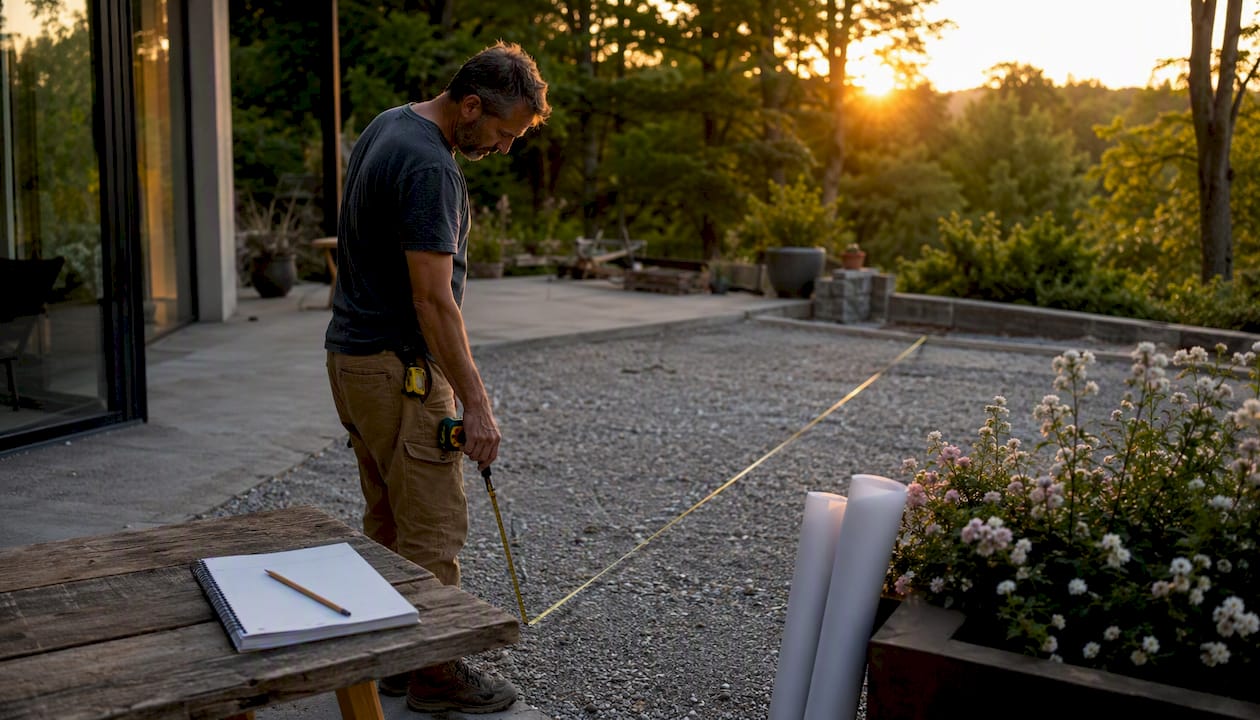
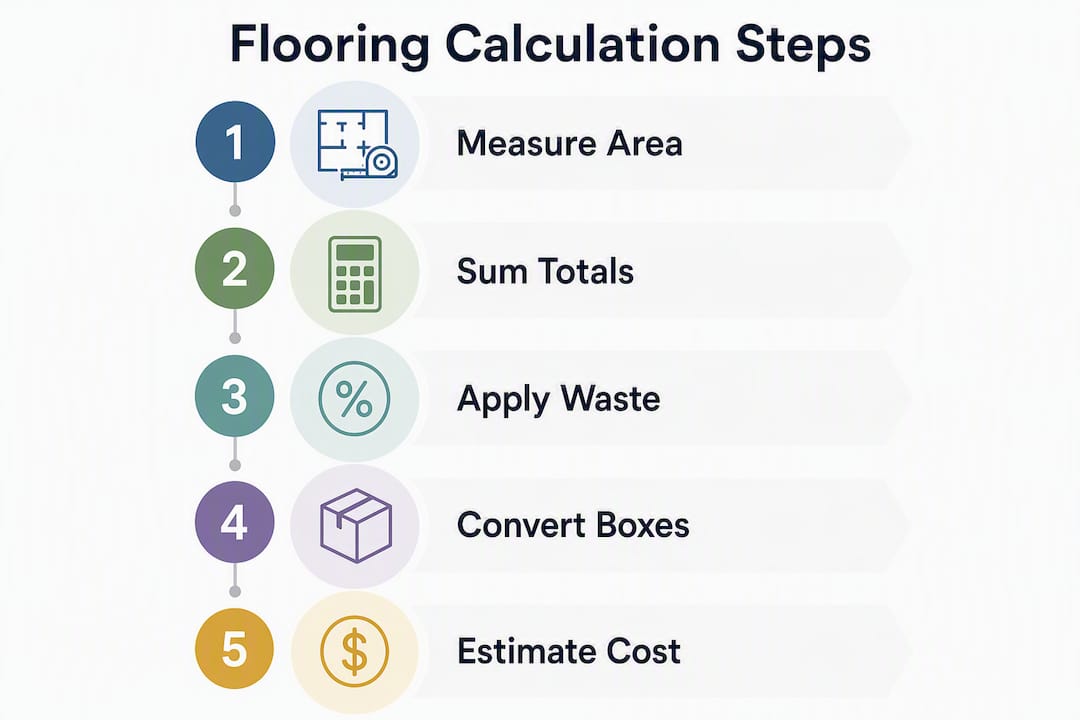
The formula is simple: multiply length × width for each area, sum all rooms, then multiply by (1 + waste %). Divide that number by the square footage per box, and round up. A 12’ × 10’ room gives you 120 sq ft. Add typical waste: use the standard percentage for your material — 7–10% for LVP, 10% for hardwood, laminate, or carpet, 15% for ceramic or porcelain tile, and 20% for natural stone. This covers cutting and trimming. Divide by coverage per box (around 20 sq ft) and round up to whole boxes, so you order about 7 boxes. That’s the whole calculation in three steps. The sections below explain how to get those inputs right so you’re not short a box mid-install.
Quick-reference formula:
- Total sq ft = sum of (length × width) for every area
- Ordered sq ft = total sq ft × (1 + waste %)
- Boxes needed = ordered sq ft ÷ coverage per box, rounded up
Buying slightly more material upfront is almost always cheaper than a second order, which may come from a different dye lot and produce a visible color mismatch you can’t fix without replacing entire rows.
Table of Contents
- How do you calculate flooring material quantities step by step?
- How should you measure rooms, closets, and doorways?
- How do you handle L-shaped rooms and multiple rooms?
- How much extra should you order by material type?
- How do you convert ordered area into boxes and estimate cost?
- Quick conversion reference for feet, inches, and square yards
- What do installers know about measuring that most homeowners miss?
- Short answers to common flooring quantity questions
- Key Takeaways
- Why ordering a little extra is the right call every time
- Quality Hardwoods of Michigan, Inc can verify your counts before you order
- Useful sources and tools to check next
- FAQ
How do you calculate flooring material quantities step by step?
Follow these steps with a tape measure, a notepad, and a basic calculator.
- Measure each rectangle. Measure length and width in feet, recording inches as decimals (6" = 0.5 ft, 3" = 0.25 ft). Write each dimension down immediately.
- Multiply length × width for each measured area to get square footage.
- Add all areas together to get your gross total before waste.
- Apply one waste percentage to the grand total (not per room). Multiply total sq ft × (1 + waste %).
- Divide by coverage per box from the product spec sheet. Always round up to the next whole box.
- Confirm with your supplier before placing the order.
Two-room worked example:
- Bedroom: 14’ × 12’ = 168 sq ft
- Closet: 5’ × 4’ = 20 sq ft
- Combined: 188 sq ft
- Add a standard waste percentage (around 10% for straight installs) to the combined area of 188 sq ft.
- Box coverage: 20 sq ft/box → 206.8 ÷ 20 = 10.34 → order 11 boxes
Inch-to-decimal conversions:
- 6" = 0.5 ft
- 3" = 0.25 ft
- 9" = 0.75 ft
- 1" = 0.083 ft
Always round your raw measurements up to the nearest inch before converting. A room that measures 11’11" becomes 12’0" for calculation purposes.
How should you measure rooms, closets, and doorways?
Accurate inputs are everything. A half-foot error in one dimension can throw off your box count by a full carton.
Measurement rules to follow:
- Measure at floor level from baseboard to baseboard, not at hip height where walls bow outward. If two measurements of the same wall differ by more than 1 inch, take a third and use the largest value.
- Always measure the longest and widest points of the room, even if the walls aren’t perfectly parallel.
- Sketch the room on paper first. Label each wall with its dimension before you multiply anything.
- Measure into doorways to the centerline of the threshold. Flooring slides under door casings and transition strips need coverage too. Homeowners frequently exclude closets and thresholds from their counts, which causes short orders.
Hidden areas to include:
- Walk-in and reach-in closets (measure as separate rectangles and add to the total)
- Bay window recesses and alcoves
- Stair landings (measure width × depth of the landing platform)
- Areas under door thresholds and transition strips
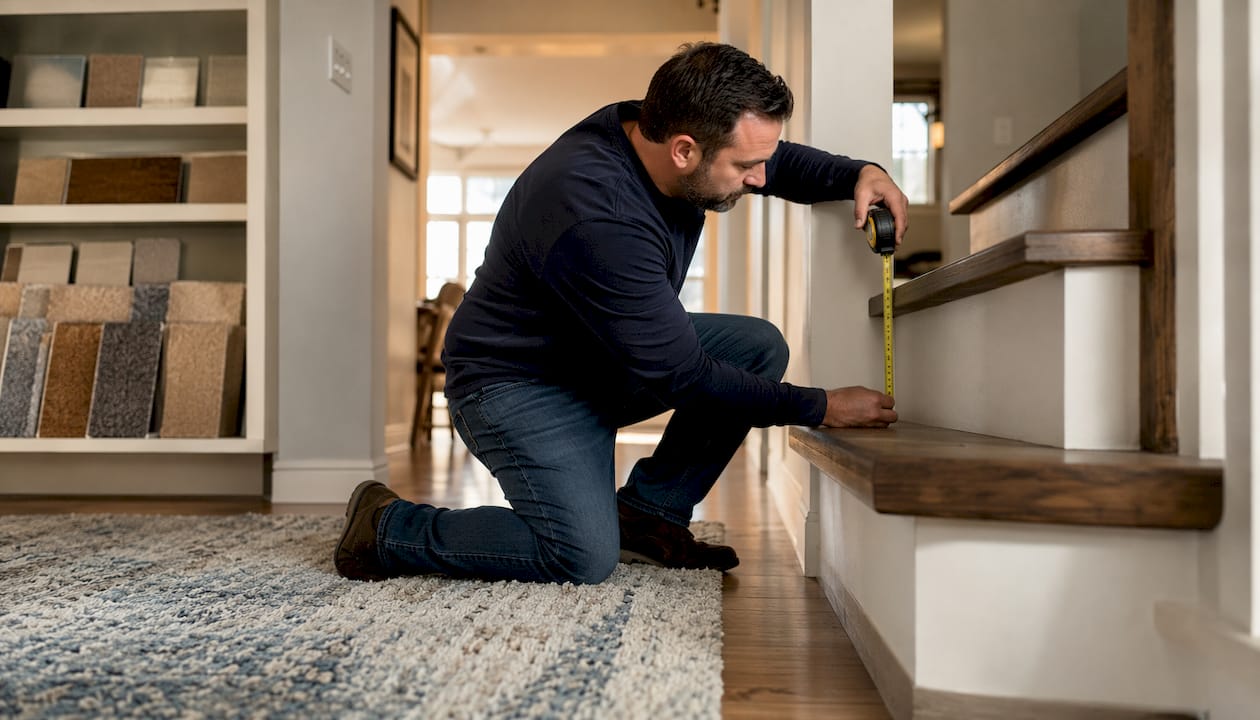
For stairs, measure one tread (the horizontal surface you step on) and one riser (the vertical face). Multiply tread depth × tread width for each step, then multiply by the number of steps. Add that to your room total if the same material runs up the staircase. Checking interior closet door clearances before you finalize measurements can also prevent surprises when thresholds are installed.
How do you handle L-shaped rooms and multiple rooms?
Irregular rooms trip up a lot of homeowners, but the fix is always the same: break the space into rectangles, calculate each one, and add the subtotals.
Dividing irregular shapes:
- L-shaped rooms: Draw a line across the inside corner to create two rectangles. Measure each separately and add the areas. It doesn’t matter where you draw the split line; the total is the same either way.
- Bay windows: Treat as a trapezoid. Measure the back wall (shortest width) and the front opening (longest width), average the two, then multiply by the depth of the bay.
- Islands and built-ins: Subtract the footprint of any permanent fixture the flooring won’t run under. Do this subtraction before applying the waste factor, or you’re paying waste on area you’re not covering.
Apply waste to the grand total, not per room. Breaking complex floor plans into rectangles and summing them first, then applying one waste percentage, prevents the inflation that comes from stacking waste on each small area separately.
Quick comparison: three rooms totaling 400 sq ft with 10% waste applied once = 440 sq ft ordered. Apply 10% per room on three 133 sq ft rooms = 439.9 sq ft, nearly the same here. But with smaller, irregular rooms (say, five rooms averaging 80 sq ft each), per-room rounding pushes the total up by a full box or more. The exception: if different rooms get different materials or different installation patterns (straight-lay in one room, diagonal in another), calculate and apply waste separately for each material.
How much extra should you order by material type?
Waste isn’t a guess. It’s a function of material, room shape, and installation pattern.
| Material | Standard waste | Diagonal layout | Herringbone/complex |
|---|---|---|---|
| Vinyl / LVP | 7–10% | +5% | +5–10% |
| Hardwood / laminate / carpet | 10% | +5% | +5–10% |
| Ceramic / porcelain tile | 15% | +5% | +5–10% |
| Natural stone | 20% | +5% | +5–10% |
Source: standard waste allowances by material and layout.
Factors that push waste higher: narrow hallways (more end cuts), rooms with many doorways, random-length board products, pattern-matched tile or wood, and first-time DIY installs where learning-curve cuts happen.
Pro Tip: Always keep at least one full, unopened box from your original order as attic stock. Matching dye lots later is genuinely difficult because batch colors shift between production runs. That one spare box can save you from replacing an entire section of floor over a single damaged plank.
How do you convert ordered area into boxes and estimate cost?
Once you have your ordered square footage (total with waste), the box math is straightforward.
Steps to get your box count:
- Find the sq ft per box on the product spec sheet or carton label.
- Divide ordered sq ft by that coverage number.
- Round up to the next whole box, always. Never round down.
- Check whether underlayment, adhesive, and stair nose pieces are counted separately. They usually are.
Most laminate and LVP boxes cover roughly 20–25 sq ft, while hardwood boxes vary from about 15–25 sq ft depending on plank width and length. Tile boxes typically cover around 15 sq ft.
Sample cost estimate for a 200 sq ft room (hardwood, 10% waste):
| Item | Calculation | Estimated cost |
|---|---|---|
| Ordered area | 200 × 1.10 = 220 sq ft | — |
| Hardwood material | 220 sq ft × $8/sq ft | — |
| Underlayment | 220 sq ft × $0.50/sq ft | — |
| Adhesive / fasteners | Allowance | — |
Material cost ranges vary widely and depend on factors like quality and location. Installation labor costs vary accordingly and should be checked locally.
Before ordering, verify these items on the spec sheet:
- Sq ft per box and boxes per pallet
- Dye-lot or batch number (note it for future reorders)
- Manufacturer’s recommended waste percentage
- Return policy for unopened boxes
- Whether underlayment is included or sold separately
Quick conversion reference for feet, inches, and square yards
Getting the math right before you multiply saves you from a cascade of errors downstream.
Common inch-to-decimal-foot conversions:
| Inches | Decimal feet |
|---|---|
| 1" | 0.083 ft |
| 2" | 1/6 ft |
| 3" | 0.25 ft |
| 4" | 1/3 ft |
| 6" | 0.5 ft |
| 9" | 0.75 ft |
| 10" | 5/6 ft |
Example: A room measuring 12’6" × 10’3" converts to 12.5 ft × 10.25 ft = 128.125 sq ft. Round to 128.1 sq ft before applying waste.
Carpet conversions: Carpet is sold by the square yard in most U.S. markets. Divide your total sq ft by 9 to get square yards. A 220 sq ft order = 24.5 sq yd, so you’d order 25 sq yd. Standard broadloom carpet comes in 12-foot-wide rolls. If your room is wider than 12 feet, you’ll need a seam, which adds waste. Confirm seam placement with your installer before ordering.
What do installers know about measuring that most homeowners miss?
The most common cause of flooring project delays is a measurement error, not a material defect. These rules come from installer practice.
Pro Tip: Use a 10-foot straight edge to check your subfloor before you finalize your order. Any dip or hump greater than 3/16" over 10 feet needs leveling with a self-leveling compound before LVP or laminate goes down. Leveling adds material and labor cost that should factor into your budget before you buy.
Installer-sourced rules:
- Measure from baseboard to baseboard at floor level. Walls bow; hip-height measurements lie.
- If two measurements of the same dimension differ by more than 1 inch, take a third and use the largest.
- Measure twice. Write it down. Don’t trust memory for a number you’ll use to spend $1,000+.
- Include every closet, alcove, and threshold run. Forgetting a 5’ × 4’ closet costs you a full box at reorder time, possibly from a different batch.
- Never apply waste per room when the same material runs throughout. Apply it once to the combined total.
- Reserve one full unopened box as attic stock. Review common flooring shopping mistakes before you finalize your order to avoid the ones that cost the most.
Online calculators give a solid baseline, but they don’t replace a product-specific check with a specialist. Use a calculator for your estimate, then confirm box counts and compatibility with your supplier before you buy.
Short answers to common flooring quantity questions
What waste percentage should I use for LVP? Use 7–10% for straight-lay LVP installations. Add 5% for diagonal patterns and another 5% for herringbone or complex layouts.
Should I order extra material for stairs? Yes. Measure each tread and riser separately, multiply by the step count, and add that area to your room total before applying the waste percentage.
Is underlayment included in box coverage? No. Underlayment is a separate product sold by the roll (typically 200 sq ft per roll). Calculate it from your net floor area plus about 5% extra for overlaps.
What if I under-order and need more material later? Contact your supplier immediately and provide the dye-lot or batch number from your original carton. Matching from a different production run is possible but not guaranteed. Ordering one extra box upfront costs far less than replacing mismatched planks.
How do I round box counts? Always round up to the next whole box. If your box calculation is not a whole number, always round up—so 10.1 boxes means you order 11. Never round down.
Key Takeaways
Accurate flooring quantities come from one formula applied correctly: measure every area, sum the totals, apply one waste percentage to the grand total, then divide by box coverage and round up.
| Point | Details |
|---|---|
| Core formula | Total sq ft × (1 + waste %) ÷ coverage per box, rounded up to whole boxes. |
| Apply waste once | Add the waste percentage to the combined grand total, not to each room separately. |
| Waste by material | LVP 7–10%, hardwood/laminate 10%, ceramic tile 15%, natural stone 20%; add 5% for diagonal patterns. |
| Subfloor check | Use a 10-foot straight edge; dips over 3/16" per 10 feet require leveling before floating floors go down. |
| Quality Hardwoods of Michigan, Inc | Lists box coverage and recommended waste on product pages; call or visit the showroom to confirm counts before ordering. |
Why ordering a little extra is the right call every time
The math is never the hard part. What trips people up is the assumption that a calculator result is the final answer. It’s a starting point.
The dye-lot issue is real and underappreciated. Flooring is manufactured in batches, and color can shift between runs in ways that are invisible on a sample card but obvious once planks are laid side by side. That’s not a defect. It’s how the process works. The only protection is buying enough from one batch the first time.
Quality Hardwoods of Michigan, Inc has been in this business for over 40 years, and the advice from that experience is consistent: the homeowners who regret their order are almost always the ones who cut the waste factor to save a box or two. The ones who are happy bought one box more than they thought they needed and kept it in the attic. The math supports it. The practical reality makes it non-optional.
Measure your rooms, run the steps in this guide, and call a supplier or installer to confirm your counts before you place the order. That last step costs nothing and catches the errors that calculators can’t.
Quality Hardwoods of Michigan, Inc can verify your counts before you order
Forty years of flooring supply means the team at Quality Hardwoods of Michigan, Inc has seen every measurement mistake in the book, and they’d rather catch yours before the order than after.
Bring your room sketch and measurements to the showroom, or call for a free material review. The team will confirm your box count, check whether your chosen product’s coverage matches your calculation, and flag any subfloor or underlayment considerations specific to your material. Product pages for luxury vinyl plank and laminate flooring list box coverage and manufacturer-recommended waste so you can cross-check your numbers before committing. Underlayment, adhesives, stair nose pieces, and finishing products are all stocked and can be quoted at the same time. Attic-stock guidance is part of every order conversation. Call or stop by to get your quantities confirmed by someone who does this every day.
Useful sources and tools to check next
- Calcipedia Flooring Calculator — estimates sq ft, box count, tile count, carpet sq yd, grout, and thinset from one planning workflow; handles multi-room inputs.
- Flooring Cost Pro — How to Measure a Room — step-by-step measuring guide with baseboard-to-baseboard rules and subfloor flatness guidance.
- Calcinum Flooring Calculator — quick waste-percentage reference by material type and layout pattern.
- CalculatorWizard Flooring Calculator — box-count calculator with attic-stock and dye-lot guidance.
- Quality Hardwoods of Michigan, Inc — Free Flooring Quotes — explains how professional estimates compare to online calculators and when to get a specialist review.
FAQ
What is the basic formula for calculating flooring quantities?
Multiply length × width for each room, sum all areas, multiply by (1 + waste %), then divide by the sq ft per box and round up to whole boxes.
How much waste should I add for tile vs. hardwood?
Add 15% for ceramic or porcelain tile and 10% for hardwood or laminate on straight-lay installs; increase both by 5% for diagonal patterns.
Do I apply the waste factor to each room or the total?
Apply it once to the combined grand total. Per-room waste inflates your order unnecessarily when the same material runs throughout.
How do I convert square feet to square yards for carpet?
Divide your total ordered square footage by 9. A 220 sq ft order equals roughly 25 sq yd; always round up.
What should I do if I need more flooring after the job is done?
Provide the dye-lot or batch number from your original carton to your supplier. Matching from a different production run is not guaranteed, which is why keeping one unopened box as attic stock is standard installer practice.