

Local flooring distributors beat big-box retailers on four fronts that actually matter: deeper product selection, faster fulfillment, real installation support, and warranty follow-through. That combination makes them the stronger choice for most contractor jobs and higher-end homeowner installs. Big-box still wins on same-day pickup for small, low-stakes repairs. Everything else favors going local.
TL;DR:
- Local distributors offer deeper product selections, including exclusive hardwood, vinyl, and custom options, that often cannot be found at big-box stores.
- They provide expert in-home diagnosis, jobsite support, and clearer warranty claims handling, leading to fewer callbacks and better long-term results.
- Distributors ensure faster fill-in orders, typically within 24 to 48 hours, helping contractors stay on schedule and avoid costly delays.
- Choosing a local distributor supports sustainability by reducing transportation miles and sourcing from domestic, sustainably managed forests.
- Overall, total project costs tend to be lower from distributors when considering waste, installation support, and volume discounts, making them a smarter choice for serious projects.
Table of Contents
- Why Local Flooring Distributor Benefits Start With Expertise, Not Inventory
- Product Selection Big-Box Stores Simply Don’t Stock
- Installation Support and Warranty Claims That Actually Get Resolved
- Faster Fulfillment Keeps Contractor Schedules Intact
- The Long-Term Payoff of Supporting Local Flooring Businesses
- What Local Flooring Distributor Benefits Actually Mean for Your Budget
- How to Choose a Local Flooring Distributor: A Practical Checklist
- Why Quality Hardwoods of Michigan Backs Up These Benefits
- The Environmental Case for Buying Flooring Locally
- Custom Options You Won’t Find on a Big-Box Shelf
- Comparing Real Costs: Local Distributor Pricing vs. Big-Box
- A Straight Recommendation on Local vs. Big-Box
- Get Distributor-Level Support From Quality Hardwoods of Michigan
- Sources
- FAQ
Why Local Flooring Distributor Benefits Start With Expertise, Not Inventory
Big-box employees rotate through departments. A flooring distributor’s staff spend their careers in one category, and that shows the moment you bring in a subfloor photo or a moisture reading.
In-home measuring and jobsite diagnosis catch problems before they become change orders. A distributor rep who’s seen a thousand installs recognizes a crowned subfloor or a moisture-trapped slab on sight, where a generalist retail associate might just ring up the sale and wish you luck. Sample handling matters too. Holding an actual plank under your own lighting, on your own subfloor, prevents the classic mistake of ordering online and discovering the color reads three shades warmer once it’s down.
Staff also walk you through adhesive compatibility, subfloor prep requirements, and how a given product actually performs in a high-moisture basement versus a sun-drenched great room. That’s the kind of tradeoff conversation a big-box aisle display can’t have with you.
Contractors lean on distributors for more than product knowledge:
- Warranty claims handling when a manufacturer defect surfaces
- Product training sessions on new adhesives or installation systems
- Priority fill on backordered SKUs during active jobs
Pro Tip: Bring a photo of the subfloor and a moisture reading to your first showroom visit. It turns a browsing trip into a real consultation.
Product Selection Big-Box Stores Simply Don’t Stock
Distributors typically carry solid and engineered hardwood, luxury vinyl plank, laminate, unfinished hardwood, plus the sundries, trims, stains, and finishes that finish a job properly. Many of those lines are sold exclusively through distribution channels and never reach a chain retailer’s shelves at all, according to independent flooring buying guides.
That depth matters when you’re matching a product to actual room conditions rather than settling for whatever’s in stock nearby:
- Wider species and grade options for solid and engineered hardwood
- Luxury vinyl plank and rigid-core lines rated for specific moisture or traffic conditions
- Trims, transitions, and finish systems matched to the specific floor, not a generic universal fit
Big-box works fine for a low-cost rental unit refresh or a same-day pickup emergency. For a room where performance and design both matter, distributor selection is worth the extra phone call.
Installation Support and Warranty Claims That Actually Get Resolved
Warranty outcomes usually come down to paperwork and process, not just product quality. Distributors support installer networks with training, the right adhesives, and jobsite consultation before problems start, and dealer reports confirm this technical backup is a major reason contractors stick with a distribution channel for specialty jobs.
That relationship pays off when something goes wrong. Manufacturer warranties often require documentation of proper installation, subfloor conditions, and product handling. A distributor who’s coordinated with your installer from day one already has that paper trail. A big-box store that just sold you a box of planks usually doesn’t.
Distributor-backed retailers tend to outperform big-box on after-sale service:
- Fewer callbacks tied to improper adhesive or underlayment use
- Faster claims resolution when a manufacturer defect appears
- Clearer documentation trail if a warranty dispute arises
Independent buying guides note this shows up in fewer reworks and stronger long-term customer satisfaction, since installation accountability is baked into the relationship instead of being an afterthought.
Faster Fulfillment Keeps Contractor Schedules Intact
Regional warehousing is the quiet advantage most homeowners never think about until a project stalls. Distributors report 24 to 48 hour turnaround on fill-in orders shipped directly from regional warehouses, a fraction of the wait national chains often quote for backordered SKUs.
Distributors are also investing in forecasting tools and automation, including AI-driven inventory management, to tighten lead times further. For a contractor mid-install, that speed is the difference between finishing on schedule and paying a crew to stand around waiting on a shipment.
Practical advantages contractors count on:
- Blanket purchase order and stock-and-release programs that lock in pricing and store materials at the distributor’s warehouse
- Same-week fill orders when a job runs short mid-install
- Protection against jobsite theft or damage since materials sit in secure warehouse storage until needed
The Long-Term Payoff of Supporting Local Flooring Businesses
Reputation is a real currency in this business, and it works in your favor. A distributor who depends on repeat contractor business and local word-of-mouth has every incentive to follow up when something goes wrong, because the next job and the one after that depend on it.
Industry veterans describe distributor-dealer relationships as functioning almost like family, simplifying supply chains in ways that pure transactional buying never can. Co-op buying networks extend that value further, giving smaller contractors access to pricing and product availability that would otherwise require chain-level purchasing volume.
Where this shows up in practice:
- Faster callback response because your next order matters to them
- Access to co-op pricing tiers normally reserved for large accounts
- Smoother handling of custom or specialty jobs once a working relationship exists
What Local Flooring Distributor Benefits Actually Mean for Your Budget
Material cost is only one line item. Waste allowances, unexpected subfloor repairs, and installer skill usually move the total cost more than the per-square-foot price tag ever does.
Resale value tells the real story here. Industry estimates put hardwood at roughly 70 to 80% cost recovery at resale, with luxury vinyl plank closer to 60 to 70%. Both numbers assume decent installation. A cheap product installed poorly can erase that recovery entirely, while a mid-tier product installed correctly with proper subfloor prep often outperforms a premium product rushed onto an unprepared base.
Quick rules of thumb:
- Prioritize lowest material cost for rentals, flip projects, or rooms you plan to replace again within a few years
- Prioritize distributor-backed selection and installer support for primary residences, resale-focused renovations, and any room with moisture or subfloor complexity
- When in doubt, spend on installation quality before spending on the plank itself
How to Choose a Local Flooring Distributor: A Practical Checklist
Run through this before committing to a distributor for a project of any size:
- Ask whether they maintain a physical showroom with real samples you can handle under your own lighting.
- Confirm typical fill-in lead times for products likely to run short mid-job.
- Ask about stock-and-release or blanket PO programs if you’re a contractor managing multiple jobs.
- Get a straight answer on their installer referral process and how they vet those installers.
- Ask exactly how warranty claims get filed and who handles the paperwork if a defect shows up.
- Request two or three references from recent similar projects.
- Clarify minimum order quantities and return policy before placing a large order.
In your first ten minutes on the phone, ask about lead times on your specific product, their installer network, and how claims get resolved. Vague answers on any of the three are a red flag.
Pro Tip: A distributor who dodges the warranty-claims question is telling you something. The good ones can explain their process in under a minute because they’ve done it a hundred times.
Watch for warning signs: no showroom to visit, evasive answers about warranty coverage, or delivery commitments that shift every time you call.
Why Quality Hardwoods of Michigan Backs Up These Benefits
Quality Hardwoods of Michigan has operated for over 40 years, built on the kind of craftsmanship and reliability this article describes rather than claimed in the abstract. A local distributor stocks hardwood, luxury vinyl plank, laminate, stains, finishes, and abrasives, and supports contractors with jobsite consultation and installer referrals.
Showroom visits remain central to how the business operates, letting homeowners and contractors handle actual samples before committing.
The Environmental Case for Buying Flooring Locally
Shorter supply chains mean fewer miles between warehouse and jobsite, and that adds up across an entire flooring project measured in hundreds of square feet rather than a single small item. A pallet of hardwood shipped from a regional warehouse an hour away has a smaller transportation footprint than the same pallet routed through a national distribution network spanning multiple states.
Local distributors also tend to carry hardwood sourced from domestic forests managed under sustainable harvest practices, since Michigan and the broader Midwest sit inside some of the country’s most productive hardwood forest regions. Buying from a distributor with direct mill relationships often means shorter, more traceable supply chains than a big-box SKU that’s changed hands across several intermediaries before reaching a shelf.
There’s a waste angle too. Distributor staff who help you calculate accurate square footage and waste allowances prevent the common problem of over-ordering material that ends up in a landfill. Big-box return policies on opened boxes are often stricter, which pushes more surplus material toward disposal rather than resale or reuse.
None of this makes local sourcing an automatic environmental win. But the shorter transportation distances, stronger ties to domestic hardwood production, and better-calibrated ordering all point in the same direction: buying local tends to waste less material and move it a shorter distance to get there.
Custom Options You Won’t Find on a Big-Box Shelf
Big-box flooring departments sell what fits on a pallet and moves fast. Distributors work differently, because their business model depends on solving specific problems rather than moving standardized volume.
Custom staining and finishing is the clearest example. A distributor can often special-order unfinished hardwood and coordinate a custom stain match to an existing floor elsewhere in the home, something a packaged big-box product simply can’t do. Width and plank-length customization follows a similar pattern. Wide-plank hardwood in nonstandard widths, or engineered products cut to specific run lengths for a particular room layout, typically comes through special order channels a distributor manages directly with the mill.

Distributors also handle mixed-material transitions better. A homeowner combining hardwood in a living room with tile in an entryway needs transition strips, thresholds, and reducers matched precisely to both floor heights. That’s a specification problem, and it’s exactly the kind of detail distributor staff solve daily rather than occasionally.
For contractors, custom options extend to volume-specific packaging and delivery scheduling built around a job’s actual phase timeline rather than a fixed retail restocking cycle. That flexibility rarely exists on a big-box sales floor, where inventory levels are set by corporate planning teams working from national sales data, not your specific project.
Comparing Real Costs: Local Distributor Pricing vs. Big-Box
Big-box pricing looks simple on the shelf tag, and that simplicity is part of the appeal. But that tag rarely reflects total project cost once waste allowance, delivery, and installation coordination enter the picture.
Local distributors typically price with more transparency around what’s actually included. A quote from a distributor commonly accounts for expected waste percentage, any special-order lead time, and whether installer coordination is bundled into the estimate. Big-box pricing, by contrast, is usually just the per-carton material cost, leaving the buyer to separately source installation, calculate waste, and handle any mid-project shortfall.

Contractor pricing tiers are another difference worth knowing about. Distributors commonly offer volume or trade pricing to contractors and repeat buyers, something a big-box retail price rarely adjusts for outside of occasional bulk promotions. Over multiple jobs, that pricing structure often closes much of the gap with big-box’s advertised low entry price.
The real cost comparison isn’t the per-square-foot number on day one. It’s the total once you factor in accurate waste calculation, installer coordination, and the odds you’ll need a fast fill-in mid-project without paying rush freight to a big-box distribution center three states away.
A Straight Recommendation on Local vs. Big-Box
Choose a local distributor when timing is tight, the product needs to match specific room conditions, or resale value is part of the calculation. Big-box works fine for low-cost rentals or same-day fixes where performance and warranty support matter less than convenience.
— Mike Solomich
Get Distributor-Level Support From Quality Hardwoods of Michigan
Everything this article covers—deep inventory, fast fill-ins, installer coordination, warranty follow-through—is what an experienced local flooring distributor has built over many years of serving regional contractors and homeowners. Rather than gambling on a big-box aisle that can’t answer subfloor questions or handle a warranty claim, you get a team that stocks solid and engineered hardwood, luxury vinyl plank, laminate, and the stains, finishes, and abrasives that finish a job right.
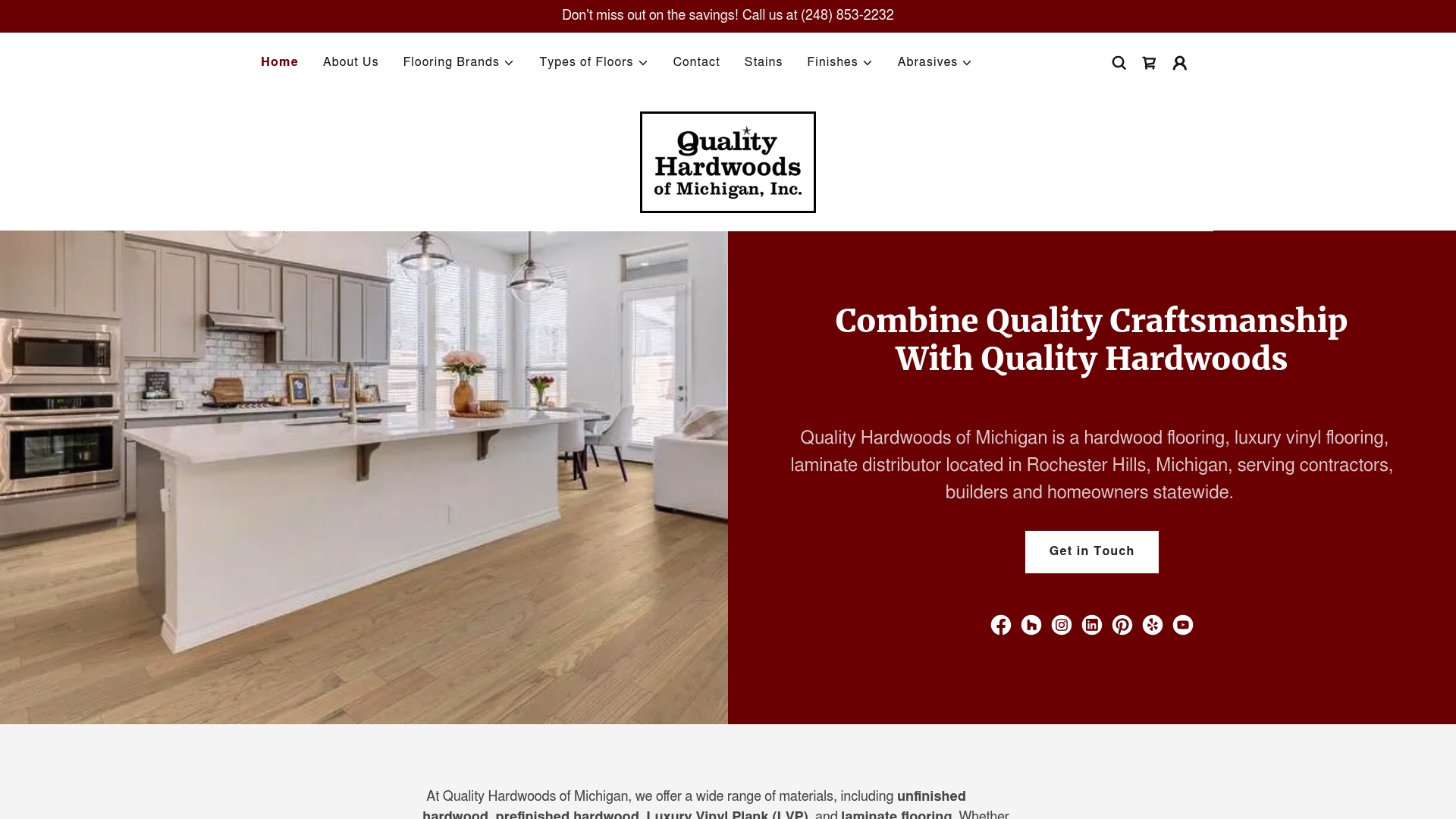
Whether you’re a contractor managing fill-in orders across multiple active jobs or a homeowner planning one careful renovation, the showroom is worth the visit before you order anything online. You can hold real samples, ask direct questions about lead times and installer referrals, and walk out with a quote instead of a guess. Request a quote or plan your showroom visit to get started on your next flooring project.
Sources
- Side-by-Side | News | Tise 2026
- Partnering with dealers: Why commercial co-ops still matter - Floor Daily
- Average cost of flooring / Flooring cost data - CostPrism
FAQ
What Is the Rule of 3 for Flooring?
The Rule of 3 is a common industry guideline for blending flooring boxes from multiple cartons as you install, pulling planks from at least three boxes at a time to mix natural color and grain variation evenly across the room. It prevents visible batching where one section of floor looks noticeably different from another. Distributor staff can walk you through this during a showroom consultation, especially on natural hardwood with heavier grain variation.
Who Are the Largest Flooring Distributors in the US?
National distribution is dominated by a handful of large wholesale networks that supply both big-box chains and independent dealers, though most regional markets, including Michigan, are also served by long-established local distributors with deep contractor relationships. Quality Hardwoods of Michigan has operated as one of those regional distributors for over 40 years, focused on Michigan contractors and homeowners specifically rather than national volume accounts.
Where Do Flooring Installers Make the Most Money?
Installers generally earn more in markets with higher renovation activity, higher cost of living, and demand for premium materials like solid hardwood and custom finishes, since labor rates tend to track regional construction costs. Installers working through distributor referral networks often see steadier project flow than those relying purely on independent marketing, since the distributor relationship brings a consistent pipeline of qualified jobs.
How Much Does 1,000 Square Feet of Flooring Cost?
Total cost depends heavily on material choice, waste allowance, and installation complexity, so there’s no single flat number that applies to every project. Distributor quotes typically build in expected waste percentage and installer coordination, which is why a distributor estimate for the same project often looks different from a big-box per-carton price that excludes those factors. Quality Hardwoods of Michigan provides project-specific quotes rather than flat online pricing, since material and labor costs vary by product and room condition.
Is It Cheaper to Buy Flooring From a Local Distributor or Big-Box?
The sticker price per carton is often lower at big-box stores, but total project cost frequently favors distributors once waste calculation, installer coordination, and fewer mid-project shortfalls are factored in. Contractors buying in volume often get trade pricing from distributors that closes much of the upfront price gap over multiple jobs.