
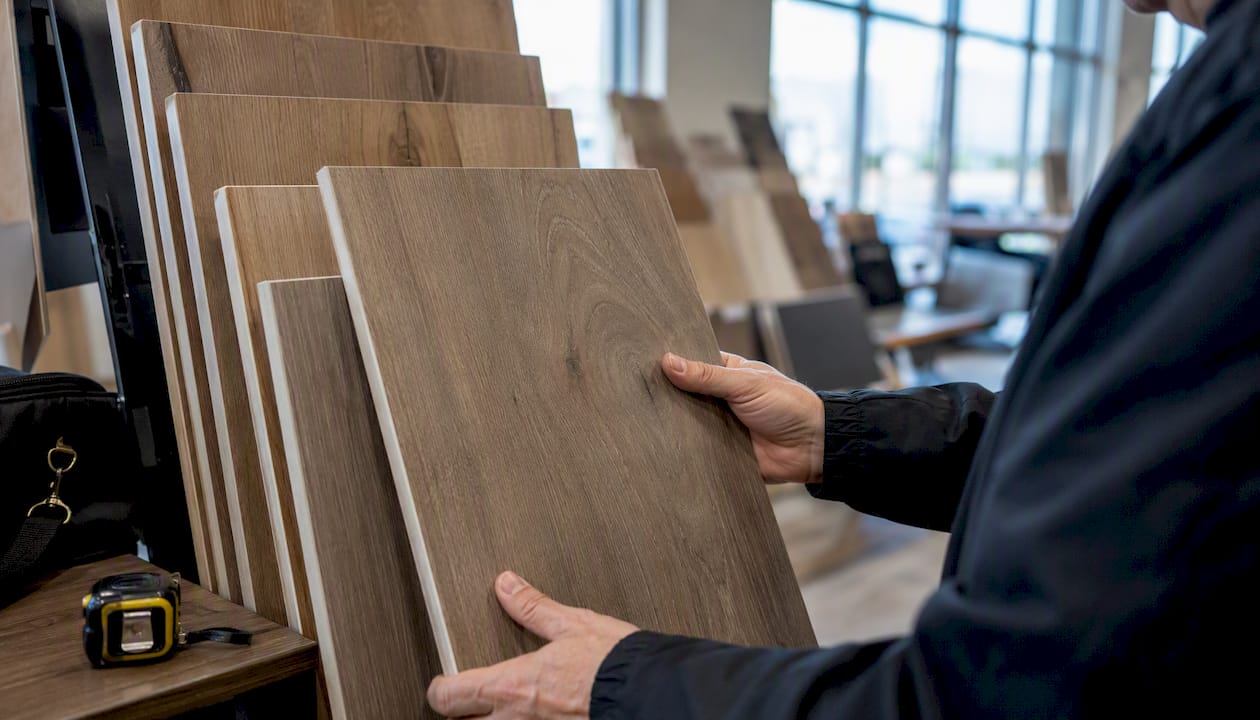
A distributor showroom is a local, trade-focused hub where retailers, contractors, and builders inspect real samples, lock in trade pricing, and arrange pickup or last-mile delivery without carrying excess stock. The role of a distributor showroom for retailers goes well beyond product display: it functions as a regional logistics partner, a specification resource, and a margin-protection tool all in one location.
Key benefits at a glance:
- Sample inspection: View and feel full-size flooring samples under realistic lighting before committing to a full order.
- Private and exclusive SKUs: Access products not sold in big-box stores, protecting your retail margin.
- Just-in-time inventory: Draw from local stock rather than warehousing product yourself.
- Trade pricing and credit terms: Volume discounts, net-30 or net-60 terms, and purchase-order support.
- Technical support: On-site staff who can answer specification, installation, and compatibility questions.
- Rapid last-mile delivery: Regional logistics that get product to the jobsite on your schedule.
Quality Hardwoods of Michigan, Inc operates this model from Rochester Hills, serving contractors, builders, and flooring retailers across Michigan with hardwood, LVP, laminate, stains, and finishes.
Key Takeaways
A distributor showroom reduces carrying costs, protects retail margin, and shortens project lead times when you use it as a trade partner rather than a walk-in store.
| Point | Details |
|---|---|
| Local inventory cuts carrying costs | Draw from regional stock instead of warehousing product yourself, reducing working capital tied up in materials. |
| Private-label SKUs protect margin | A moderate portion of some distributors’ assortments are private labeled, giving independents products consumers cannot price-shop online. |
| Confirm lead times in writing | Always get written lead-time and pricing confirmation before placing an order to avoid supply interruptions. |
| Seven-point checklist for evaluation | Score any showroom on inventory depth, lead times, delivery, credit terms, warranty support, samples, and exclusive SKUs. |
| Quality Hardwoods of Michigan, Inc | Rochester Hills distributor covering all seven evaluation criteria, with trade accounts, statewide delivery, and 40-plus years serving Michigan trade buyers. |
Table of Contents
- What roles does a distributor showroom play for retailers and contractors?
- How to use a distributor showroom: a step-by-step workflow
- Key showroom services that reduce retailer risk and overhead
- How a showroom helps independent retailers compete with big-box and online sellers
- How to evaluate and choose a distributor showroom
- How Quality Hardwoods of Michigan’s showroom supports retailers and contractors
- What retail buyers should actually prioritize at a distributor showroom
- Quality Hardwoods of Michigan, Inc: visit the showroom or request a B2B quote
- Sources
- FAQ
What roles does a distributor showroom play for retailers and contractors?
A flooring distributor’s primary role is acting as a local advocate in the supply chain by providing just-in-time inventory, rapid last-mile delivery, and technical support so retailers and contractors can operate without holding excessive stock. That single function branches into several distinct operational roles.
Product display and specification support. Curated floor displays let trade buyers compare species, grades, and finish options side by side. Showroom staff provide specification sheets, installation guidelines, and compatibility notes for subfloor types, which cuts the back-and-forth between a buyer and a manufacturer’s tech line.
Private-label and exclusive SKUs. Distributors add value through private labeling, and some estimate that a moderate portion of their assortment is private labeled. For an independent retailer, that means stocking products a consumer cannot find on a competitor’s shelf or price-compare online. It is one of the most direct margin-protection tools available.
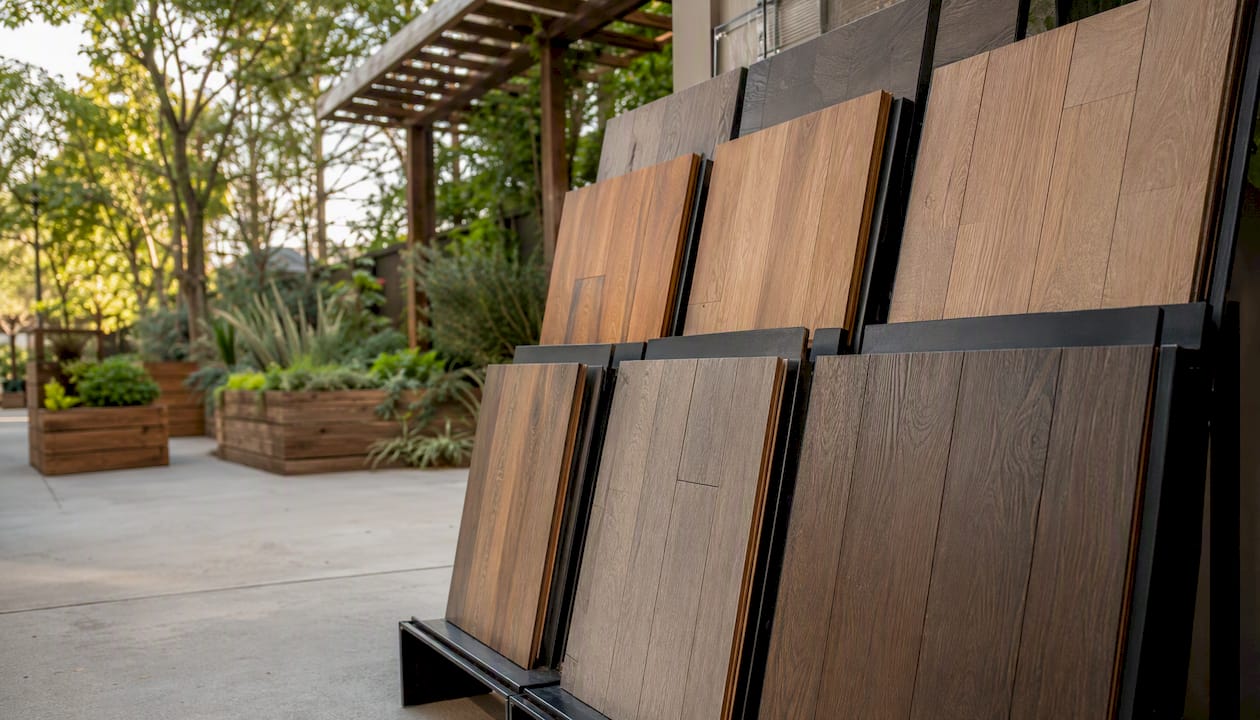
Trade pricing and volume discounts. A true flooring distributor focuses on trade pricing, inventory depth, and project consistency rather than walk-in retail presentation. Volume purchasing also reduces dye-lot risk: when you order enough product from a single lot, you avoid the costly mid-project substitution that happens when a SKU sells out.
Order staging and logistics. Showroom staff can stage orders for pickup or schedule delivery windows that align with your installation crew. Regional distributors with daily delivery routes shorten lead times and support payables and receivables functions for both manufacturers and retailers.
Warranty and claims facilitation. When a product issue surfaces after installation, the distributor is the first call. Staff who know the manufacturer’s warranty terms can file claims faster than a retailer navigating a manufacturer’s national support line alone.
Pro Tip: Ask your showroom rep which SKUs are exclusive or private-labeled before building your floor display. Stocking even two or three exclusive lines gives you products a consumer cannot cross-shop on Amazon or at a big-box store.
How to use a distributor showroom: a step-by-step workflow
A repeatable visit workflow saves time and prevents the most common ordering mistakes.
- Prepare before you arrive. Gather room measurements, jobsite photos, subfloor type, existing trim or adjacent material samples, and your installer’s contact information. Showroom consultations are most productive when buyers bring measurements and jobsite photos and request full-size samples to check color under site lighting.
- Consult on specification and compatibility. Walk the showroom with a staff member. Confirm species, grade, finish, and thickness against your subfloor and moisture conditions. Ask about adjacent materials and transition pieces.
- Confirm pricing, lead times, and minimums. Get written confirmation of trade pricing, any volume minimums, current lead times, and dye-lot availability. Never place an order based on a verbal estimate.
- Place the order through your trade account or PO. Contractors with an established trade account can often reduce lead times and avoid supply interruptions by ordering against a standing account rather than one-off transactions.
- Schedule logistics. Decide between showroom pickup and scheduled delivery. Confirm the delivery window with your installer so the product arrives when the crew is ready, not a week before.
- Inspect on delivery and document. Check carton counts, lot numbers, and surface condition before the installer opens boxes. Note any discrepancies immediately; most distributors require damage claims within a defined window.
- Handle returns and warranty questions through the showroom. Keep your order documentation. If a warranty claim arises, the distributor’s staff can coordinate with the manufacturer on your behalf.
What to bring to every showroom visit:
- Room dimensions and square footage (add your waste factor)
- Subfloor type and moisture test results if available
- Photos of the space, existing trim, cabinetry, and adjacent flooring
- Installer contact and any spec requirements they have flagged
- Your preferred delivery window and jobsite address
Key showroom services that reduce retailer risk and overhead
The distributor showroom’s services translate directly into lower carrying costs and fewer project delays.
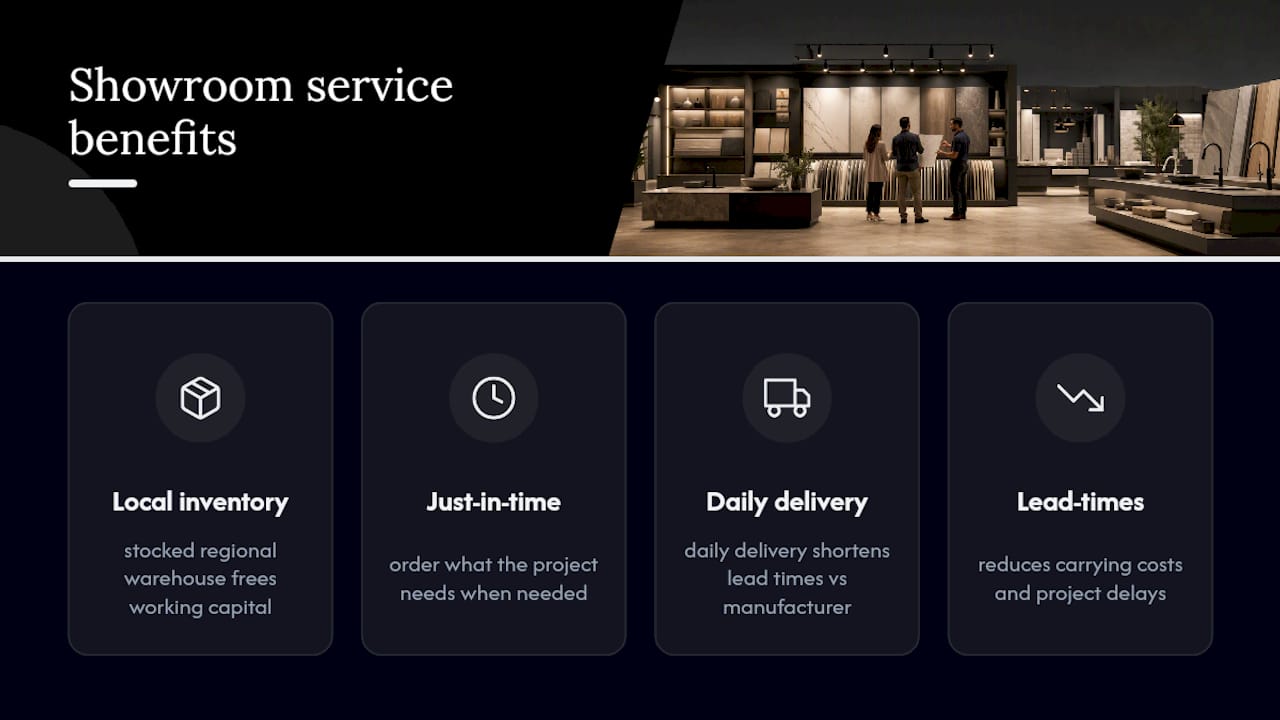
Local inventory and just-in-time fulfillment. A stocked regional warehouse means you do not need to tie up working capital in a back-room full of flooring. You order what the project needs, when it is needed. Regional distributors that offer daily delivery routes can shorten lead times significantly compared to ordering direct from a national manufacturer.
Credit terms and invoicing support. Net-30 or net-60 terms improve contractor cash flow, particularly on multi-unit builds where material costs run ahead of client payments. This payables support is something online-only sellers rarely offer trade buyers.
Technical and specification support. On-site staff training, installation guidance, and warranty coordination reduce rework. A contractor who gets the right product specification the first time avoids the cost of pulling up and replacing incorrectly specified flooring. For help building accurate project budgets around these purchases, project cost estimating guides can pair well with what you learn at the showroom.
Marketing and merchandising support. Curated point-of-sale displays, sample boards, and private-label product programs help independent retailers present a polished floor display without a large merchandising budget. Distributors that focus on regional merchandising and local relationships can provide a better match to local customer tastes than national one-size-fits-all programs.
How a showroom helps independent retailers compete with big-box and online sellers
Independent flooring retailers face real pricing pressure from online discounters and big-box chains. The distributor showroom is one of the clearest structural advantages available.
- Private and exclusive SKUs. When roughly a quarter of a distributor’s assortment is private labeled, independent retailers can stock products that simply do not exist at a national chain. A consumer who wants that specific product has to buy it from you.
- Service differentiation. Technical support, curated displays, local delivery, and trade credit are services big-box stores and online sellers rarely match at the project level. A contractor who needs a dye-lot guarantee for a 40-unit apartment building cannot get that from an online cart.
- Dye-lot and inventory consistency. Multi-unit projects require consistent product across every unit. A distributor with deep local stock can reserve a full lot for a project, eliminating the substitution risk that comes with ordering piecemeal.
- Specification packages. Bundling flooring with matching stains, finishes, and transition pieces into a specification package creates a defensible offer a consumer cannot easily replicate by price-shopping individual components.
Pro Tip: Build two or three showroom-only specification packages (floor + stain + finish + transitions) and price them as a bundle. Consumers comparing individual component prices online will not find an apples-to-apples match, which keeps the conversation on value rather than price.
How to evaluate and choose a distributor showroom
Use this checklist to score any distributor showroom before committing to a trade account.
- Inventory breadth and local stock levels. Can they fill a 2,000-square-foot order from local stock today, or does everything ship from a national warehouse?
- Lead times. What is the standard lead time for in-stock versus special-order product? Get this in writing.
- Delivery capabilities. Do they offer last-mile delivery to your jobsite, or is pickup the only option? What is the delivery window flexibility?
- Credit terms. Are net-30 or net-60 terms available for trade accounts? What is the credit application process?
- Warranty and claims support. Who handles manufacturer warranty claims? How long does the process typically take?
- Sample availability. Can you take full-size samples to the jobsite? Is there a deposit or loan program?
- Private-label or exclusive options. What percentage of their assortment is exclusive to their network?
Red flags to watch for:
- Vague or verbal-only lead-time commitments
- No trade account or credit program
- Limited sample access or samples only available in small chips
- Opaque return policy with no written terms
- Staff who cannot answer basic installation or specification questions
A simple pass/fail score across these seven criteria will surface a weak distributor quickly. Any showroom that fails on inventory depth, lead times, or credit terms is a supply-chain risk for your business.
How Quality Hardwoods of Michigan’s showroom supports retailers and contractors
Quality Hardwoods of Michigan, Inc operates a trade-focused showroom in Rochester Hills with over 40 years of service to Michigan contractors, builders, and flooring retailers.
Showroom services and capabilities:
- In-person displays of hardwood, LVP, laminate, and related products
- Trade pricing and volume discounts for contractors and retailers
- Local inventory with pickup available at the Rochester Hills location
- Statewide delivery options across Michigan
- Credit and trade account support
- Specification and product selection assistance from experienced staff
- Marketing and merchandising support, including private-label and exclusive product options
- Stains, finishes, and abrasives alongside flooring products
Against the seven-point evaluation checklist above, Quality Hardwoods of Michigan, Inc covers every criterion: local stock, clear ordering process, delivery and pickup options, trade account support, warranty coordination, full-size sample access, and exclusive product lines. Installation is performed by third-party installers; the showroom focuses on material sourcing and specification.
Pro Tip: Call ahead or book an appointment before your first visit. Bring your project measurements and jobsite photos so the showroom team can pull relevant samples and confirm lot availability before you arrive.
What retail buyers should actually prioritize at a distributor showroom
Most buyers walk into a distributor showroom focused on price. That is the wrong starting point.
Price matters, but the three things that actually determine whether a project finishes on time and on budget are inventory reliability, clear lead times, and technical support that prevents rework.
Assign one person on your team as the single point of contact at the showroom. Confirm lead-time commitments in writing before every order. And use the showroom’s technical staff as a resource, not just a checkout counter. Those three habits protect your schedule, your margin, and your client relationships more reliably than negotiating an extra point of discount.
Quality Hardwoods of Michigan, Inc: visit the showroom or request a B2B quote
Michigan contractors, builders, and flooring retailers who need reliable material sourcing with local inventory, trade pricing, and statewide delivery have a direct option in Rochester Hills.
Quality Hardwoods of Michigan, Inc carries hardwood, LVP, laminate, stains, finishes, and accessories, all available through the showroom or via phone and online quote. Trade accounts, credit terms, and pickup or delivery options are available for qualifying buyers. For new construction projects in Southeast Michigan, the new construction hardwood service page covers project-specific sourcing in detail. Installation is handled by third-party installers; the team focuses on getting you the right product, in the right quantity, on time.
Visit the showroom in Rochester Hills, request a B2B quote online, or call to confirm availability and schedule a delivery window.
Sources
- The State of Distribution: A panel of distributors weighs in on their value proposition and strategies for success
- What Sets a True Flooring Distributor Apart from Retail Showrooms - Fedco
- Ferguson Flooring: Pros, Cons, and Buying Guide - D and G Flooring
FAQ
What does a distributor showroom do for a retailer?
A distributor showroom gives retailers access to trade pricing, local inventory, full-size product samples, and logistics support (pickup or delivery) without requiring them to carry large amounts of stock themselves.
How do showrooms help contractors manage lead times?
Contractors with a trade account at a regional distributor can draw from local stock and schedule deliveries around their installation crew, reducing the gap between order and jobsite delivery compared to ordering direct from a national manufacturer.
What should I bring to a distributor showroom visit?
Bring room measurements, jobsite photos, subfloor type, existing trim or adjacent material samples, and your installer’s contact information. Confirm pricing and lead times in writing before placing any order.
How do private-label SKUs protect a retailer’s margin?
Private-label and exclusive products are not available at big-box stores or online, so consumers cannot directly compare prices. Some distributors estimate roughly a quarter of their assortment is private labeled, giving independent retailers a meaningful pricing buffer.
Does Quality Hardwoods of Michigan, Inc offer delivery across Michigan?
Yes. Quality Hardwoods of Michigan, Inc offers statewide delivery across Michigan in addition to pickup at the Rochester Hills showroom. Trade accounts and credit terms are available for qualifying contractors and retailers.