
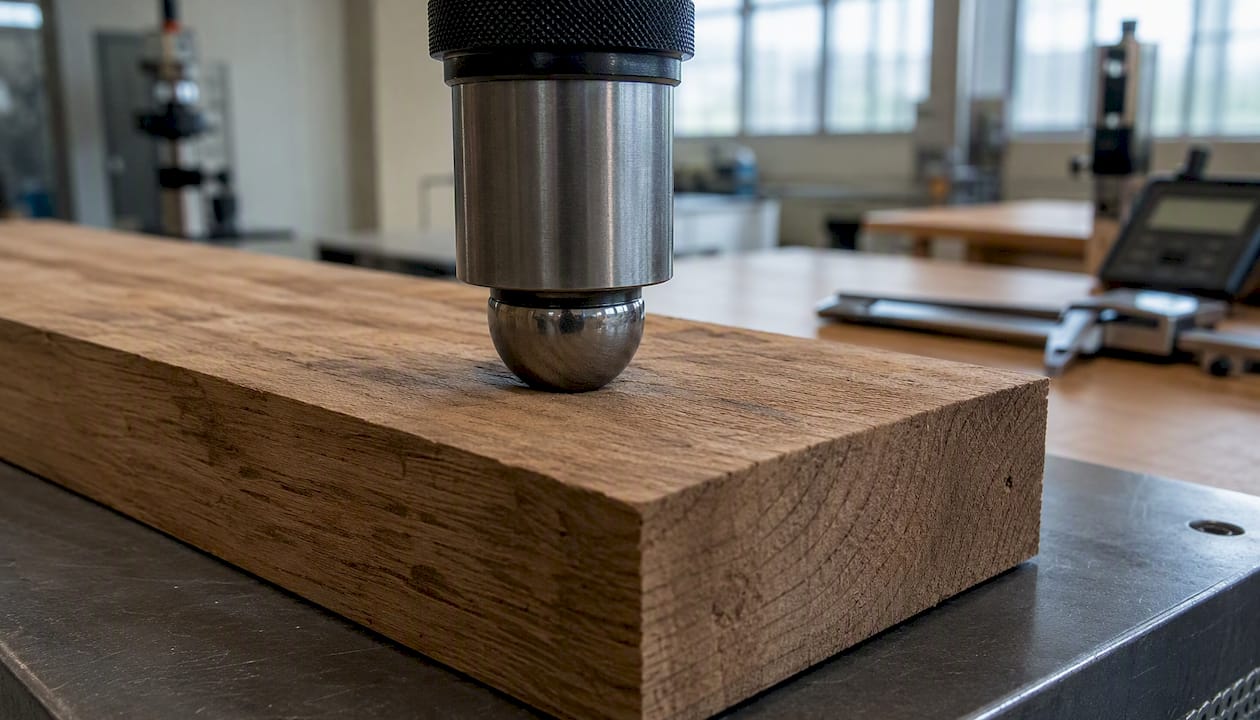
The Janka hardness test measures the force required to press a .444-inch steel ball halfway into a wood sample, giving you a pound-force (lbf) number that predicts how well a species resists dents. Higher is harder. But that number alone won’t tell you whether a floor will hold up in your kitchen for twenty years. Pair the Janka score with finish quality and floor construction, and you have an actual durability picture. The NWFA confirms that Janka values indicate dent resistance but are only one part of overall durability.
Here’s a quick framework for reading any Janka score:
- Softer species: Pine and cherry. Fine for bedrooms and low-traffic spaces where aesthetics matter more than dent resistance.
- Medium species: Walnut, red oak, and white oak. The sweet spot for most living rooms, dining rooms, and moderate-traffic kitchens.
- Hard species: Hickory/Pecan, Brazilian cherry/Jatoba, strand-woven bamboo. Built for entryways, busy family kitchens, homes with large dogs, and rental units that need to survive heavy use.
ASTM D143 and ASTM D1037 are the test standards most commonly referenced in the industry. Hickory is the go-to example of a species that genuinely earns its high number in real-world conditions.
Key Takeaways
Janka hardness is a reliable starting filter for species selection, but finish quality and floor construction determine long-term durability more than the number alone.
| Point | Details |
|---|---|
| Janka measures dent resistance | The lbf score predicts how a species resists point-load denting, not surface abrasion or finish wear. |
| Rating thresholds by room | Below 1,000 lbf for bedrooms; 1,000–1,600 lbf for living areas; above 1,600 lbf for kitchens, pets, and entryways. |
| Finish often matters more | An aluminum-oxide factory finish on a mid-Janka species can outperform a poor finish on a harder species. |
| Engineered floors need different specs | Check wear-layer thickness (mm) and manufacturer abrasion rating, not just species Janka value. |
| Quality Hardwoods of Michigan, Inc | Carries hardwoods across the full Janka range with finish and spec guidance for Michigan contractors and homeowners. |
Table of Contents
- How does the Janka hardness test actually work?
- Common flooring species and their Janka values
- How do you interpret a Janka score for your home?
- Why Janka isn’t the whole durability story
- Practical questions to ask before you buy
- Where do Janka numbers come from, and why do lists disagree?
- A perspective on using Janka wisely
- Quality Hardwoods of Michigan, Inc: species selection made concrete
- Sources
- FAQ
How does the Janka hardness test actually work?
The Janka hardness test uses a steel ball measuring .444 inches (11.28 mm) in diameter. A testing machine presses that ball into a wood sample until it is embedded exactly halfway. The force recorded at that point, measured in pound-force (lbf), is the Janka value. Results are averages across multiple samples, not a single reading from a single board.
Pro Tip: Published Janka numbers are averages, and the standard deviation is rarely shown. Moisture content, sample location within the log, heartwood versus sapwood, and even the cut angle all shift the result. Treat any published number as a useful comparison point, not a guarantee.
A few things worth knowing about how the numbers are generated:
- ASTM D143 covers small clear specimens of solid wood and is the standard most commonly referenced for solid hardwood species.
- ASTM D1037 applies to wood-based panels and composite products, making it more relevant for engineered flooring evaluations.
- Engineered flooring is often not rated with the Janka method at all. Instead, manufacturers may use product-level indentation tests or report wear-layer thickness, which is a more practical metric for engineered products anyway.
- Regional variations in the same species (e.g., Appalachian versus Pacific Coast growth) can produce meaningfully different results.
The bottom line: when two products list Janka values from different sources, you may be comparing apples to oranges. Ask where the number comes from.
Common flooring species and their Janka values
The NWFA species data is the most widely cited reference for solid wood Janka values in North America. The table below draws from that source.
| Species | Janka Value (lbf) | Best For |
|---|---|---|
| Brazilian Cherry (Jatoba) | (high) | Highest-traffic areas, commercial grade residential |
| Hickory / Pecan | (high) | Busy kitchens, homes with large dogs, entryways |
| Hard Maple | (medium) | Gyms, playrooms, moderate-to-high traffic |
| White Oak | (medium) | Living rooms, kitchens, wide-plank applications |
| Red Oak | (medium) | General residential, refinishable heritage floors |
| Black Walnut | (medium) | Living spaces, offices, aesthetic-priority rooms |
| Cherry | (soft) | Bedrooms, low-traffic formal rooms |
| Strand-Woven Bamboo | (very high) | High-traffic, pet-heavy, budget-conscious buyers |
A few notes on reading this table. Soft maple runs around 950 lbf, well below hard maple, so confirm which variety you’re buying. Strand-woven bamboo is technically a grass, not a wood, but it competes directly with hardwood flooring and its Janka-equivalent values vary widely by manufacturer and compression process. Brazilian cherry’s 2,690 lbf sounds impressive, but its dramatic color shift over time and limited refinishability are real trade-offs.
Hickory is the practical standout for Michigan families. It is notably harder than red oak, absorbing the kind of daily punishment that shows up as dents in softer species. Walnut sits at the other end of the personality spectrum: lower hardness, but its tight grain, natural oils, and deep color make it a favorite for living rooms and home offices where the floor is more furniture than workhorse.
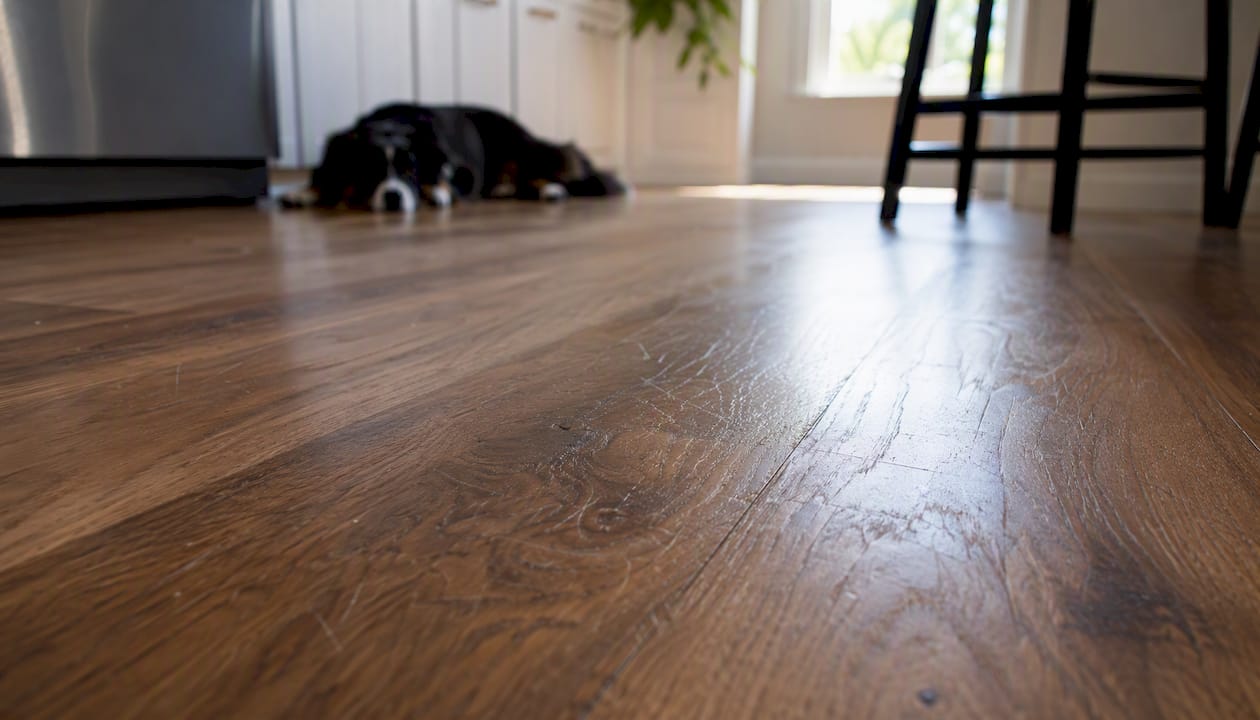
For color and species pairing ideas, the popular wood floor colors guide at Quality Hardwoods of Michigan, Inc covers how stain behavior differs across oak, walnut, maple, and more.
How do you interpret a Janka score for your home?
A number on a spec sheet only matters when you connect it to how a room actually gets used. Here’s how to translate Janka scores into room-by-room decisions.
Bedrooms and low-traffic rooms: Anything above 900 lbf is generally fine. Cherry and soft maple are legitimate choices here. The floor takes almost no impact load, so appearance and refinishability should drive the decision.
Living rooms and dining rooms: Target 1,000–1,400 lbf. Red oak and walnut both land in this range and handle normal foot traffic, furniture legs, and occasional dropped items without chronic denting. White oak at 1,360 lbf is a strong all-around pick.
Kitchens and entryways: Aim for 1,300 lbf minimum, and lean toward 1,500+ if you have a large household. White oak handles most kitchens well. Hickory is the safer call for families who cook heavily and track in grit.
Homes with dogs: Large dogs with hard nails are the most punishing test a residential floor faces. Hickory (~1,820 lbf) or strand-woven bamboo are the practical choices. Red oak will show nail scratches within months in a home with a 70-pound dog. For high-traffic flooring guidance specific to Michigan homes, Quality Hardwoods of Michigan, Inc has a dedicated resource.
Heritage homes where refinishability matters: Prioritize solid wood over engineered, and choose species with enough thickness to sand multiple times. Red oak and white oak are the standard answers here because they’re widely available, refinishable, and carry a predictable grain.
Two modifiers that change how you read the Janka score: finish and board width. A wide-plank floor (5 inches or wider) moves more with humidity changes, which creates gaps and surface stress that no Janka rating addresses. Narrower boards in the same species will hold up better in Michigan’s seasonal humidity swings. Finish type matters just as much, covered in detail in the next section.
Why Janka isn’t the whole durability story
This is where most buyers get tripped up. A floor’s real-world durability depends on at least five factors beyond species hardness, and finish is the biggest one most people underweight.
- Finish type and abrasion resistance: An aluminum-oxide factory finish on a medium-Janka species will outlast a site-applied oil finish on a harder species in most residential conditions. The finish is the first line of defense against surface wear. Understanding the differences between hardwood floor finish types helps you ask the right questions before you buy.
- Engineered vs. solid construction: Engineered flooring has a thin hardwood veneer over a plywood or HDF core. The species Janka value applies only to that veneer. A 2mm wear layer on a high-Janka species gives you less refinishing life than a 3/4-inch solid board of a softer species.
- Dimensional stability: Species with tighter grain and lower movement coefficients (white oak, hard maple) handle humidity fluctuations better than wide-grained or ring-porous species. Michigan winters and summers create real seasonal movement.
- Board width: Wider boards amplify movement. A 7-inch white oak plank will gap and cup more than a 3-inch strip of the same species under the same conditions.
- Installation quality and acclimation: A properly acclimated floor installed over a flat, dry subfloor will outperform a harder species rushed into installation. No Janka rating compensates for a bad install.
The NWFA’s durability guidance makes this point directly: finish, cut, and environmental control all influence real-world performance alongside species hardness. ASTM D2394 (Falling-Ball Indentation) and abrasion tests give complementary data to Janka because they measure different failure modes. Janka predicts denting from point loads. Abrasion tests predict surface finish wear from foot traffic and grit. Both matter, and neither alone tells the full story.
Pro Tip: Ask for the manufacturer’s abrasion class or Taber abrasion rating on any prefinished product. A high Janka score with a poor abrasion rating means the finish will dull and scratch long before the wood dents.
Practical questions to ask before you buy
Whether you’re at a showroom or reviewing a quote, these are the questions that separate a well-matched floor from an expensive regret.
- What is the species Janka value, and what source is it from? If the seller can’t name a source (NWFA table, manufacturer test report), treat the number skeptically.
- What finish is applied, and what is the abrasion rating or warranty? Factory aluminum-oxide finishes typically carry longer wear warranties than site-applied finishes.
- For engineered products: what is the wear-layer thickness in millimeters? Below 2mm limits refinishing to once, if at all. At 4mm or above, you have real refinishing flexibility.
- What are the acclimation requirements? Any reputable product comes with specific temperature and humidity acclimation instructions. Missing instructions are a red flag.
- What board width is recommended for your subfloor and climate? Wider boards need tighter humidity control.
When comparing spec sheets, look for these columns: Janka value with source, finish abrasion class or Taber rating, wear-layer thickness (engineered), humidity acclimation range, and warranty duration by category (structural vs. finish).
Red flags worth walking away from:
- No wear-layer spec on an engineered product
- Janka value listed without a source or test standard
- Missing acclimation instructions
- Finish warranty under 10 years on a prefinished product marketed as “commercial grade”
When to choose a harder species over a better finish: when the floor will face point-load impacts (dropped tools, heavy furniture dragged without pads, large dogs) rather than surface abrasion. When to prioritize finish: when the primary concern is long-term sheen and surface wear from foot traffic and cleaning.
Where do Janka numbers come from, and why do lists disagree?
The two ASTM standards most commonly referenced for wood hardness testing are ASTM D143 (solid wood specimens) and ASTM D1037 (wood-based panels and composites). These define the test geometry and conditions, but published species tables still vary because:
- Moisture content at testing: Drier wood tests harder. Most published values use air-dried samples (~12% moisture content), but not all sources specify this.
- Heartwood vs. mixed samples: Heartwood is typically harder than sapwood. Tables that mix both will show lower averages.
- Sample size and averaging: The Janka hardness test Wikipedia entry notes that published values are averages and that standard deviation is rarely reported, meaning two sources can both be “correct” while showing different numbers.
- Regional and growth variation: The same species grown in different regions produces wood with different density.
The NWFA species table is the most authoritative North American reference for solid wood flooring. For buyers with sustainability goals or projects targeting LEED credits, the USGBC provides guidance on responsible wood sourcing that can affect species selection.
When two lists show different Janka values for the same species, check whether they specify moisture content and sample type.
A perspective on using Janka wisely
The Janka number is the most misused spec in flooring retail. Buyers fixate on it because it’s a single, comparable number, and single numbers feel decisive. The problem is that a floor’s durability is a system, not a species.
Hickory at 1,820 lbf installed with a thin oil finish in a wide-plank format in a Michigan home without humidity control will underperform white oak at 1,360 lbf installed with a quality aluminum-oxide finish, proper acclimation, and a maintenance routine. The Janka score didn’t lie. The buyer just used it as the only variable.
The species choice matters most at the extremes: cherry in a busy kitchen is a mistake no finish will fix, and Brazilian cherry in a bedroom is overkill that costs money without adding value. In the middle range, 1,200–1,600 lbf, finish and construction decisions matter more than the 100-point Janka differences between species. That’s where most buyers are shopping, and that’s where most of the confusion lives.
The practical advice: use Janka to eliminate species that are clearly too soft for your use case, then make the final call on finish, construction, and aesthetics. Don’t use it to choose between white oak and red oak for a living room. Use it to rule out cherry for a kitchen with two kids and a golden retriever.
Quality Hardwoods of Michigan, Inc: species selection made concrete
Choosing between hickory, white oak, and walnut is easier when you can hold a sample in your actual lighting, not just read a spec sheet. Quality Hardwoods of Michigan, Inc carries unfinished and prefinished hardwoods across the full Janka range, from mid-hardness domestic species to high-Janka exotics, along with the stains, finishes, and abrasives that determine how a floor actually performs over time.
Contractors and builders get direct access to product specs, wear-layer data, and finish compatibility guidance for both solid and engineered products. Homeowners can visit the showroom to compare samples side by side, or request statewide delivery for Michigan projects. The team can walk you through Janka values, finish options, and acclimation requirements before you commit to a species.
For new construction projects in Southeast Michigan, the hardwood flooring for new construction page covers supply options, spec support, and how to get a quote. Browse the full flooring brands inventory to compare product lines and specs across categories.
Sources
FAQ
What’s a good Janka rating for residential flooring?
For most residential rooms, a Janka rating of 1,000 lbf or higher provides adequate dent resistance. High-traffic areas, kitchens, and homes with pets benefit from species at 1,300 lbf or above, such as white oak (1,360 lbf) or hickory (1,820 lbf).
What is the hardest wood flooring you can buy?
Among common flooring species, strand-woven bamboo and Brazilian cherry (Jatoba) rank among the hardest. Exotic hardwoods like Ipé and Cumaru are harder still, though availability and workability vary.
Does a higher Janka score always mean a more durable floor?
No. Finish type, wear-layer thickness on engineered products, board width, and humidity control all affect real-world durability. The NWFA notes that Janka is one part of the durability picture, not the whole story.
What is the hardest most durable hardwood flooring for everyday use?
Hickory is considered a practical high-hardness domestic species for everyday residential use. It combines strong dent resistance with wide availability, refinishability, and compatibility with most finish types. Quality Hardwoods of Michigan, Inc stocks hickory alongside other high-Janka species for buyers who need both durability and domestic sourcing.
Recommended
- Hardwood Flooring Subfloor Requirements: A Complete Guide — Quality Hardwoods of Michigan
- Hardwood Flooring Warranty Types: A Builder’s Guide — Quality Hardwoods of Michigan
- Johnson Hardwood Flooring Review: Michigan Buyer’s Guide | Quality Hardwoods of Michigan
- Preverco Flooring Review MI | Quality Hardwoods of Michigan