
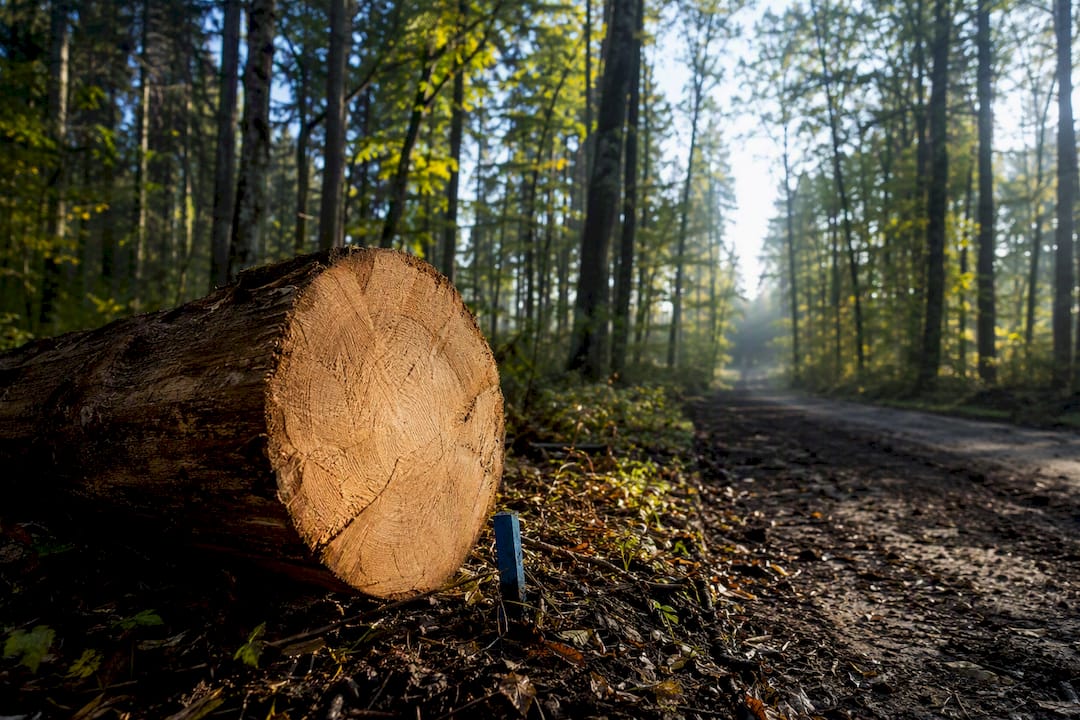
FSC-certified hardwood means an independent auditor verified the timber came from a responsibly managed forest and tracked it through every hand that touched it before it reached your floor. That chain-of-custody trail is the whole point of the FSC certified wood flooring system, and it’s a legitimate sustainability signal, not a marketing sticker. Before you buy, ask the seller for the chain-of-custody certificate number and check it yourself. That single step separates a real claim from a green-sounding label.
TL;DR:
- Only products with both forest management and chain-of-custody certification prove responsible sourcing and traceability, requiring verification via certificate numbers.
- FSC certification applies to solid and engineered hardwoods, with wear-layer thickness and species variety affecting refinishing potential and longevity.
- Certification’s primary value is in proof of origin, not quality of finish, VOC levels, or manufacturing standards, which must be checked separately.
- Availability of certified hardwood varies regionally, depending on species, supply chain certifications, and local demand, affecting lead times and selection.
- FSC-certified wood offers environmental and social benefits but doesn’t guarantee indoor air quality or lower carbon footprint without additional considerations.
Table of Contents
- What FSC Certification Actually Means for Hardwood Flooring
- Solid, Engineered, and Species: How FSC Applies to Real Flooring
- How to Verify an FSC Claim Before You Buy
- Real Benefits and Honest Limits of FSC Hardwood
- Keeping an FSC Hardwood Floor Looking Right for Decades
- What to Ask a Distributor Before You Sign Off on Flooring
- How We Handle FSC Sourcing at Quality Hardwoods of Michigan
- FSC vs. Non-Certified Hardwood: What Actually Changes
- Myths About FSC Hardwood Flooring That Won’t Die
- Does FSC Certification Actually Raise Resale Value?
- Beyond FSC: Other Sustainability Certifications Worth Knowing
- Why FSC Hardwood Can Be Harder to Find in Some Regions
- Certification, Indoor Air Quality, and What Doesn’t Overlap
- The Editorial Take: Where FSC Buyers Get It Wrong
- Ready to Source Certified Hardwood? Here’s Where to Start
- Sources
- FAQ
What FSC Certification Actually Means for Hardwood Flooring
The Forest Stewardship Council is an international nonprofit that sets standards for responsible forest management, covering everything from biodiversity protection to the rights of indigenous communities working near harvested land, according to SCS Global Services. Certification isn’t self-reported. Forests and supply-chain companies go through independent audits, repeated on a schedule, to keep their certificates active.
Two separate certificates matter here:
- Forest management certification confirms the forest itself is harvested responsibly.
- Chain-of-custody certification confirms every company that processed, milled, or distributed the wood kept it separated from uncertified material, a system the FSC documents in detail.
Without both links intact, a “certified” claim on a box of flooring means very little. Traceability is what turns a forestry standard into a product guarantee.
Solid, Engineered, and Species: How FSC Applies to Real Flooring
FSC certification attaches to the wood itself, not to a construction method, so both solid and engineered hardwood can carry it. Solid planks are one piece of timber top to bottom; engineered planks stack a hardwood wear layer over plywood or composite layers, which makes them more stable in humidity swings but limits how many times they can be sanded.
- Oak, maple, walnut, and various Appalachian species show up regularly as FSC-certified options.
- Grade (select, character, or the more rustic “cabin” grades) affects color consistency and price, but grade and certification are independent of each other. A character-grade board can be just as certified as a premium select board.
- Wear-layer thickness on engineered planks determines refinishing life; planks with a wear layer of 3/32 inch or more generally tolerate at least one full sanding and recoat cycle, sometimes two.
If longevity matters as much as sourcing, ask for the wear-layer spec before you ask about the finish color.
How to Verify an FSC Claim Before You Buy
Anyone can print an FSC logo on a brochure. What you’re checking for is a real, current chain-of-custody certificate tied to the specific product you’re buying.
- Ask the distributor or manufacturer for their exact Chain of Custody certificate number, a requirement the FSC certification system spells out for every company in the supply chain.
- Enter that number into the FSC certificate search to confirm it’s active and matches the company selling you the product.
- Understand the label variant: FSC 100% means all wood is certified, FSC Mix blends certified and controlled material, and FSC Recycled covers reclaimed content. Each means something different for what’s actually in the plank.
Pro Tip: If a salesperson can’t produce a certificate number on request, or gives you a vague “it’s all sustainable” answer instead, treat that as a red flag and ask a second supplier.
Real Benefits and Honest Limits of FSC Hardwood
Independent audits back up the environmental and social benefits: protected biodiversity zones, restrictions on old-growth harvesting, and enforced labor standards for workers in certified forests, per SCS Global Services. That’s a genuinely different supply chain than uncertified logging in many parts of the world.
But certification has real limits worth knowing before you buy:
- It says nothing about finish quality, VOC levels in adhesives, or how well the mill milled the boards.
- FSC certification doesn’t automatically mean a smaller carbon footprint than a locally sourced, uncertified alternative. Shipping distance and mill efficiency both factor in.
- Renewable materials like bamboo and cork can also carry FSC certification, and neither is automatically the “greener” pick over certified hardwood. It depends on the project.
Certification verifies where the wood came from. It doesn’t verify how well the flooring was made, which is why manufacturing quality and finish still need separate scrutiny.
Keeping an FSC Hardwood Floor Looking Right for Decades
Certification protects the forest it came from. Keeping the floor itself in good shape is on you, and the rules are the same whether the wood is certified or not.
- Keep indoor relative humidity between 35% and 55% to prevent boards from cupping or gapping as seasons change.
- Sweep or vacuum regularly and mop with a microfiber pad, not a wet mop or steam cleaner, which can force moisture into seams.
- Recoating timelines depend on wear-layer thickness and foot traffic; thin engineered wear layers may only support one recoat, while solid hardwood generally handles several full sandings over its lifetime.
A maintenance routine built around these basics protects both your investment and the floor’s finish for years longer than sporadic cleaning ever will.
What to Ask a Distributor Before You Sign Off on Flooring
Walk into a showroom with questions ready, not just a color preference.
- What is your Chain of Custody certificate number, and can I verify it myself?
- What species and region did this specific batch come from, and does the grade match what’s on the sample board?
- What’s the wear-layer thickness on engineered options, and what VOC standard does the finish or adhesive meet?
- Can I get a physical sample before ordering, and what’s your current lead time for the quantity I need?
Pro Tip: Always insist on a physical sample, not just a photo. Wood grain, color variation, and sheen look different under your own lighting than they do on a screen.
Certified material often carries a modest premium over uncertified stock. Weigh that premium against what you’re actually getting: verified sourcing, consistent supply, and a paper trail that holds up if a future buyer or inspector asks questions.
How We Handle FSC Sourcing at Quality Hardwoods of Michigan
Sourcing consistency is the difference between a builder finishing a job on schedule and one waiting on backordered material with no clear origin. Quality Hardwoods of Michigan, Inc has spent decades supplying contractors, builders, and homeowners across Michigan, and consistent, traceable sourcing is part of what keeps repeat customers coming back to the showroom rather than gambling on an unknown supplier.
FSC vs. Non-Certified Hardwood: What Actually Changes
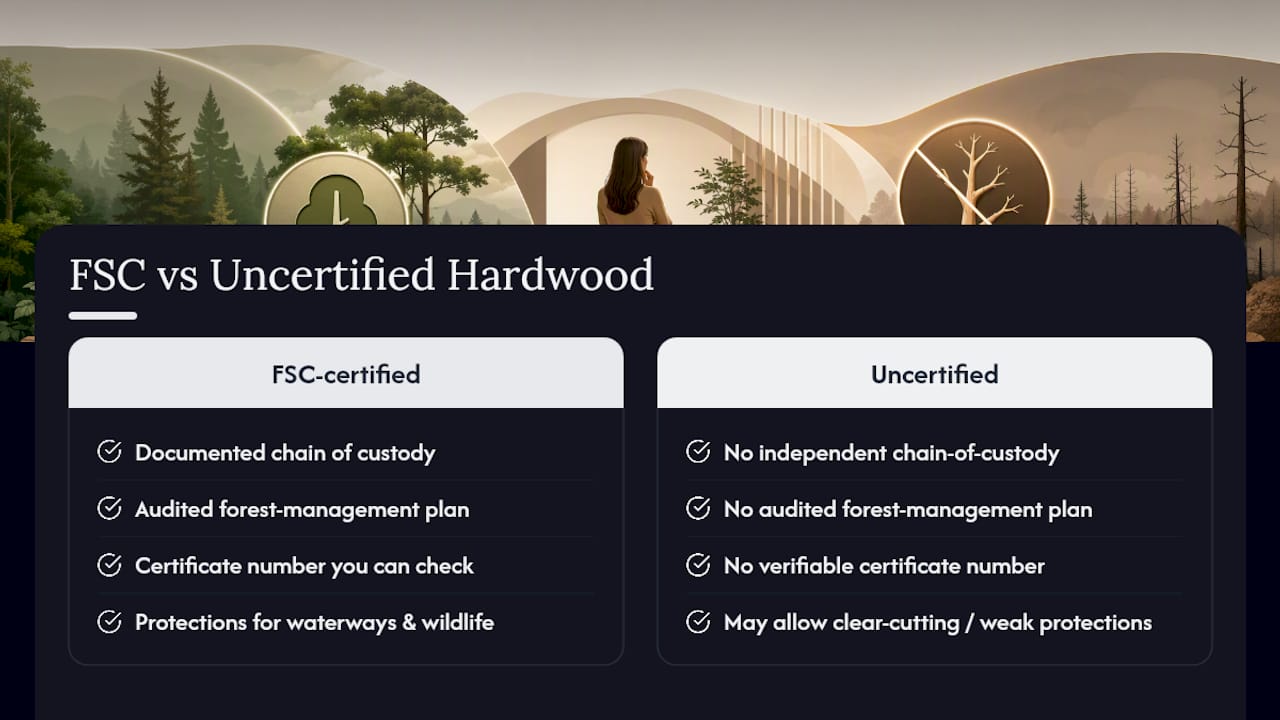
The gap between certified and uncertified hardwood isn’t in how the plank looks or performs on your floor. It’s upstream, in the forest and the paperwork.
Uncertified hardwood can come from anywhere, including regions with weak logging oversight, unclear land rights, or no restrictions on cutting old-growth stands. There’s no audit trail requiring the seller to prove otherwise. That doesn’t mean every uncertified board came from a clear-cut rainforest. Plenty of small domestic sawmills sell excellent, responsibly harvested wood without paying for FSC audits, which cost money and paperwork that smaller operations sometimes skip. But you have no independent way to verify their claims beyond taking their word for it.
FSC-certified wood carries a documented trail: an audited forest-management plan, a tracked chain of custody, and a certificate number you can check yourself. The environmental difference shows up in specifics: certified forests operate under restrictions on clear-cutting, protections for waterways and wildlife corridors, limits on harvesting near sensitive habitats, and standards that SCS Global Services audits against annually.
The honest comparison isn’t “certified is green, uncertified is destructive.” It’s “certified comes with proof, uncertified asks for trust.” For a buyer who wants documentation to back up a sustainability claim, on a spec sheet, in a LEED submission, or just for peace of mind, that proof is the entire value proposition. For a buyer who’s confident in a known local mill’s practices, the environmental outcome might be similar even without the certificate. The paperwork is what differs most, not necessarily the tree.
Myths About FSC Hardwood Flooring That Won’t Die
A few misconceptions keep circulating in flooring showrooms, and they’re worth correcting directly.
Myth: FSC certification means the flooring is higher quality. Certification verifies sourcing and chain of custody, not manufacturing standards, according to the FSC itself. A certified plank can still have a thin wear layer, an uneven finish, or poor milling. Quality and certification are two different questions.
Myth: All FSC labels mean the same thing. They don’t. FSC 100% means every fiber is certified. FSC Mix allows a blend of certified and “controlled” wood that meets minimum responsible-sourcing criteria but isn’t fully certified itself. Skipping past that distinction on a box label leads to buyers assuming more than the product actually delivers.
Myth: Uncertified wood is automatically bad for the environment. Plenty of small mills and regional suppliers harvest responsibly without pursuing FSC audits, which carry real costs that don’t always make sense for a small operation. Certification is strong proof of responsible sourcing. Its absence isn’t proof of the opposite.
Myth: FSC certification guarantees low VOC emissions or better indoor air quality. Certification covers where the timber came from, not what adhesive or finish gets applied to it later. A certified floor finished with a high-VOC coating still off-gasses like any other high-VOC floor.
Myth: Certification adds a huge cost premium. The premium is usually modest, more a reflection of paperwork and audit overhead passed through the supply chain than a dramatic markup on the wood itself.
Grade, species, and certification are three separate variables. Confusing them is the single most common mistake buyers make walking into a showroom.
Does FSC Certification Actually Raise Resale Value?
Certification alone rarely moves a home’s sale price the way a kitchen remodel does, but it plays a specific role for a specific kind of buyer.
Appraisers don’t have a standard line item for “FSC-certified flooring” the way they do for square footage or a finished basement. So the direct dollar impact on a typical resale is modest and hard to isolate from the flooring’s overall condition and style. Where certification does carry weight is with buyers actively searching for sustainably built or renovated homes, a growing segment in markets with strong green-building interest. For that buyer, documented certification is a differentiator that a generic “eco-friendly” listing description can’t match, because it’s verifiable.
Certification also matters more in specific transaction types than in a general home sale. Builders working toward LEED or other green-building certifications for a project need documented, verifiable sourcing, and FSC paperwork is often a required line item, not an optional nice-to-have. In that context, certification isn’t a resale bonus; it’s a project requirement that affects whether the building qualifies at all.
For most homeowners selling a typical single-family house, well-maintained hardwood, certified or not, tends to matter more to buyers and appraisers than the certification itself. Condition, species, finish, and how well the floor was cared for over its life carry more weight in a standard appraisal than a certificate number most buyers have never heard of. If resale is your main motivation for choosing certified material, expect the floor’s overall condition to matter more than the paperwork behind it.
Beyond FSC: Other Sustainability Certifications Worth Knowing
FSC isn’t the only credential in sustainable flooring, and knowing the alternatives helps you read a spec sheet without getting confused by overlapping logos.
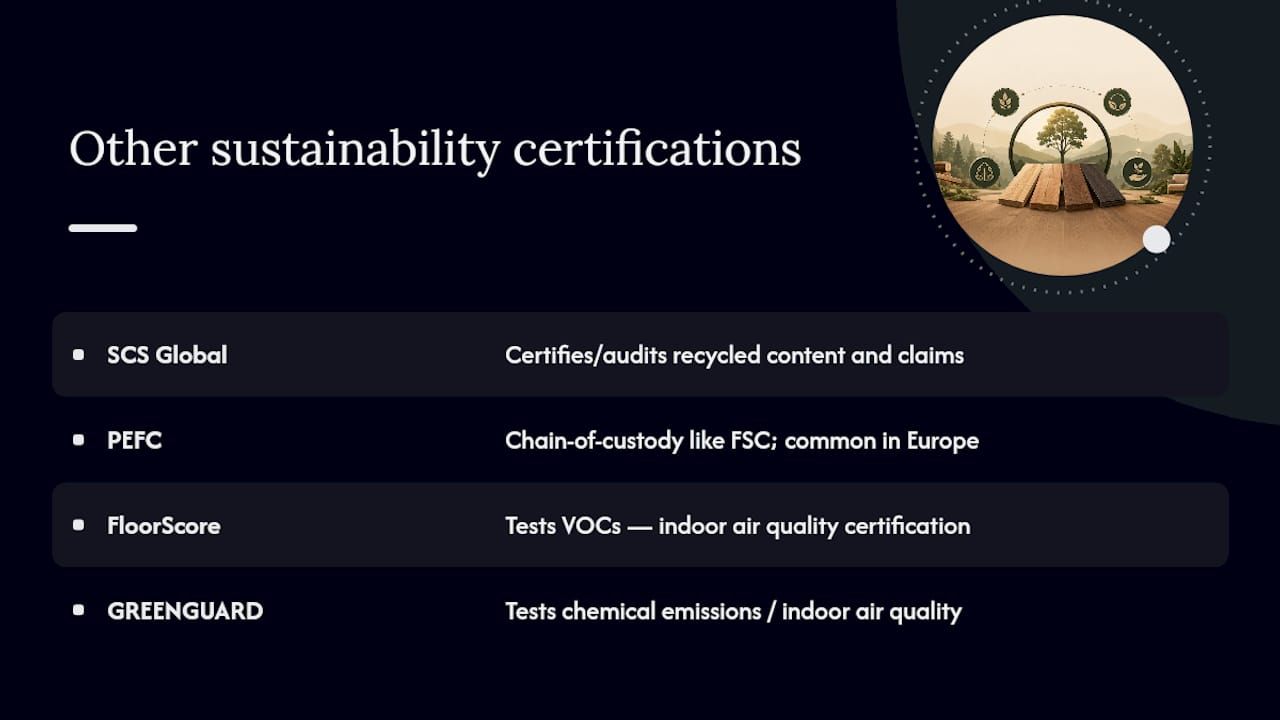
SCS Global Services operates as both a certifier and an auditor for various sustainability claims beyond FSC’s specific forestry standard, including recycled content verification and other environmental claims that flooring manufacturers sometimes reference alongside or instead of FSC, per SCS Global Services.
PEFC (Programme for the Endorsement of Forest Certification) is FSC’s main global counterpart, operating a similar chain-of-custody model but through a different network of national forestry standards. You’ll see it more often on European-sourced wood than on domestic American hardwood.
FloorScore certification focuses specifically on indoor air quality, testing flooring products for VOC emissions rather than sourcing. A floor can be FloorScore certified and FSC certified at the same time, since they measure completely different things.
GREENGUARD certification, similarly, targets chemical emissions and indoor air quality rather than forest sourcing.
None of these compete directly with FSC because most of them measure something FSC doesn’t touch, like emissions or finish chemistry, rather than forest management. The practical takeaway: if indoor air quality is your top priority, look for FloorScore or GREENGUARD on top of, not instead of, an FSC sourcing claim. Renewable materials like bamboo and cork round out the sustainable-flooring conversation and can carry their own certifications worth comparing against certified hardwood, a comparison worth reading in full if you’re weighing alternative sustainable flooring materials against hardwood altogether.
Why FSC Hardwood Can Be Harder to Find in Some Regions
Availability of certified stock varies more than most buyers expect, and it comes down to which species grow where and which mills bother pursuing certification.
Domestic species like oak and maple, common throughout the American Midwest and Appalachian region, tend to have decent certified availability because enough large-scale forestry operations in those regions have gone through the FSC audit process. Walnut and some specialty species can be tighter, since certified supply depends on which specific forests and mills in that supply chain hold current certificates, not just whether the species itself is commonly harvested.
Regional supply also shifts with demand. A distributor serving a market with strong green-building interest, more architects and builders specifically requesting certified material, tends to stock more of it consistently. A market with less demand may only carry certified options as special order, which extends lead time and sometimes limits your choice of species or grade within the certified category.
This is where working with an established regional distributor pays off. A supplier with existing relationships up the supply chain can source certified material even when it’s not sitting on the showroom floor, where a smaller retailer might simply tell you it’s unavailable. If you’re planning a project with a firm timeline, ask about certified lead times early. Special-order certified stock can take considerably longer than pulling from in-stock inventory, and that gap catches builders off guard more often than it should.
Certification, Indoor Air Quality, and What Doesn’t Overlap
FSC certification and indoor air quality are two different conversations that get conflated constantly, and it’s worth being precise about where they do and don’t connect.
FSC certification verifies the timber’s origin and chain of custody. It says nothing directly about the finish, adhesive, or underlayment applied during manufacturing or installation, which is where most indoor air quality concerns around hardwood flooring actually originate. A certified oak plank finished with a high-VOC polyurethane will emit the same way any other high-VOC finished floor does. The wood’s sourcing history doesn’t change its off-gassing profile.
That said, there’s an indirect connection worth knowing. Buyers who care enough about sustainability to seek out FSC certification often care about indoor air quality too, and reputable distributors selling certified hardwood tend to also carry low-VOC finish and adhesive options because that customer base asks for both. It’s a correlation in buying behavior, not a built-in guarantee.
If indoor air quality matters to your household, ask about finish VOC content separately from your certification question. Look for water-based finishes with documented low-VOC formulations, and ask whether the adhesive used for engineered plank installation meets a recognized low-emission standard. A partner resource on low-VOC flooring options covers this in more depth if air quality is a priority for a household with young children or anyone with respiratory sensitivities.
The bottom line: treat certification and air quality as two separate line items on your buying checklist, not one combined assumption. Ask about both, verify both, and don’t let a certified logo answer a question it was never designed to answer.
The Editorial Take: Where FSC Buyers Get It Wrong
Most people either treat an FSC label as a stamp of overall quality or dismiss it as marketing fluff. Both reactions miss what the certification actually does. It verifies a chain of custody, nothing more and nothing less, and that narrow scope is exactly why it’s trustworthy. A standard that tried to guarantee finish quality, VOC levels, and carbon footprint all at once would be too diluted to audit properly.
The real failure in how people shop for certified flooring isn’t skepticism. It’s the opposite: assuming the logo does more work than it’s designed to do, then getting surprised when a certified floor still has a mediocre finish or a thin wear layer. The conventional advice, “look for the FSC logo,” stops one step too early.
Verify the certificate number. Ask about wear layer separately. Ask about finish chemistry separately. Treat certification as one solid data point in a buying decision built on several data points, not as the whole decision. That’s the difference between a buyer who gets exactly what they paid for and one who’s disappointed six months later for reasons that had nothing to do with sourcing.
— Mike Solomich
Ready to Source Certified Hardwood? Here’s Where to Start
Some distributors give builders and homeowners something a lot of online-only retailers can’t: a real showroom where you can hold a sample, ask for a chain-of-custody number on the spot, and get a straight answer instead of a chatbot script. They stock unfinished and prefinished hardwood alongside FSC-certified options, and can provide certificate details on request so you’re not left guessing before a big purchase.
If you’re specifying material for a new build, our new construction hardwood flooring services page covers what to expect on supply timelines and volume pricing for contractors. Homeowners comparing options can also browse our full flooring brand lineup to see what’s currently in stock or available to order. Call ahead or stop by the showroom, bring your species and grade preferences, and we’ll pull certified samples and a quote while you’re standing on the floor deciding what looks right in your own light.
Sources
- SCS Global Services — FSC forest certification
- Forest Stewardship Council — FSC
- FSC certificate search
- NWFA — Maintenance guidance
- Green Building Alliance — Flooring materials
FAQ
Is FSC Wood Good Quality?
FSC certification confirms responsible sourcing and chain of custody, not manufacturing quality; wear-layer thickness, milling precision, and finish are separate factors worth checking independently.
What Are the Three Grades of Hardwood Flooring?
Common grades run select (most uniform color and grain), character or number grade (more natural variation and knots), and rustic or cabin grade (the most variation, often the most budget-friendly); grade is independent of FSC certification.
What Is FSC Certified Cedar Wood?
FSC certified cedar means the cedar timber came from a forest audited against FSC’s responsible-management standards and was tracked through a certified chain of custody, the same system used for oak, maple, and other certified species.
Is FSC Certification Legit?
Yes. FSC certification relies on independent third-party audits and a documented chain-of-custody system, and buyers can verify any certificate number directly through FSC’s own database rather than taking a seller’s word for it.