
Consistent hardwood sourcing is the single procurement decision that most directly protects build quality, schedule predictability, and sustainability claims on any U.S. residential or commercial project. When you specify verified species, documented chain-of-custody, and defined grading standards from a reliable supplier, you eliminate the cascade of problems that starts the moment a mismatched lot arrives on-site. The key standards that make this verifiable are FSC (Forest Stewardship Council) chain-of-custody certification, ASTM D7612 source categories, and the risk-based guidance from AHEC (American Hardwood Export Council). Quality Hardwoods of Michigan, Inc brings all three together for Michigan contractors and builders.
Key facts every builder should know before ordering:
- The majority of U.S. hardwood timberland is privately owned by non-industrial landowners, which means certification coverage varies widely by region and species.
- Grading is a subjective mill interpretation. Two mills grading the same species to the same nominal grade can produce boards with noticeably different character, color range, and defect frequency.
- Chain-of-custody documentation is the paper trail that connects a finished floor board back to a responsibly managed forest, and it is the only way to substantiate an ESG or LEED claim at project closeout.
Key Takeaways
Consistent hardwood sourcing protects build quality, schedule, and sustainability claims by requiring chain-of-custody documentation, defined grading standards, and verified supplier credentials on every order.
| Point | Details |
|---|---|
| Chain-of-custody on every invoice | Require FSC COC certificate codes on invoices to substantiate any sustainability or LEED claim. |
| ASTM D7612 in contract language | Specify an acceptable source category (Responsible or Certified) in POs to set a clear acceptance threshold. |
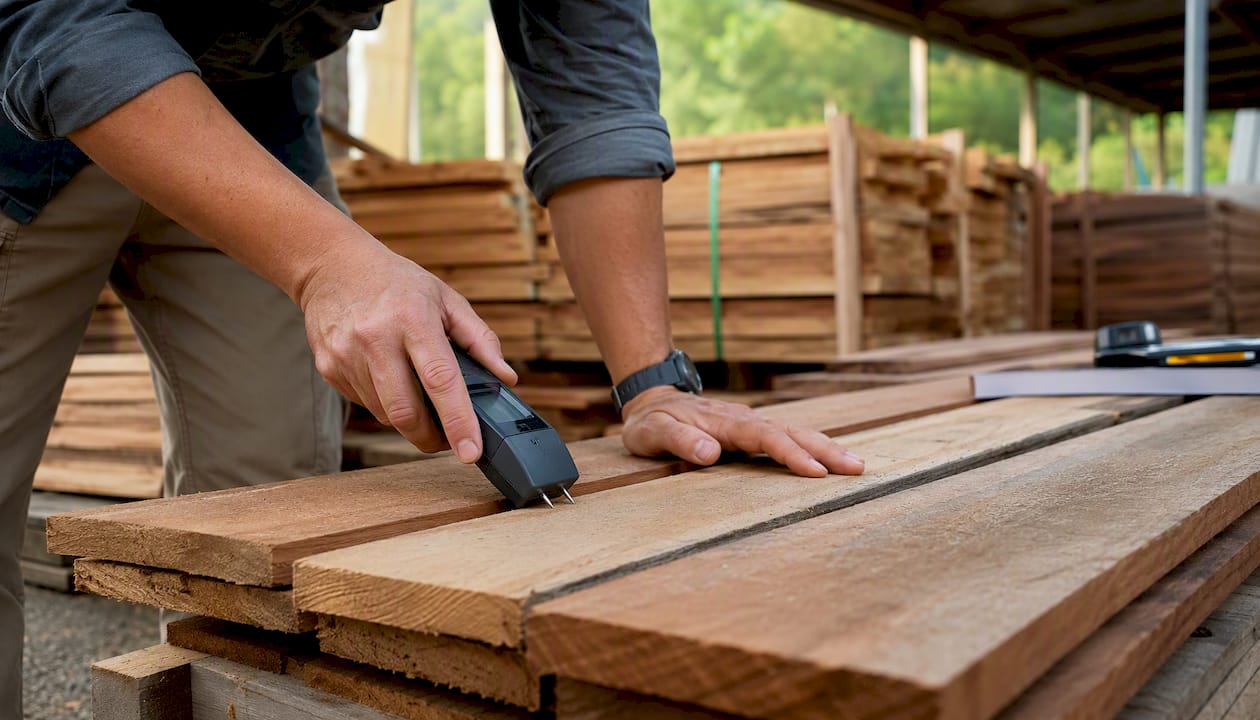
| Moisture content at delivery | Specify 6%–9% MC for Michigan interior installations and measure on arrival to prevent callbacks. |
| Risk-based checks where certification is sparse | Use AHEC’s framework combining geographic governance data and mill documentation when full FSC coverage is unavailable. |
| Quality Hardwoods of Michigan, Inc | Provides documented COC on certified lines, sample board programs, and inventory depth for Michigan contractor projects. |
Table of Contents
- Why consistent hardwood sourcing matters for project outcomes
- Which U.S. standards and certifications should you specify?
- How does inconsistent sourcing hurt your schedule and budget?
- Your procurement checklist for consistent hardwood supply
- How do you verify a supplier’s sourcing claims?
- How Quality Hardwoods of Michigan supports your sourcing process
- Does inconsistent sourcing damage sustainability goals beyond certifications?
- What legal compliance requirements apply to U.S. hardwood sourcing?
- The one sourcing change that pays off fastest
- Quality Hardwoods of Michigan, Inc: contractor pricing and certified inventory
- Sources
- FAQ
Why consistent hardwood sourcing matters for project outcomes
Predictable grading is the most immediate payoff. When every delivery comes from the same mill, graded to the same interpretation, you can plan cut lists, minimize waste, and match dye lots across rooms without a last-minute scramble. Inconsistent sourcing breaks that chain at the worst possible moment, usually mid-installation.
The project-level benefits stack up quickly:
- Grading and appearance: Consistent mill sourcing means color range, grain character, and defect frequency stay within the range your client approved on the sample board.
- Moisture content: Stock from a known local supplier arrives pre-acclimated to regional conditions, reducing warp, gapping, and callbacks after installation.
- Scheduling: Fewer reorders and substitutions mean your flooring sub stays on the critical path instead of waiting on a replacement shipment.
- Waste reduction: Predictable defect rates let you order closer to actual need. Surprise defects in a poorly graded lot can push waste well above what your estimate allowed.
- ESG and LEED documentation: A single documented source with COC codes on every invoice makes sustainability reporting straightforward at project closeout.
Pro Tip: Industry practitioners consistently report that switching to a single verified supplier for a species reduces on-site waste and reorder frequency. When estimating, budget waste factors based on your actual historical data from that supplier rather than generic species averages.
Reliable sourcing also reduces emergency procurement costs, a dynamic well-documented in manufacturing supply chains that applies directly to construction projects dependent on consistent hardwood supply.
Which U.S. standards and certifications should you specify?
Three frameworks do the real work in U.S. hardwood procurement.
FSC chain-of-custody is the most recognized standard globally. When a supplier holds FSC COC certification, every invoice can carry a certificate code that traces the material back through the supply chain. The FSC Wood Sourcing Policy Guide provides template procurement language you can adapt directly into purchase orders and supplier agreements. Specifying the FSC COC code on invoices is the minimum requirement for any project claiming certified wood content.
ASTM D7612 classifies wood product sources into three categories: Non-Controversial (legal, no significant controversy), Responsible (meets additional environmental and social criteria), and Certified (third-party certified, including FSC). Specifying an acceptable ASTM D7612 category in your contract language gives you a clear, defensible acceptance threshold that goes beyond a simple “certified or not” binary.
AHEC’s risk-based approach fills the gap where full certification is sparse. Because much U.S. hardwood comes from non-industrial private landowners, blanket FSC coverage is not always available. AHEC recommends combining geographic governance data, mill documentation, and third-party risk assessments to demonstrate responsible sourcing without requiring a certificate that may not exist for that forest type. An expert panel review of the Seneca Creek studies found negligible risk of illegal harvest in U.S. hardwood exports, which supports using risk-based checks as a credible complement to certification.
How does inconsistent sourcing hurt your schedule and budget?
The damage from poor sourcing rarely shows up as a single dramatic failure. It accumulates.
- A grading mismatch means boards that passed nominal inspection arrive with defect rates outside your cut-list assumptions.
- Unexpected moisture content causes cupping or gapping after installation, triggering callbacks that cost labor time you did not budget.
- Late substitutions, when your specified species or grade is unavailable from an unvetted supplier, force on-site decisions that compromise the design intent.
- Compliance gaps, specifically missing COC documentation, can disqualify a project from LEED credits after the work is already done.
The downstream effects on labor hours and client trust are harder to quantify but real. Consistent lumber quality directly reduces waste, improves scheduling, and supports long-term structural performance. For high-end or architecturally integrated features like custom staircases or wide-plank feature floors, where solid wood consistency affects both aesthetics and fit, the tolerance for sourcing variability is essentially zero.
Your procurement checklist for consistent hardwood supply
Build these steps into every purchase order and supplier agreement before the first board arrives.
- Specify the certification requirement. State the acceptable FSC COC code, ASTM D7612 source category, or equivalent in the PO.
- Require COC documentation on every invoice. No code, no acceptance.
- Define moisture content acceptance range. For interior hardwood flooring in Michigan, specify 6%–9% MC at delivery and require a moisture meter check at receiving.
- Require sample board approval before full delivery. Lock in color range, grain character, and finish response before committing to a full lot.
- Set lead-time minimums. Build supplier lead times into the project schedule so substitutions are never forced by a scheduling gap.
- Record lot numbers at delivery. This enables tracebacks if a grading issue surfaces after installation.
Sample PO language: “All hardwood supplied under this order shall carry FSC chain-of-custody documentation (certificate code on invoice) or meet ASTM D7612 Responsible source category. Moisture content at delivery shall be 6%–9%. Supplier shall provide sample board approval prior to full shipment. Substitutions require written approval.”
At delivery, a site foreman should:
- Inspect COC documents against the invoice certificate code.
- Measure MC on a sample of boards from each bundle.
- Compare delivered boards against the approved sample.
- Record lot numbers and flag any variance before installation begins.
Pro Tip: Structure your POs to include a “priority allocation” clause for your preferred species and grade. Suppliers with deep inventory will often hold stock for customers whose POs clearly specify requirements, reducing the chance of substitution during high-demand periods.
How do you verify a supplier’s sourcing claims?
Verification takes about 15 minutes per supplier and is worth every one of them.
- Search the supplier’s FSC certificate number on the FSC public certificate search to confirm it is current and covers the species you are ordering.
- Check that the certificate code appears on the invoice, not just in a marketing brochure.
- Ask for mill documentation: species, origin region, and harvest date. Red flags include vague origin descriptions (“mixed tropical hardwood”) or missing harvest documentation.
- Use a calibrated moisture meter at delivery. Do not rely on supplier claims alone.
- For species or regions where full certification is rare, apply the AHEC risk-based framework: request geographic governance data and mill-level sourcing records.
Supplier audit questions worth asking annually:
- Has your FSC COC certificate been audited in the past 12 months?
- Can you provide lot-level traceability back to the mill?
- What is your process when a specified species is out of stock?
Local distributors who maintain inventory depth and sample programs reduce rework and substitution risk during construction phases, because the verification steps above are already embedded in their procurement process.
How Quality Hardwoods of Michigan supports your sourcing process
Working with a Michigan-based distributor with over 40 years of regional experience changes the practical reality of sourcing verification. Quality Hardwoods of Michigan, Inc maintains documented chain-of-custody on certified product lines, offers sample board programs for contractor approval before full orders, and carries inventory depth across common species and grades so substitutions are rarely necessary.

For Midwest projects specifically, local acclimation matters. Stock that has been stored in a Michigan warehouse is already conditioned to regional humidity ranges, which reduces the MC variance that causes callbacks on interior installations.
For new-construction hardwood supply and contractor bulk ordering, Quality Hardwoods of Michigan, Inc provides the documentation, sample programs, and inventory reliability that make the procurement checklist above straightforward to execute. The bulk purchasing benefits for contractors extend beyond price: consistent lot allocation across a multi-phase project is one of the most underappreciated advantages of a long-term supplier relationship.
Does inconsistent sourcing damage sustainability goals beyond certifications?
Yes, and the damage is harder to document than a grading mismatch. When sourcing is inconsistent, you lose visibility into forest-level impacts: biodiversity, regeneration rates, and watershed health.
Forests managed under verified programs maintain habitat corridors and species diversity that unmanaged or poorly documented harvests do not. Buying from unverified sources, even when the wood is technically legal, can contribute to fragmentation of old-growth adjacent stands or harvest of species with slow regeneration cycles. Neither shows up on a certificate of origin.
A risk-based sourcing approach, as AHEC recommends, asks suppliers to document not just legality but forest management practices: regeneration commitments, harvest intensity relative to growth rates, and protection of high-conservation-value areas. These questions go beyond what any single certification label answers. For builders pursuing sustainable flooring options, understanding the difference between certified, responsibly sourced, and merely legal wood is the foundation of a credible sustainability claim.
What legal compliance requirements apply to U.S. hardwood sourcing?
The primary U.S. law governing hardwood legality is the Lacey Act, which prohibits the import, export, transport, sale, or purchase of plants (including wood products) taken in violation of any U.S. or foreign law. For domestic hardwood, this means suppliers must be able to document species, harvest origin, and compliance with applicable state and federal timber regulations.
Key compliance points for U.S. builders:
- Lacey Act declarations are required for imported wood products. For domestic hardwood, the Act still applies if the wood was harvested in violation of state law.
- State timber harvest regulations vary. Michigan, for example, has its own forest practices rules governing harvest on private land.
- LEED and WELL building standards require documented chain-of-custody for wood credits. Missing documentation at project closeout disqualifies the credit retroactively.
- Green building codes in some jurisdictions are beginning to reference FSC or equivalent certification as a compliance pathway for wood sourcing.
This is general information, not legal advice. Confirm current Lacey Act requirements and applicable state regulations with a qualified attorney or the U.S. Fish and Wildlife Service before finalizing procurement policy.
The one sourcing change that pays off fastest
Most contractors updating procurement practices try to overhaul everything at once and end up changing nothing. The highest-leverage single change is adding a COC requirement to your next purchase order. One line of PO language, specifying that the supplier must provide an FSC certificate code or ASTM D7612 Responsible source documentation on the invoice, immediately filters out the suppliers who cannot meet it and signals to those who can that you are a serious buyer worth prioritizing.
Roll it into an existing PO template so it requires no new workflow. Test it on one species across one project. The difference in documentation quality and grading consistency will be apparent by the time the first delivery arrives.
Pro Tip: When introducing COC requirements to a long-standing supplier relationship, frame it as a project requirement rather than a vendor evaluation. Most established distributors already have the documentation; they just haven’t been asked to include it on invoices.
Quality Hardwoods of Michigan, Inc: contractor pricing and certified inventory
Forty-plus years of Michigan hardwood distribution means Quality Hardwoods of Michigan, Inc already has the documentation, inventory depth, and sample programs your next project needs. Request contractor pricing, check stock on your specified species and grade, or schedule a showroom visit to run sample board approvals before your delivery date.
For new-construction projects and bulk contractor orders, the hardwood flooring for new construction page is the fastest path to a quote. Browse the full flooring product catalog to confirm available species, grades, and certified options before your next PO goes out. Call or visit the showroom to get your sample approval process started today.
Sources
- Wood sourcing policy guide | FSC Connect
- Demonstrating the sustainability of U.S. hardwood products (AHEC report)
FAQ
What is FSC chain-of-custody and why does it matter for builders?
FSC chain-of-custody (COC) certification traces wood from a certified forest through every step of processing and distribution to the final product. Requiring a COC certificate code on invoices is the only way to substantiate a certified wood claim on a LEED or ESG project.
What does ASTM D7612 mean in a purchase order?
ASTM D7612 classifies wood sources as Non-Controversial, Responsible, or Certified. Specifying an acceptable category in your PO sets a clear, defensible acceptance threshold beyond a simple “certified or not” requirement.
How do I verify a supplier’s FSC certification before ordering?
Search the supplier’s FSC certificate number on the FSC public certificate database to confirm it is current and covers the species you are ordering, then check that the same code appears on the invoice at delivery.
Why does local hardwood sourcing reduce callbacks on Michigan projects?
What is the Lacey Act and how does it affect hardwood procurement?
The Lacey Act prohibits the sale or transport of wood products harvested in violation of U.S. or foreign law. For U.S. builders, it means suppliers must be able to document species, harvest origin, and compliance with applicable state and federal timber regulations.