

For most homes, AC3 covers everyday living space just fine, and AC4 is the smart upgrade for kitchens, hallways, and busy family rooms. Reserve AC5 for homes with heavy pet traffic, rental turnover, or a home business generating near-commercial foot traffic. One caveat before you shop: AC rating measures wear resistance only, not water resistance, so don’t assume a higher number means a safer bet in a bathroom or laundry room.
TL;DR:
- AC4 laminate flooring generally offers enough durability for kitchens, hallways, and homes with pets, providing a good balance between cost and wear resistance.
- The difference between AC4 and AC5 lies in abrasion resistance, with AC5 surviving about 60% more rotations, suitable only for spaces with commercial-like traffic or heavy use.
- AC ratings measure wear resistance only and do not indicate water resistance, so waterproof features are separate and critical for moisture-prone areas.
- Matching the laminate’s AC rating to each room’s traffic is essential for longevity, with AC3 enough for bedrooms and AC4 recommended for high-traffic or animal-heavy areas.
- Many homeowners overspend on higher AC ratings or neglect core and warranty details, which are crucial for actual durability and performance.
Table of Contents
- What AC Rating Laminate Flooring Actually Measures
- Matching AC Ratings to Every Room in Your House
- AC4 vs AC5: When the Upgrade Actually Pays Off
- What AC Rating Won’t Tell You
- Your Shopping Checklist for AC-Rated Laminate
- Why the Right AC Rating Is Rarely the Highest One
- Get Laminate Samples Matched to Your Rooms
- Sources
- FAQ
What AC Rating Laminate Flooring Actually Measures
AC stands for Abrasion Class, a wear rating created by the European Producers of Laminate Flooring and standardized under EN 13329, the European testing protocol laminate manufacturers use worldwide. The number tells you how the wear layer performed under lab conditions, not how the floor will feel underfoot or how it handles a spilled glass of water.
The core test is the Taber abrasion test. A machine spins an abrasive wheel against the laminate’s surface layer, counting rotations until the pattern beneath starts to show through. More rotations survived means a tougher wear layer, and that number is what separates AC1 from AC6.
EN 13329 doesn’t stop at abrasion. The full test panel also checks:
- Impact resistance — how the surface handles a dropped pan or a dining chair leg
- Stain resistance — whether common household substances leave a permanent mark
- Burn resistance — how the surface reacts to a dropped cigarette or hot ash
- Surface wear — the Taber rotation count that produces the AC number itself
What it never tests: water intrusion at the seams, plank thickness, or core composition. Two boards can carry the identical AC4 rating and still behave completely differently in a flood.
Matching AC Ratings to Every Room in Your House
Room-by-room shopping beats guessing a single rating for the whole house, especially if your traffic patterns vary the way most homes do.
- Bedrooms and guest rooms: AC2 or AC3 is plenty. Foot traffic is light, shoes usually stay at the door, and the wear layer rarely gets tested.
- Living rooms and dining rooms: AC3 is the baseline here too, though a home with kids who treat the living room like a playground benefits from stepping up to AC4.
- Kitchens, entryways, and mudrooms: AC4 earns its premium in these zones. Grit tracked in from outside acts like sandpaper on a floor, and AC4’s thicker wear layer handles it better over time.
- Homes with multiple dogs or cats: Claws and constant pacing wear a floor faster than typical foot traffic, which pushes AC4 from “nice to have” into “worth the extra cost.”
- Rental properties: Tenant turnover means unpredictable care habits. AC4 minimum, with AC5 justified if the property sees frequent, hard use between leases.
- Home offices with client visits or a home-based business: Foot traffic starts resembling light commercial use, which is exactly the scenario AC5 was built for.
If matching the same plank across every room matters to your design, buying one rating for the entire house simplifies things. But mixing AC ratings by zone while keeping the same color and finish across product lines is common practice and saves real money. A family with two dogs and a busy kitchen might run AC4 through the main floor and drop to AC3 in bedrooms, since most manufacturers offer matching finishes across their AC tiers.
AC4 vs AC5: When the Upgrade Actually Pays Off
The technical gap between AC4 and AC5 comes down to rotations survived in the Taber test. AC4 typically holds up to roughly 4,000 rotations before wear shows through, while AC5 pushes past 6,500, a jump of roughly 60% more abrasion resistance.
The number that matters: AC5 laminate withstands about 60% more abrasion cycles than AC4 before the wear layer fails, according to the rotation thresholds manufacturers test against.
That extra durability comes at a price, and for most households it’s not a price worth paying. AC5 makes sense when:
- The space sees light commercial traffic (a small storefront, a busy home office)
- Multiple large dogs live in the house full time
- The property turns over between renters frequently and durability protects your margin
- You’re flooring a shared hallway in a multi-unit building
For a typical single-family home without those pressures, AC4 already outperforms what daily life throws at it. Spending more to reach AC5 rarely buys a proportional benefit unless your traffic pattern genuinely resembles commercial use.
What AC Rating Won’t Tell You
AC rating and water resistance are two completely separate specs, and confusing them is the most expensive mistake a laminate shopper makes. A waterproof AC3 board can outperform a non-waterproof AC4 board in any room where moisture is a real risk, like a mudroom or a laundry closet.
Beyond water resistance, check these specs separately from the AC number:
- Core type: HDF cores resist moisture better than standard MDF cores, even at the same AC rating.
- Locking system: A tighter click lock reduces gapping over time regardless of wear rating.
- Underlayment: Some products include it, some require it purchased separately, and skipping it voids some warranties.
- Warranty length: Warranty terms typically scale with AC rating, with AC4 often carrying longer residential coverage than AC3.
Pro Tip: Read the warranty’s exclusions section before the coverage-length headline. Some warranties that promise 25 years exclude wear from pet claws or commercial use entirely, which matters more than the number on the front page.
If moisture is a genuine concern in your space, it’s worth comparing laminate against luxury vinyl alternatives that handle standing water differently than any laminate core can.
Your Shopping Checklist for AC-Rated Laminate
Walk into a showroom or start a quote conversation armed with specific questions, and you’ll avoid the two most common regrets: buying too little durability for a busy kitchen, or overpaying for AC5 in a guest bedroom.
- Ask for the EN 13329 test documentation, not just the AC number printed on the box. Reputable distributors can produce it.
- Get the water-resistance classification in writing, separate from the AC rating, especially for kitchens and entries.
- Request the full warranty text, not the marketing summary, and check for pet, commercial-use, or subfloor exclusions.
- Order sample boards for the actual rooms you’re flooring, viewed in that room’s light, not just under showroom lighting.
- Compare the price premium between adjacent AC classes on the same product line. The jump from AC3 to AC4 is usually modest, while AC4 to AC5 costs more.
- Confirm what’s included in the quote: underlayment, installation labor, and trim pieces are sometimes quoted separately.
- Ask about replacement policy for wear-through claims specifically, since general warranty coverage and wear-through coverage aren’t always the same clause.
Why the Right AC Rating Is Rarely the Highest One
Homeowners tend to treat AC rating like a horsepower number, assuming higher always wins. It doesn’t. AC5 laminate in a guest bedroom is money spent on durability nobody will ever test, while AC3 in a kitchen with two kids and a dog is a floor you’ll be replacing years sooner than you expected.
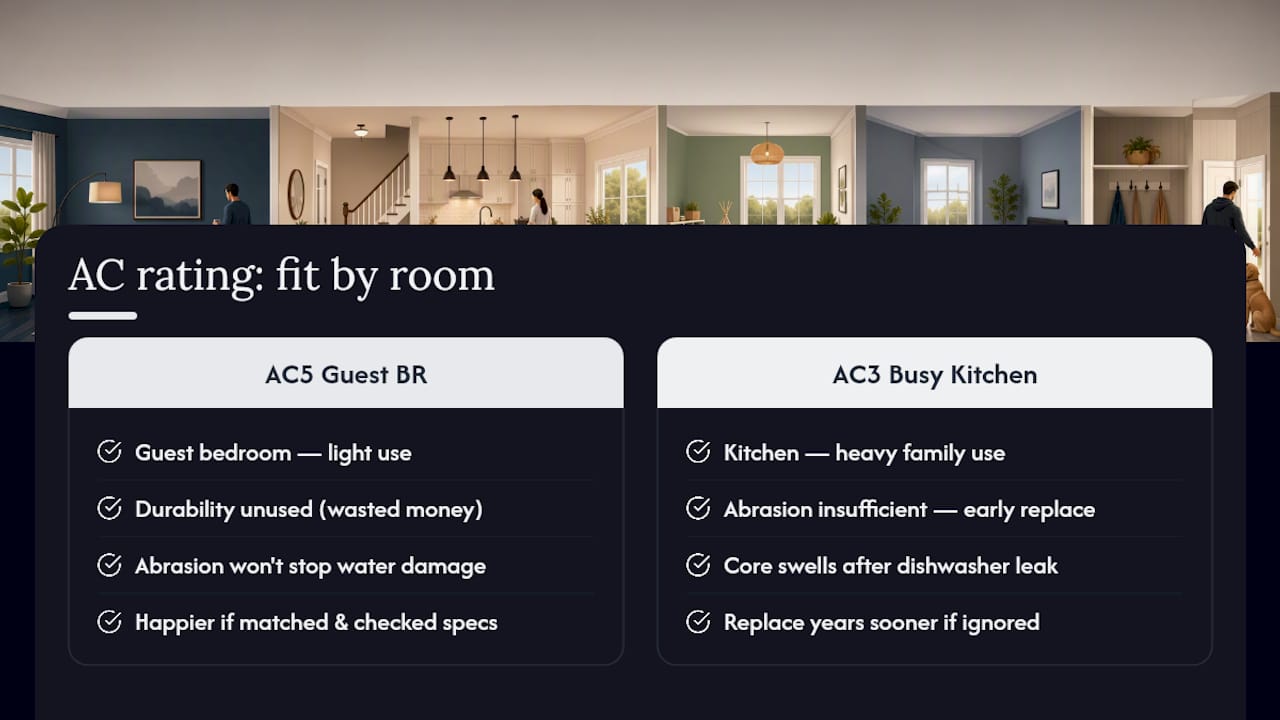
The bigger mistake I see isn’t picking the wrong AC number. It’s picking the right AC number and ignoring everything else on the spec sheet. A homeowner who spends an extra dollar per square foot moving from AC3 to AC4 but skips checking the core material or warranty exclusions has solved the wrong problem. Abrasion resistance means nothing if the core swells the first time the dishwasher leaks overnight.
After four decades supplying flooring materials across Michigan, the pattern holds: the homeowners happiest with their floors five years later are the ones who matched the rating to the room, checked the water resistance separately, and read the warranty before buying, not after a claim got denied. That’s a five-minute conversation in a showroom, and it saves years of regret.
— Mike Solomich
Get Laminate Samples Matched to Your Rooms
Some flooring distributors offer personalized consultations about which AC rating fits which room in your house, backed by side-by-side samples instead of a single display board. You can walk our laminate flooring selection in person, compare AC4 against AC5 boards under real light, and leave with a quote that accounts for underlayment and warranty terms upfront instead of as a surprise later.

If your project spans multiple zones, ask about mixing AC ratings across your laminate flooring selection to control cost without sacrificing durability where it counts. Bring your room dimensions and traffic patterns (pets, kids, home office use) to a showroom visit or phone quote, and the staff can walk you through water-resistance classifications alongside AC rating so you’re comparing the full spec sheet, not just one number. Request a quote or schedule a showroom visit to see samples matched to your specific rooms.
Sources
- What is a laminate floor AC rating? — Floor & Decor help center
- AC4 Vs AC5 laminate flooring — Flooring Contractors San Diego
- AC rating flooring: pros, cons, and buying guide — D and G Flooring
FAQ
Which Is Better, AC4 or AC5?
Neither is universally better. Most single-family homes get better value from AC4.
What Is AC3 or AC4 of Laminate Floor?
AC3 is the residential standard suited to bedrooms, living rooms, and dining rooms with normal foot traffic. AC4 is the upgrade tier recommended for kitchens, hallways, and mudrooms where grit and heavier use wear a floor faster.
What Does AC5 Mean for Laminate?
AC5 indicates the laminate survived roughly 6,500 or more rotations in the Taber abrasion test, the threshold associated with light commercial and heavy residential use. It’s rarely necessary in an ordinary home unless traffic patterns approach commercial levels.
Is AC4 Laminate Good?
Yes, AC4 is a strong choice for busy households, kitchens, and homes with pets or kids, offering meaningfully more wear resistance than AC3 for a modest price premium. It’s the most common upgrade recommendation for main living areas.
Does a Higher AC Rating Mean a Waterproof Floor?
No. AC rating measures abrasion, impact, stain, and burn resistance only. A waterproof AC3 product can outperform a non-waterproof AC4 product in any room where moisture is a concern, so check water-resistance claims separately.