

Flooring category management is the practice of treating a related group of flooring products as a mini-business, with its own assortment targets, lifecycle plan, and maintenance protocols, rather than buying products one at a time and hoping for the best. Done right, it preserves manufacturer warranties, simplifies maintenance across multiple surface types, and cuts lifetime cost on every project. Organizations like NielsenIQ, the ECR Community, and Michigan-based distributors such as Quality Hardwoods of Michigan, Inc have all documented the same core finding: category management produces better outcomes than single-product buying because it aligns assortment, vendor relationships, and maintenance into one coherent strategy.
Table of Contents
- What does flooring category management actually cover?
- Why category management matters for contractors, builders, retailers, and homeowners
- How do you implement flooring category management step by step?
- What operational practices protect warranties and simplify daily work?
- What KPIs should you track, and how often?
- What mistakes do most flooring programs make?
- Who owns what, and what should you ask your supplier?
- What does a typical timeline and budget look like?
- How does this work on a real Michigan project?
- Key Takeaways
- Why the “just buy good floors” mindset costs you more
- Quality Hardwoods of Michigan, Inc: your category partner in Michigan
- Useful sources
- FAQ
What does flooring category management actually cover?
The phrase borrows from retail strategy. A category-as-mini-business means you set targets, assign a budget, and measure results for a product group, not just individual SKUs. For flooring, that group might be all resilient surfaces in a multifamily building, or all hardwood products in a retail showroom.
Key terms worth knowing:
- Assortment: The specific products and SKUs you stock or specify for a project or store.
- Lifecycle cost: Total cost from purchase through installation, maintenance, refinishing, and eventual replacement.
- Sell-through: The percentage of stocked inventory sold or installed within a given period.
- Category scorecard: A one-page dashboard tracking margin, turnover, warranty claims, and maintenance spend by product group.
- Preventive vs. restorative maintenance: Preventive work stops damage before it starts; restorative work reverses wear that has already occurred.
- Category captain/partner: A distributor or vendor who leads category strategy on behalf of the buyer, often providing data and protocol guidance.
Scope includes procurement, specification, maintenance planning, warranty alignment, and ongoing reporting. It does not cover installation labor management or general construction scheduling.
Why category management matters for contractors, builders, retailers, and homeowners
The clearest benefit is fewer premature replacements. Proactive maintenance and refinishing extend usable life and reduce downtime compared with waiting until a floor fails and replacing it entirely. That matters whether you are a contractor protecting your reputation, a retailer managing inventory turns, or a homeowner budgeting for a 20-year horizon.
For a contractor bidding a Michigan multifamily project, category management means specifying compatible products upfront so one cleaning protocol covers all surfaces, cutting crew training time and chemical inventory. For a retailer, it means stocking a curated assortment where every product in a category shares compatible maintenance requirements, which reduces customer callbacks. For a homeowner, it means knowing that the LVP in your basement and the hardwood in your living room each have a documented maintenance schedule tied to their warranty terms.
Michigan’s climate adds a layer most national guides skip. Moisture-sensitive solid hardwood should not go in basements or high-humidity zones. Dimensionally stable SPC-core LVP is the better call for those spaces, and that decision belongs in the category plan before a single board is ordered.
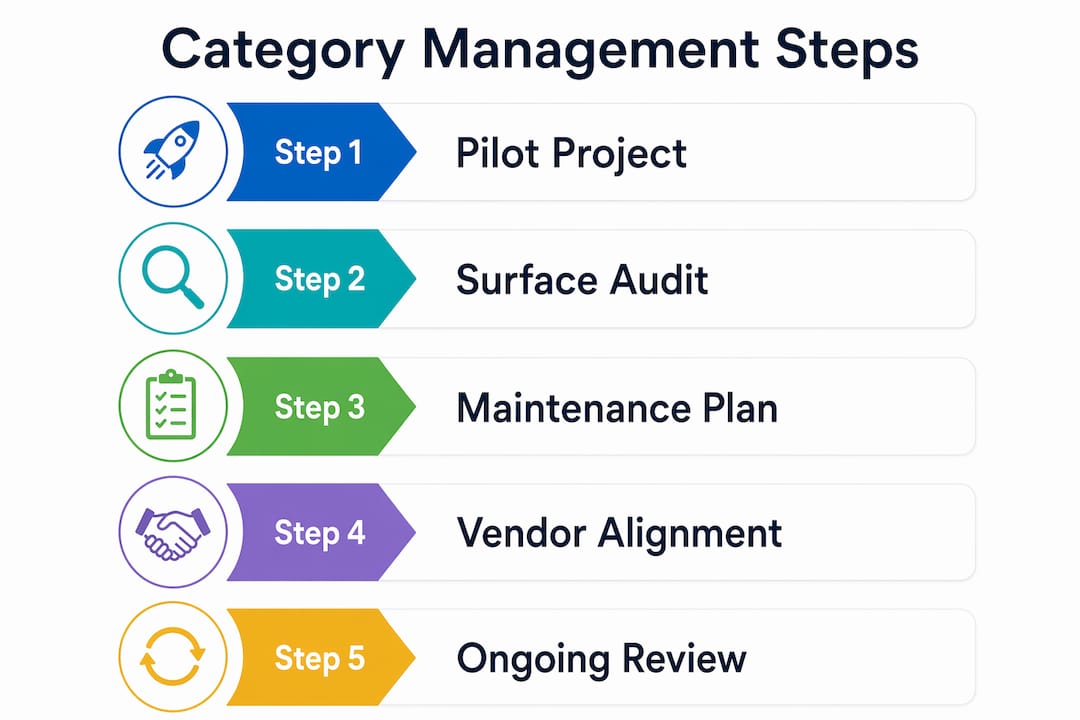
How do you implement flooring category management step by step?
The eight-step framework used across retail and distributor partnerships translates cleanly to flooring projects.
- Assess (weeks 1–2): Audit existing surfaces, pull sales or maintenance data, and document current warranty status. Budget: staff time plus any third-party audit fee.
- Define category role (week 2): Decide whether the category is a traffic driver, profit generator, or convenience offering. This shapes assortment depth.
- Set scorecard targets (week 3): Agree on KPIs: inventory turnover, margin per category, maintenance cost per square foot, warranty claim frequency.
- Design assortment and specs (weeks 3–4): Select products with compatible maintenance protocols. Mismatched chemistries void warranties.
- Align vendors and partners (week 4): Confirm distributor support, delivery lead times, and maintenance product availability.
- Implement SOW and maintenance protocols (days 1–30 of pilot): Roll out cleaning schedules, train crews, and document everything.
- Measure and iterate (days 30–90): Review scorecard monthly. Flag exceptions weekly.
- Repeat: Quarterly strategy reviews close the loop.
90-day pilot checklist: Pick one high-impact category (LVP in multifamily corridors is a strong starting point). Run steps 1–6 in the first 30 days. Measure one KPI for 60 days. Present findings to ownership or the general contractor at day 90 and decide on broader rollout.
What operational practices protect warranties and simplify daily work?
Pre-installation surface audits
Before any flooring goes down, audit the subfloor: check moisture levels, flatness tolerance, and existing finish compatibility. Skipping this step is the single most common cause of warranty denial. The audit should be documented in writing, signed by the installer, and filed with the product warranty paperwork.

Pro Tip: Ask your distributor for the manufacturer’s published moisture limits before the audit. If the subfloor reads above that threshold, you have written justification to delay installation rather than risk a voided warranty.
Maintenance frequency by material
| Material | Daily | Weekly | Periodic (quarterly or as needed) |
|---|---|---|---|
| Hardwood (prefinished) | Dry dust mop | Damp mop with approved cleaner | Screen and recoat; full refinish at regular multi-year intervals |
| LVP / LVT / SPC | Sweep or vacuum | Damp mop, pH-neutral cleaner | Inspect wear layer; replace damaged planks |
| Carpet | Vacuum high-traffic zones | Spot treat stains | Hot-water extraction periodically every year or more |
| Ceramic / porcelain tile | Sweep | Damp mop | Grout resealing on a periodic annual schedule |
| Sealed concrete | Sweep | Damp mop | Reseal as needed; polish annually |
Avoiding multi-surface silos
Operational silos across floor types are the largest avoidable cost driver in facilities with mixed surfaces. The fix is a unified cleaning protocol that covers all surfaces in a building with one set of approved products and one trained crew. A distributor partner who recommends cohesive product lines can cut equipment variety and training time significantly.
What KPIs should you track, and how often?
- Inventory turnover by subcategory: Monthly. Low turns signal overstocking or poor assortment fit.
- Sell-through rate: Monthly for retailers; per-project for contractors.
- Gross margin per category: Monthly scorecard.
- Maintenance cost per square foot: Monthly. Rising cost is an early warning for restorative work.
- Warranty claim frequency: Quarterly. More than one claim per category per quarter warrants a protocol review.
- Days to repair or replacement: Track per incident. Longer cycles indicate supply chain or labor gaps.
Reporting cadence: weekly for operational exceptions, monthly for scorecards, quarterly for strategy reviews. Centralized reporting across sites or projects keeps standards consistent and surfaces problems before they become expensive.
What mistakes do most flooring programs make?
- The polish-and-replace trap: Applying finish coats over a deteriorating surface delays the inevitable and often voids the warranty. Schedule restorative work based on surface condition, not a fixed calendar.
- Procurement without maintenance alignment: Failing to match products to manufacturer maintenance protocols frequently voids warranties. Specify compatible finishes, adhesives, and cleaning chemistries at the buying stage.
- Fragmented vendor contracts: Multiple vendors with no coordination means no one owns the category. Consolidate where possible.
- Ignoring traffic zone data: Treating a lobby the same as a back office wastes budget. Zone by traffic intensity and schedule accordingly.
- No written SOW: Verbal maintenance agreements leave warranty protection unenforceable.
Who owns what, and what should you ask your supplier?
Role map:
- Owner/client: Approves category strategy, signs off on lifecycle budget.
- General contractor: Coordinates installation sequencing and subfloor prep sign-off.
- Flooring contractor/installer: Executes pre-install audit, documents conditions, installs per spec.
- Distributor (category partner): Recommends compatible product lines, supplies maintenance guidance, supports warranty claims.
- Maintenance team: Executes daily and periodic protocols per the SOW.
- Facility manager: Tracks KPIs, escalates warranty issues, schedules restorative work.
Supplier questions to ask before you buy:
- What are the exact warranty terms, and which maintenance products are approved?
- Does this product share cleaning chemistry with the other surfaces in this project?
- What is your response SLA for warranty claims?
- Can you provide a written maintenance protocol I can include in the SOW?
- What is the recommended refinishing or restoration interval for this product?
What does a typical timeline and budget look like?
- Initial assessment (weeks 1–4): Site audit, data collection, category role definition. Primary cost is staff or consultant time.
- Pilot phase (days 1–90): One category, one location. Budget for any inventory adjustments, crew training, and a reporting tool (even a shared spreadsheet works at this scale).
- Rollout (months 4–12): Expand to additional categories and locations. Add formal reporting cadence and vendor scorecards.
Refinishing instead of replacing a resilient floor typically costs less and causes less downtime than full replacement. That math should appear explicitly in your lifecycle budget from day one.
How does this work on a real Michigan project?
Picture a Michigan contractor managing a 40-unit multifamily renovation in the Detroit metro area. The project specifies LVP for corridors and living areas and prefinished hardwood for owner units. Without category management, the maintenance crew ends up with three different cleaning products, two mop systems, and no written protocol. Warranty claims start appearing at month six.
With category management, the contractor works with Quality Hardwoods of Michigan, Inc as the distributor partner. Quality Hardwoods of Michigan, Inc recommends SPC-core LVP for the high-humidity corridor zones and a compatible prefinished hardwood line for the units, both maintained with the same pH-neutral cleaner. The installer documents the pre-install moisture readings. The maintenance SOW is written before move-in. At month six, zero warranty claims.
Quality Hardwoods of Michigan, Inc has served Michigan contractors, builders, and retailers for over 40 years. Their showroom and Michigan flooring distributor services include product selection guidance, maintenance protocol recommendations, and coordination support for projects of any scale.
Key Takeaways
Flooring category management works because it aligns assortment, maintenance, and vendor relationships into one accountable system that extends floor life and protects warranties.
| Point | Details |
|---|---|
| Define the category as a mini-business | Set assortment targets, lifecycle budgets, and a scorecard before buying any product. |
| Pre-install audits protect warranties | Document subfloor moisture and condition in writing before installation begins. |
| Match maintenance to materials | Mismatched cleaning chemistries void warranties; specify compatible products at procurement. |
| Track at least one KPI in 30 days | Maintenance cost per square foot or warranty claim frequency gives early program health signals. |
| Quality Hardwoods of Michigan, Inc | Serves as a distributor category partner for Michigan projects, with 40+ years of product and protocol guidance. |
Why the “just buy good floors” mindset costs you more
Most flooring failures I see on Michigan projects share one root cause: the buying decision and the maintenance plan were made by different people who never talked to each other. A contractor picks a beautiful prefinished hardwood, the property manager hires a cleaning crew that uses the wrong product, and the warranty is void before the first winter is over. The floor was not the problem. The process was.
Category management fixes that by forcing the conversation to happen at the start, not after the damage is done. The distributor who can tell you which products share a maintenance protocol is worth more than the one who just offers the lowest price per square foot. That is the practical case for treating your flooring category as a mini-business, and it holds whether you are managing one home or forty units.
Quality Hardwoods of Michigan, Inc: your category partner in Michigan
Decades of Michigan flooring experience mean Quality Hardwoods of Michigan, Inc has seen what works and what causes expensive callbacks. For contractors and builders, that translates into product recommendations where the hardwood, LVP, and laminate lines you specify actually share compatible maintenance protocols, so your crews are not juggling three different cleaning systems on one job.
The practical next step: bring your site plans, traffic estimates, and a rough spec list to the Quality Hardwoods of Michigan, Inc showroom. The team will help you build a category plan around products they stock, including vinyl flooring options suited to Michigan’s humidity demands. No obligation, no pressure. Just a conversation that saves you warranty headaches later. Call or visit to schedule your consultation.
Useful sources
- NielsenIQ: Category Management Steps and Benefits — Best for understanding the eight-step framework and scorecard structure. Use this for procurement and strategy planning.
- ECR Community: Essential Guide to Day-to-Day Category Management — Detailed lifecycle process guide; best for retailers building a repeatable category review cycle.
- Retail Town: Category Management in Retail Buying — Practical assortment and role-setting guidance for showroom and retail buyers.
- NJC Management: Strategic National Floor Care Programs — Best for lifecycle maintenance tiers, restorative scheduling, and centralized reporting standards.
- Cleaning and Maintenance Management: Rethink Resilient Flooring Lifecycle — Covers restoration-vs-replacement economics; use for lifecycle cost planning.
- Maintenance Sales News: Managing Multiple Flooring Types — Best for multi-surface silo problems and distributor partnership value.
- Diverzify: Flooring Maintenance Program — Warranty alignment and maintenance protocol matching; use for procurement checklists.
- Quality Hardwoods of Michigan, Inc: Flooring Articles and Expert Guides — Regional resource hub for product selection, maintenance, and Michigan-specific guidance.
FAQ
What is flooring category management in simple terms?
It is the practice of managing a group of related flooring products as a single business unit, with shared assortment, maintenance, and lifecycle targets, rather than buying products individually without a coordinated plan.
How does category management protect flooring warranties?
Specifying products with compatible maintenance protocols at the procurement stage prevents the cleaning chemistry mismatches that most commonly void manufacturer warranties.
What is a good first step for a Michigan contractor?
Run a pre-installation surface audit on one project, document the subfloor moisture readings, and confirm the maintenance protocol with your distributor before installation begins.
How often should you review a flooring category scorecard?
Review operational exceptions weekly, run a full scorecard monthly, and conduct a strategy review quarterly to catch problems before they require expensive corrective work.
Can Quality Hardwoods of Michigan, Inc help with category planning?
Yes. Quality Hardwoods of Michigan, Inc functions as a distributor category partner, offering product selection guidance, maintenance protocol recommendations, and support for Michigan contractors, builders, retailers, and homeowners.