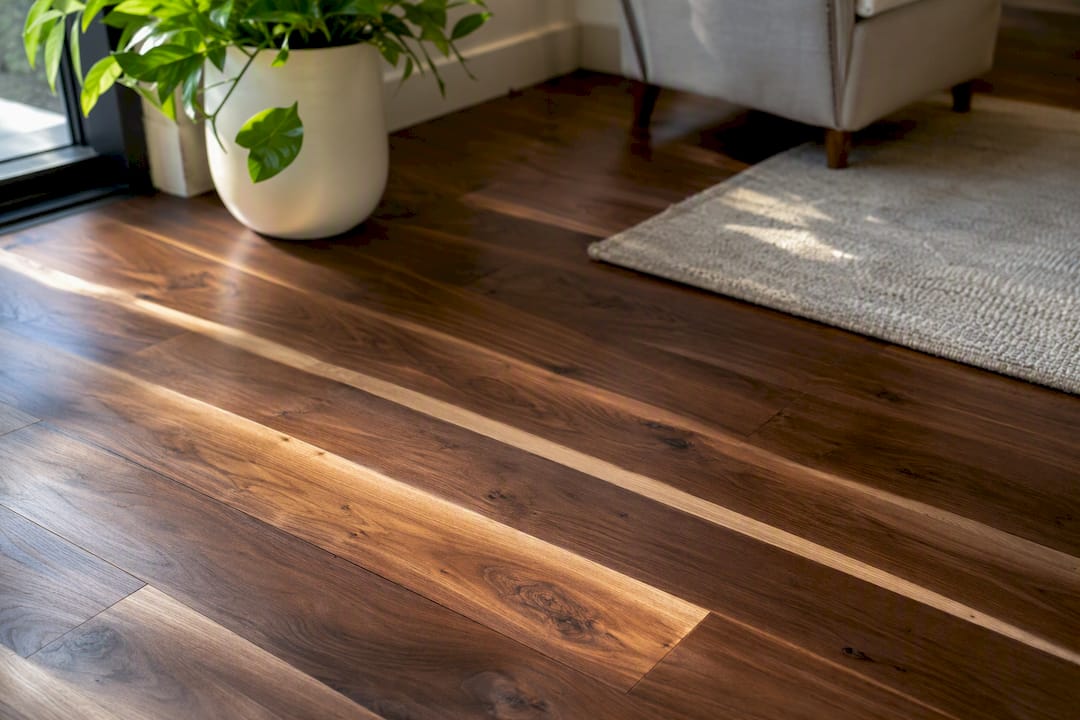
Walnut flooring delivers a rich, chocolate-brown look that no other domestic species quite matches, but it comes softer and pricier than oak or maple. Choose it when the room’s job is to look intentional and high-end rather than survive daily abuse from kids, dogs, or work boots.

Weigh these factors before you commit:

  • Foot traffic: low to moderate traffic rooms suit walnut; mudrooms and busy hallways don’t.
  • Household: large dogs and young kids mean more dents than walnut hides well.
  • Budget: solid walnut sits at the premium end of hardwood pricing.
  • Light exposure: south-facing rooms accelerate walnut’s natural color shift.

The rest of this guide breaks down walnut’s specific advantages, its real drawbacks, how it stacks up against oak and maple, and what to ask your supplier before you order a single plank.

Key Takeaways

Walnut flooring rewards design-focused, moderate-traffic rooms with unmatched natural color depth, but its softer Janka rating and higher cost make it a poor fit for heavy-wear or wet spaces.

Point Details
Hardness trade-off Janka ≈1,010 means walnut dents easier than oak (≈1,290) or maple (≈1,450).
Cost expectation Solid walnut material runs roughly $6 to $14 per square foot before installation labor.
Light sensitivity Walnut lightens with UV exposure, so rotate rugs and consider UV-inhibiting finishes.
Best-fit rooms Bedrooms, dining rooms, and home offices outperform mudrooms and kitchens for walnut.
Where to source it Quality Hardwoods of Michigan stocks solid and engineered walnut, with samples and installer referrals available through its Michigan showroom.

Table of Contents

Walnut Flooring Pros and Cons Start With Its Species Profile

American black walnut is the species behind nearly every walnut floor sold in the U.S., and its personality comes from three traits: color, hardness, and how it ages. The heartwood runs a deep, warm chocolate brown with subtle, straight grain patterns and occasional wavy figure. Sapwood, by contrast, is pale cream, which is why grade selection matters so much (more on that later).

Hardness is where the trade-offs start. American black walnut rates roughly 1,010 on the Janka hardness scale, noticeably softer than red oak or maple, which both come in higher on the same scale.

That number matters in practice, not just on a spec sheet:

  • Walnut dents more easily under a dropped cast-iron pan or a rolling chair without a mat.
  • It still resists everyday wear well enough for bedrooms, dining rooms, and offices.
  • Its tighter grain takes wide-plank formats beautifully, with minimal cupping when properly acclimated.

One quirk surprises a lot of first-time buyers: walnut lightens with UV exposure over time instead of darkening like cherry does, which means a rug left in place for a year or two can leave a visible “tan line” once you move it.

The Real Advantages of Walnut Hardwood Flooring

Walnut earns its premium price tag through a handful of genuine, tangible benefits, not just brand cachet.

  1. A deep color that needs no help. Walnut’s natural heartwood tone eliminates the need for heavy staining to achieve a dark, designer look. Where you might layer three coats of ebony stain onto white oak to get a similar effect, walnut arrives close to that color already, which keeps the grain looking natural instead of painted on.

  2. A long refinishing runway. Solid walnut planks can typically go through several professional sand-and-refinish cycles over their lifespan, generally in the range of five to eight, depending on the plank’s initial thickness and how aggressively each sanding removes material. That means a well-installed walnut floor can outlast two or three kitchen remodels around it.

  3. Flexible finish response. Walnut takes both oil-based and water-based polyurethane well. Water-based poly keeps the color closer to walnut’s natural tone, while oil-based finishes deepen the warmth and add amber over time. Hardwax oil finishes are also popular here because they play well with walnut’s natural low sheen, especially in rooms going for a matte, Scandinavian-leaning look.

  4. Dimensional stability for wide planks. Walnut moves predictably with seasonal humidity swings, which is part of why it’s a common choice for 6 inch and 7 inch wide-plank installations that would show gaps and cupping in less stable species.

  5. Resale pull in the right market. In design-forward listings, a walnut floor in the primary bedroom or a formal dining room reads as a deliberate upgrade, the kind buyers notice on a walkthrough even if they can’t name the species.

Pro Tip: If you love walnut’s tone but worry about upkeep, ask about solid wood interior doors worth it hardwax oil finishes for high-visibility rooms. They’re easier to spot-repair than polyurethane because you can recoat a small area without sanding the whole floor.

The Drawbacks Nobody Skips in a Walnut Flooring Review

The disadvantages of walnut flooring come down to softness, cost, and light sensitivity, and none of them are deal breakers on their own, but stacked together they rule out certain rooms entirely.

Diagram of walnut flooring main drawbacks comparison

Dents and scratches show up faster. At a Janka rating around 1,010, walnut simply doesn’t shrug off impacts the way scratch-resistant hardwood species do. Felt pads under furniture legs, area rugs in high-contact zones, and keeping dogs’ nails trimmed all matter more with walnut than with a harder floor.

Close-up of dents and scratches on walnut floor

It costs more, plainly. Solid walnut material typically runs $6 to $14 per square foot, with engineered versions often landing a bit lower depending on veneer thickness. Add installation labor on top of material, and a walnut project can run well above a comparable red oak job, so budget the difference in before you fall for a sample board.

Sun exposure changes the color permanently. As covered above, walnut lightens with UV exposure rather than holding its tone. Rotate rugs and runners every few months in sunny rooms, and consider a finish with UV inhibitors, which slow the shift without stopping it entirely.

Sunlight faded versus original walnut floor color

Wet rooms are off the table. Solid walnut doesn’t belong in bathrooms, laundry rooms, or mudrooms. Engineered walnut over concrete or radiant heat improves stability, but even engineered formats have limits in consistently damp environments.

Maintenance has a rhythm. Regular dust mopping, a hardwood-safe cleaner, and prompt spill cleanup keep walnut looking sharp. Because scratches show against its smooth, tight grain more than they would on a textured species, plan on touch-up coats sooner than you might with oak, and budget for that when you’re calculating long-term cost.

Species comparisons come down to a simple trade: how much toughness are you willing to give up for looks?

  • Walnut (Janka ≈1,010): Softest of the common four, but unmatched natural color depth.
  • Red oak (Janka ≈1,290): The workhorse choice, hides wear well, and takes stain evenly.
  • Maple (Janka ≈1,450): Very hard and pale, better suited to bright, minimal spaces than dark, moody ones.
  • Hickory (Janka ≈1,820): The toughest of the four, ideal for high-traffic commercial or family spaces, though its busy grain pattern isn’t for everyone.

Oak and hickory both hide scuffs and dents better simply because their grain is busier and their surface is harder. Maple suits light, airy rooms where you want brightness, not depth. Engineered walnut splits the difference: same face-grain look, better dimensional performance over concrete or radiant heat. The decision rule is straightforward: if the look matters more than raw toughness, walnut wins; if the floor needs to survive teenagers and large dogs without babying, oak or hickory are the safer bet.

When Is Walnut Flooring Worth It?

Walnut earns its keep in specific rooms and for specific households, not everywhere.

  1. Primary bedrooms, formal dining rooms, and home offices are walnut’s best fit, since they see moderate foot traffic and reward a warm, high-end look.
  2. Design-focused homeowners with a flexible renovation budget get the most value, especially when the floor is a visual anchor for the whole room.
  3. Concrete subfloors and radiant heat systems call for engineered walnut rather than solid, since it handles moisture-driven movement better.
  4. Mudrooms, kitchens, and homes with large dogs or heavy uncovered hallway traffic are where walnut consistently disappoints. Save it for the rooms where showing off matters more than shrugging off abuse.

Buying and Installation Tips From the Trade

Getting a walnut floor right starts before installation day, at the ordering counter.

  • Specify grade. Select or clear grades minimize sapwood and knots; character grade costs less but shows more natural variation.
  • Choose your cut. Rift and quarter-sawn planks resist movement better; plain-sawn yields more usable wood and shows walnut’s figure more dramatically.
  • Match finish to sun exposure. UV-inhibiting finishes slow color shift in bright rooms; water-based poly keeps tone truer than oil.
  • Ask about subfloor prep and moisture testing. NWFA installation standards cover acclimation time and recommended wear-layer thickness for engineered planks.
  • Confirm three numbers up front: material cost per square foot, installation labor per square foot, and a refinishing allowance for year ten.

Pro Tip: Ask your supplier for a sample board acclimated in your actual room for a few days before you commit. Walnut’s tone can shift noticeably under different light temperatures, and a five-minute look at a showroom sample rarely tells the full story.

Why This Guide Comes From a Flooring Supplier, Not a Blogger

This guide is written by Mike Solomich, drawing on decades of hands-on flooring distribution experience across residential and commercial projects. Quality Hardwoods of Michigan has spent more than 40 years stocking unfinished and prefinished hardwoods, luxury vinyl plank, laminate, stains, and finishes for contractors and homeowners across Michigan.

That inventory depth means walnut buyers get more than a spec sheet. Staff can pull sample boards for side-by-side comparison, explain when engineered vs solid construction actually matters for a specific subfloor, and refer buyers to installers who’ve handled walnut’s particular quirks before.

Walnut rewards buyers who plan ahead: right grade, right cut, right finish for the room’s light exposure. Get those three decisions right at the counter, and the floor takes care of itself for decades.

Visit the Michigan showroom to see walnut samples under real light before ordering.

What the Walnut Debate Usually Gets Wrong

Most walnut flooring content treats “is walnut flooring worth it” as a yes-or-no question, and that’s the wrong frame. The real question is which room, which household, which light exposure. Walnut isn’t a downgrade from oak; it’s a different tool built for a different job.

The advice that annoys me most is the blanket warning to avoid walnut if you have kids or pets. That’s lazy. A family with a calm senior dog and a home office gets years of trouble-free use from walnut in that office, even while their mudroom rightly gets something tougher. The smarter approach is room-by-room material selection, not a single hardwood choice for the whole house.

What buyers should prioritize first isn’t the Janka number. It’s grade and cut. A select-grade, quarter-sawn walnut floor with the right finish will outperform a plain-sawn character-grade floor installed carelessly, regardless of species. Get those decisions right before you even think about maintenance routines.

— Mike Solomich

Get Walnut Flooring Samples and a Quote in Michigan

Skip the guesswork of ordering walnut flooring sight unseen online. Quality Hardwoods of Michigan, Inc stocks solid and engineered walnut in person, so you can compare grain, grade, and finish samples under your own project’s lighting before you commit a dollar to material.

Quality Hardwoods of Michigan, Inc

That in-person comparison matters more with walnut than almost any other species, since its color and figure vary noticeably between select and character grades. Beyond walnut itself, the showroom carries alternatives worth comparing side by side, including luxury vinyl plank for water-heavy rooms and laminate options for tighter budgets. If your project involves new construction, the team also supports installation planning for builders and contractors working on tighter timelines. Stop by the showroom or request a quote online to get a sample board matched to your room’s light and traffic before you order.

Sources

FAQ

What Are the Disadvantages of Walnut Flooring?

Walnut’s main drawbacks are its softer Janka rating (around 1,010), which makes it prone to dents and scratches, along with higher material costs and a tendency to lighten unevenly under UV exposure. It’s also not recommended for wet rooms like bathrooms without an engineered format.

What Is the Healthiest Flooring to Put in Your House?

Solid hardwood species like walnut, oak, and maple are generally considered low-allergen flooring options since they don’t trap dust, pet dander, or allergens the way carpet does. Choosing a low-VOC finish, such as a water-based polyurethane or hardwax oil, further reduces indoor air quality concerns during and after installation.

Warm, natural mid-to-dark tones like walnut’s chocolate brown are gaining ground over the stark gray floors that dominated the past decade, as homeowners shift toward richer, more organic palettes. Walnut fits this trend directly since it delivers that deep tone without heavy staining.

Is Walnut or Oak Flooring Better?

Neither is universally “better.” Oak is harder, cheaper, and more forgiving in high-traffic or family-heavy homes, while walnut offers a richer natural color and a more upscale look for moderate-traffic, design-focused rooms. The right choice depends on the specific room’s traffic level and your priorities between durability and appearance.