
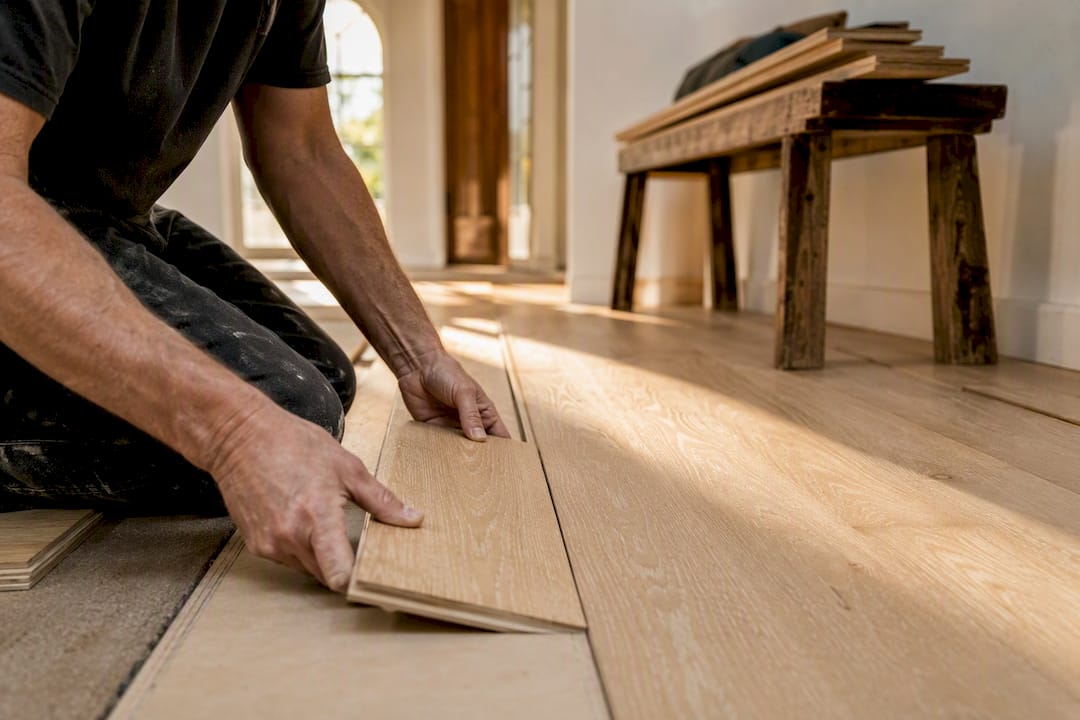
Quarter sawn white oak is the cut that resists cupping and warping best, prized for its straight vertical grain and the shimmering medullary ray fleck that shows up in wider boards. Choose it for wide-plank flooring, tabletops, or anywhere seasonal humidity swings would ruin a plain-sawn board. Expect to pay 50% to 100% more than plain-sawn stock for that stability and figure.
TL;DR:
- Quarter sawn white oak offers significantly higher stability than plain-sawn due to its perpendicular growth rings, making it ideal for wide surfaces and radiant heat floors.
- The cut exposes dramatic ray fleck patterns in wider boards, while narrower options resemble rift sawn with straighter grain and less figure.
- Expect to pay 50% to 100% more for quarter sawn white oak, with costs rising for wider boards and higher grades, and lead times increasing for custom specifications.
- The quality of quarter sawn oak depends on precise milling, with potential issues like inconsistent ray fleck and mineral streaking requiring careful inspection and clear labeling.
- Using stainless steel fasteners prevents iron tannin stains in white oak, and testing finishes on sample boards ensures the ray fleck remains prominent.
Table of Contents
- What Quarter Sawn White Oak Looks Like: Grain, Rays, and Color
- Why Quarter Sawn Oak Moves Less Than Plain-Sawn Boards
- Quarter Sawn vs Rift Sawn vs Plain Sawn: What Actually Differs
- Sizes, Grades, and What Quarter Sawn White Oak Costs
- Where Quarter Sawn White Oak Actually Earns Its Premium
- How to Specify Quarter Sawn White Oak When You Order
- Finishing and Caring for Quarter Sawn White Oak
- Where to See and Source Quarter Sawn White Oak in Michigan
- The History Behind Quarter Sawn White Oak’s Reputation
- Common Defects and Grading Issues to Watch For in Quarter Sawn Stock
- Sourcing Quarter Sawn White Oak Sustainably
- Cutting and Joining Quarter Sawn White Oak in the Shop
- Quarter Sawn White Oak Compared to Other Species
- An Editorial Take on Buying Quarter Sawn White Oak
- Get Quarter Sawn White Oak From a Michigan Supplier Who Stocks It
- Sources
- FAQ
What Quarter Sawn White Oak Looks Like: Grain, Rays, and Color
Cut a log radially and you get boards with tight, parallel grain lines running straight down the face, none of the cathedral arches you see in plain-sawn oak. The real signature, though, is the medullary ray fleck: those silvery, almost iridescent flecks scattered across the surface come from ray cells that run perpendicular to the growth rings, and quarter sawing exposes them at their most dramatic angle.
Color runs the usual white oak range, from pale cream to light tan, with occasional darker mineral streaks that some buyers love and others reject outright. How much fleck you actually see depends heavily on board width and how the mill breaks down the log.
- Wider boards show more pronounced, larger ray fleck patterns
- Narrower boards often read closer to rift sawn, with straighter, quieter grain and less obvious fleck
- Milling angle and how close to true quarter the board was cut both shift the intensity of the figure
If you’re chasing that classic Arts and Crafts look, ask for wider stock. If you want a calmer, more linear appearance, narrower quarter sawn or rift sawn boards deliver that without sacrificing much stability.
Why Quarter Sawn Oak Moves Less Than Plain-Sawn Boards
The growth rings in a quarter sawn board run roughly perpendicular to the face, not parallel to it. Wood shrinks and swells far more across the rings than along them, so orienting the rings vertically dramatically cuts the width-wise movement that causes plain-sawn boards to cup, crown, or gap with the seasons.
By the numbers: Quarter sawn and rift sawn cuts are recognized in the hardwood industry as meaningfully more dimensionally stable than plain-sawn lumber, precisely because of this ring orientation.
That stability advantage matters most where wood spans a wide, unbroken surface: a 36-inch tabletop, a wide-plank floor over radiant heat, or a panel in a frame-and-panel door. On a narrow trim board, the difference barely registers.
One thing to keep straight: stability isn’t the same as hardness. Quarter sawing doesn’t change white oak’s Janka rating (around 1,360 pounds-force for white oak generally), so a quarter sawn floor won’t dent or scratch differently than a plain-sawn one from the same tree. What changes is how flat and true the board stays over time, not how tough its surface is underfoot.
Quarter Sawn vs Rift Sawn vs Plain Sawn: What Actually Differs
Every mill talks about these three cuts differently, so here’s the short version. Plain sawn is the cheapest and most common, cut straight through the log with minimal waste, giving you the familiar cathedral grain pattern but the most seasonal movement. Quarter sawn and rift sawn both come from cutting the log into quarters first, then slicing each quarter at specific angles, which wastes more wood and drives up cost.
- Plain sawn: cathedral grain, lowest cost, least stable, highest mill yield
- Quarter sawn: vertical grain plus ray fleck, high stability, moderate to high cost, lower yield
- Rift sawn: straightest, quietest grain with minimal fleck, similar stability to quarter sawn, lowest yield and typically the highest price per board foot
Because true quarter sawn cutting produces a mix of angles, mills often sell “rift and quartered” blends rather than sorting every board individually. That’s efficient for the mill, but it means the label alone doesn’t guarantee what you’re getting. One board in a rift-and-quartered bundle might show heavy ray fleck while its neighbor looks almost plain. Marketplace labeling on this point is notoriously loose, so always ask for end-grain photos or a percent breakdown before you commit to a large order.
Sizes, Grades, and What Quarter Sawn White Oak Costs
Plank width is the single biggest lever on both appearance and price. Standard quarter sawn flooring runs 3 to 5 inches wide; anything wider than that gets progressively rarer because fewer logs yield boards that size at a true quarter angle.
- Width: narrower boards (2 to 3 inches) show subtler figure and cost less; wide boards (5 inches and up) show dramatic ray fleck and command a premium
- Grade: select grades minimize knots and color variation for a cleaner look; character or rustic grades keep mineral streaks and small knots at a lower price point
- Format: solid quarter sawn oak works over wood subfloors and traditional nail-down installs, while engineered quarter sawn oak layers a quarter sawn wear layer over a stable plywood core, which holds up better over concrete slabs or radiant heat
Rift and quartered flooring generally carries a real markup over plain sawn, so budget accordingly if the look and stability matter to your project. Our quarter sawn white oak flooring options span both solid and engineered constructions if you want to compare actual product specs.
Where Quarter Sawn White Oak Actually Earns Its Premium
Quarter sawn oak isn’t the right call for every project. It shines where movement control or visible figure justify the extra cost.
- Wide-plank flooring: less cupping across wider boards than plain sawn can manage
- Radiant heat floors: engineered quarter sawn formats tolerate the temperature swings better
- Tabletops and wide panels: woodworkers routinely specify quarter sawn here because cupping across a 30 inch glued-up top is unacceptable
- Craftsman and Mission furniture: the ray fleck is practically the signature of the style
- Face-frame cabinet doors: linear grain reads clean and formal
If you actually want busy cathedral grain, quarter sawn is the wrong pick. Plain sawn oak still makes sense for budget-driven trim, subfloor-adjacent applications, or anyone who prefers that traditional grain movement.
How to Specify Quarter Sawn White Oak When You Order
Getting what you actually want from a supplier comes down to precise language and a few pointed questions, not just saying “quarter sawn” and hoping for the best.
- Specify “true quarter sawn” or state a target ring angle, and ask the mill for an end-grain photo before the order ships.
- Confirm what percentage of the run is true quarter versus rift, since most “rift and quartered” bundles are a blend.
- Ask about kiln-dry status and moisture content, S4S (surfaced four sides) versus S2S, and the grade being shipped.
- Decide solid versus engineered based on your subfloor and whether radiant heat is involved.
- Request a sample board matched to your target width before committing to a full order.
Wider, true quarter sawn boards are rarer at the mill, and lead times stretch when a supplier has to custom-sort a run to your specs.
Finishing and Caring for Quarter Sawn White Oak
The ray fleck responds best to finishes that don’t muddy it. Clear or lightly tinted oil finishes and matte polyurethanes let the fleck show through, while heavy, dark stains can flatten the contrast that makes quarter sawn oak worth the premium in the first place. Test any stain on an offcut before committing to the whole floor.
One caution that trips up a lot of first-time installers: white oak’s natural tannins react with iron.
Fastener fact: Using standard steel nails or staples on white oak can cause permanent dark stains where the metal meets the wood, a reaction between the tannins and iron. Stainless steel fasteners avoid it entirely.
- Let flooring acclimate to the room’s humidity for several days before installation
- Use stainless fasteners for any exposed or near-surface fastening
- Sweep or vacuum regularly and avoid standing water, which is true of any white oak floor regardless of the cut
- Recoat the finish every few years rather than waiting for heavy wear to force a full refinish
Where to See and Source Quarter Sawn White Oak in Michigan
Quality Hardwoods of Michigan, Inc has spent more than 40 years distributing hardwood flooring to contractors, builders, and homeowners across the state, and quarter sawn and rift-and-quartered white oak are part of the specialty inventory we regularly stock and source for custom orders. That kind of longevity in the flooring trade means we’ve handled the sourcing questions in this guide hundreds of times over, from confirming ring angle with a mill to matching sample boards to a client’s existing trim.
If you want to see the ray fleck and vertical grain in person before ordering, options like St. Andrews White Oak give you a prefinished white oak reference point, and a showroom visit lets you compare width and grade side by side rather than guessing from a photo online.
The History Behind Quarter Sawn White Oak’s Reputation
Quarter sawing isn’t a modern marketing invention. Sawyers were cutting logs this way well before power equipment existed, originally because quarter sawn boards resisted the warping that ruined wagon wheel spokes, ship timbers, and other pieces that had to hold their shape under stress. The extra labor of hand-splitting a log into quarters before sawing was worth it when failure meant a broken axle or a leaking hull.
The style most people associate with quarter sawn white oak today, though, comes from the Arts and Crafts and Mission furniture movements of the late 1800s and early 1900s. Furniture makers like Gustav Stickley built entire design philosophies around exposing the medullary ray fleck rather than hiding it, using quarter sawn white oak as a showcase feature rather than a structural afterthought. That aesthetic choice stuck. A century later, the same fleck pattern that once signified honest, well-built furniture still reads as a mark of quality craftsmanship.
Steam-powered sawmills in the late 1800s made quarter sawing commercially viable at scale for the first time, since cutting a log into quarters and resawing each piece takes more passes and produces more waste than a straight-through plain sawn cut. Mills had to charge more to cover that lost yield, and that price gap between quarter sawn and plain sawn lumber has persisted ever since, for the same underlying reason: you get fewer usable boards per log no matter how efficient your equipment gets.
Flooring didn’t really catch up to furniture’s appreciation for the cut until much later, once wide-plank floors and radiant heat systems created real demand for a board that would stay flat under thermal stress.

Common Defects and Grading Issues to Watch For in Quarter Sawn Stock
Quarter sawn white oak isn’t immune to defects, and a few problems show up more often in this cut specifically because of how the boards are milled.
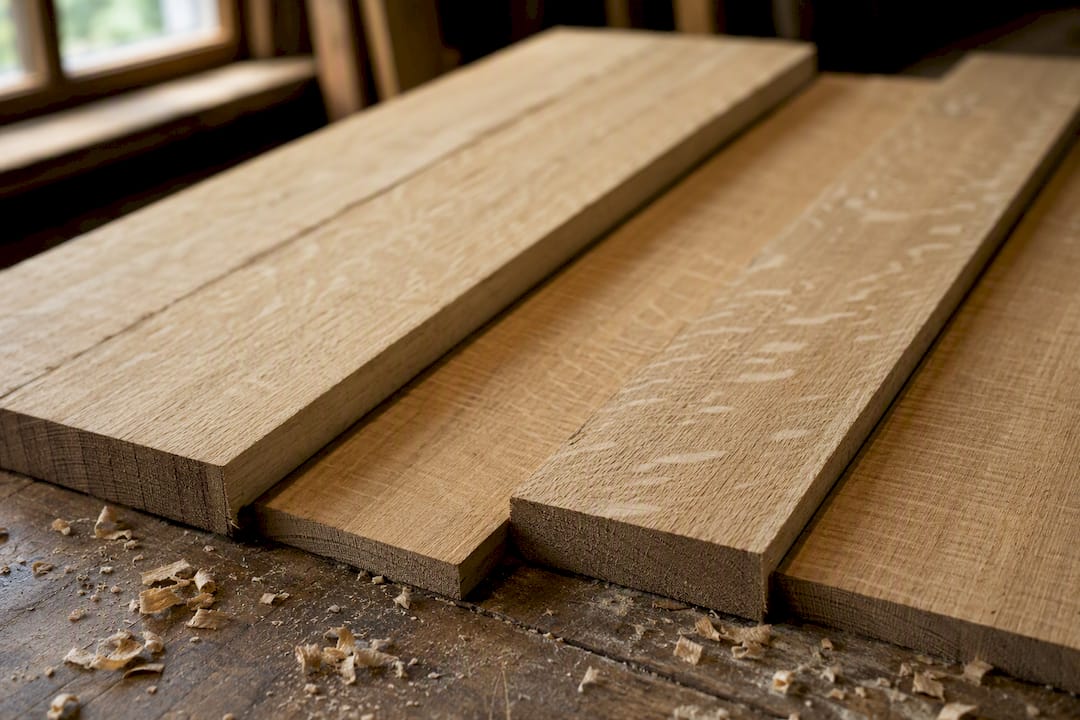
Watch for inconsistent ray fleck within the same order. Because quarter sawing only produces true quarter boards from the sections of the log closest to the center, a single run can mix heavily flecked boards with nearly flat ones. That’s a milling reality, not a defect exactly, but it becomes a problem if you expected uniform figure across a floor or tabletop and didn’t ask for percent-quarter details up front.
Check for mineral streaking, those gray or greenish-black discolorations that occur naturally in white oak regardless of cut. They’re more visible on quarter sawn boards because the flatter grain doesn’t camouflage them the way plain-sawn cathedral patterns do. Some buyers want a select grade that minimizes streaking; others like the character.
Look closely at end grain for checking, small splits that radiate from the board ends. Quarter sawn boards can be more prone to this during drying because the ray cells create natural planes of weakness. A reputable supplier grades these out before the wood reaches your job site, but it’s worth inspecting a sample board yourself.
Finally, watch for boards mislabeled as quarter sawn that are actually rift sawn or a plain sawn board cut near the quarter. Requesting end-grain photos before a bulk order remains the most reliable way to catch this before it becomes an expensive surprise.
Sourcing Quarter Sawn White Oak Sustainably
White oak grows across most of the eastern half of the United States, and it’s not a scarce or endangered species, so sustainability concerns around quarter sawn white oak center less on the tree itself and more on how the log gets broken down.
Quarter sawing inherently produces more waste than plain sawing, since cutting a log into quarters and resawing each section at specific angles leaves more offcuts and lower overall yield per log. That’s simply the tradeoff for the stability and figure you’re paying for. Reputable mills put those offcuts to use as flooring underlayment, mulch, or biomass fuel rather than sending them to a landfill, so it’s worth asking a supplier how they handle mill waste if that matters to your project.
Look for lumber sourced from mills that practice selective harvesting rather than clear-cutting, and ask whether the stock carries any forest-management certification. Buying quarter sawn white oak regionally, rather than shipping it long distances, also cuts down on the transportation footprint tied to a naturally heavier product. White oak’s durability works in sustainability’s favor too: a well-built quarter sawn floor or table can last generations with basic refinishing, which spreads the environmental cost of that extra milling waste over a much longer service life than a piece of furniture built to be replaced in a decade.
Cutting and Joining Quarter Sawn White Oak in the Shop
Quarter sawn white oak cuts and machines much like any other white oak, but its grain orientation changes how it behaves at the joint line, and a few adjustments save you from cracked panels and failed glue-ups down the road.
When ripping quarter sawn boards, expect slightly more tearout on the ray fleck itself if your blade isn’t sharp, since you’re cutting across those ray cells rather than with the grain. A blade with a higher tooth count reduces this. For hand tools, a sharp plane iron set for a fine cut handles the ray fleck cleanly; a dull iron will tear the fleck into a fuzzy mess instead of leaving it glossy.
For glue-ups, quarter sawn boards’ lower width-wise movement makes them more forgiving in wide panels than plain sawn stock, but you still need to account for some expansion across the width. Standard practice applies: use floating panels in frame-and-panel construction rather than gluing a wide panel rigidly into a frame, and orient growth rings in alternating directions on glued-up tabletops when your stock allows it.
Mortise-and-tenon joints hold well in quarter sawn oak because the vertical grain orientation gives consistent strength along the length of the tenon. Dovetails cut cleanly too, since the straight grain doesn’t wander the way plain sawn cathedral grain can. One practical note for finishing joints: the ray fleck can catch stain differently at a joint line where end grain and face grain meet, so test your finish across a sample joint, not just a flat board face, before committing to a full piece.
Quarter Sawn White Oak Compared to Other Species
White oak isn’t the only wood that takes well to quarter sawing, but it’s the one most associated with the cut for good reason. Quarter sawing works on nearly any species, yet the visual payoff varies enormously because ray cell size and density differ from tree to tree.
Sycamore, another common quarter sawn wood, produces a fine, lacy ray fleck that’s more delicate and uniform than oak’s bold pattern. It’s a popular alternative for buyers who want the technique’s stability benefits without oak’s more dramatic figure. Quarter sawn maple, meanwhile, barely shows ray fleck at all since maple’s ray cells are much smaller, so you get the stability advantage with almost none of the visual drama.
Red oak quarter saws similarly to white oak in terms of ray fleck, since the two species are closely related, but red oak’s rays tend to run slightly smaller and its overall color leans pinker rather than white oak’s cream and tan range. Red oak also has open pores that make it more porous and less water-resistant, which is part of why white oak dominates flooring and outdoor-adjacent applications like boat building.
Quarter sawn cherry and walnut both take the cut well for furniture work but rarely get requested for their ray fleck. Buyers choose those species for color and figure elsewhere in the grain, with quarter sawing valued mainly for the stability it brings to wide panels rather than the ray pattern itself. For a buyer choosing between species, the real question isn’t which wood quarter saws best. It’s whether you want oak’s bold fleck, a subtler alternative like sycamore, or a species chosen for reasons that have nothing to do with the cut at all.
An Editorial Take on Buying Quarter Sawn White Oak
Most buying guides treat quarter sawn white oak as a purely aesthetic upgrade, something you pay more for because it looks nicer. That undersells the real reason to spend the extra money: movement control. If your project involves a wide surface, radiant heat, or a humidity swing you can’t control, the ray fleck is a bonus on top of the actual reason to specify this cut.
The conventional advice to just “ask for quarter sawn” falls short because it treats the term as a guarantee rather than a starting point. Given how loosely mills label rift-and-quartered bundles, the buyers who get burned aren’t the ones who paid too much. They’re the ones who assumed the label meant uniform figure across every board and never asked for a sample or an end-grain photo first.
If you take one thing from this guide, prioritize the conversation with your supplier over the marketing copy on a product page. A knowledgeable distributor who’s handled thousands of custom orders can tell you honestly whether a given run will deliver the look you have in mind, before you’ve committed to a full order you can’t return.
— Mike Solomich
Get Quarter Sawn White Oak From a Michigan Supplier Who Stocks It
Most big-box flooring aisles carry plain sawn oak and call it a day, which leaves buyers who actually want quarter sawn or rift-and-quartered white oak stuck special-ordering blind from a catalog. Quality Hardwoods of Michigan, Inc stocks quarter sawn and rift-and-quartered white oak in both solid and engineered formats, so you can see actual boards and compare ray fleck and width in person rather than guessing from a website photo.

That matters most for contractors and homeowners planning wide-plank floors, radiant heat installations, or a custom tabletop where a mismatched shipment means a costly redo. Our team has walked hundreds of buyers through exactly the specification questions covered in this guide, from grade selection to solid-versus-engineered decisions for your subfloor. If you’re ready to move forward, request samples or get a quote for new-construction hardwood installation, or visit our showroom in Michigan to hold a sample board under real light before you order.
Sources
- What’s the Actual Difference Between Quarter Sawn and Rift Sawn Wood for Furniture? - Wood Work Science
- Rift and Quartered White Oak Flooring: A Buyer’s Guide - D and G Flooring
- White Oak - Rift & Quarter Sawn - Development - Hickman Woods
- USDA research on wood-tannin and iron staining
- Quartersawn wood & rift sawn wood explained - Fine Homebuilding
FAQ
Is quarter sawn white oak more expensive than plain sawn?
Yes. Quarter sawn white oak typically costs 50% to 100% more than plain sawn stock because the cutting process wastes more wood per log and yields fewer usable boards.
What is the difference between white oak and quarter sawn white oak?
White oak is the species; quarter sawn describes how the log was cut. Plain sawn white oak and quarter sawn white oak come from the same tree but differ in grain pattern, stability, and price because of the milling method.
What are the disadvantages of quarter sawn white oak?
The main drawbacks are cost, limited width availability, and inconsistent ray fleck within a single order since not every board from a quarter sawn run shows the same figure intensity. Lead times also run longer for custom widths or select grades.
Is quarter sawn oak stronger than plain sawn oak?
Not in terms of hardness. Quarter sawing doesn’t change white oak’s Janka rating or overall strength; what it improves is dimensional stability, meaning the board resists cupping and warping better than a plain sawn board from the same tree.