

For most projects, regional distributors with trade programs are the strongest alternative to qualityflooring4less.com alternatives—they combine product depth, installation coordination, and warranty support that generic discount sites rarely match. If you need a fast shortlist, here it is:
- Regional distributors with trade programs (Quality Hardwoods of Michigan, Inc, River City Flooring): best for contractors, builders, and homeowners who need samples, installation referrals, and a real person to call. Ideal for complex renovations.
- National online discount retailers (FastFloors, EFLOORS, Floor & Decor): best for straightforward buys where price and shipping speed matter more than hand-holding. Works well for homeowners replacing a single room.
- Specialty hardwood wholesalers and mills (TrueHardwoods and similar): best for builders or designers sourcing hard-to-find species, wide planks, or custom finishes at volume pricing.
Build a shortlist of three suppliers across different categories before committing, then verify trade programs and warranty support directly.
Table of Contents
- How do the top qualityflooring4less.com alternatives compare?
- What each supplier type actually offers you
- What does flooring actually cost, and how long will it take?
- How do you choose the right flooring supplier?
- Online retailers vs. regional distributors: when does each model win?
- Key Takeaways
- What most buyers get wrong when picking a flooring supplier
- Quality Hardwoods of Michigan, Inc: showroom, trade programs, and real project support
- Useful sources and resources
- FAQ
How do the top qualityflooring4less.com alternatives compare?
The table below maps the four main supplier categories against the dimensions that actually drive buying decisions. One category will fit your project better than the others.
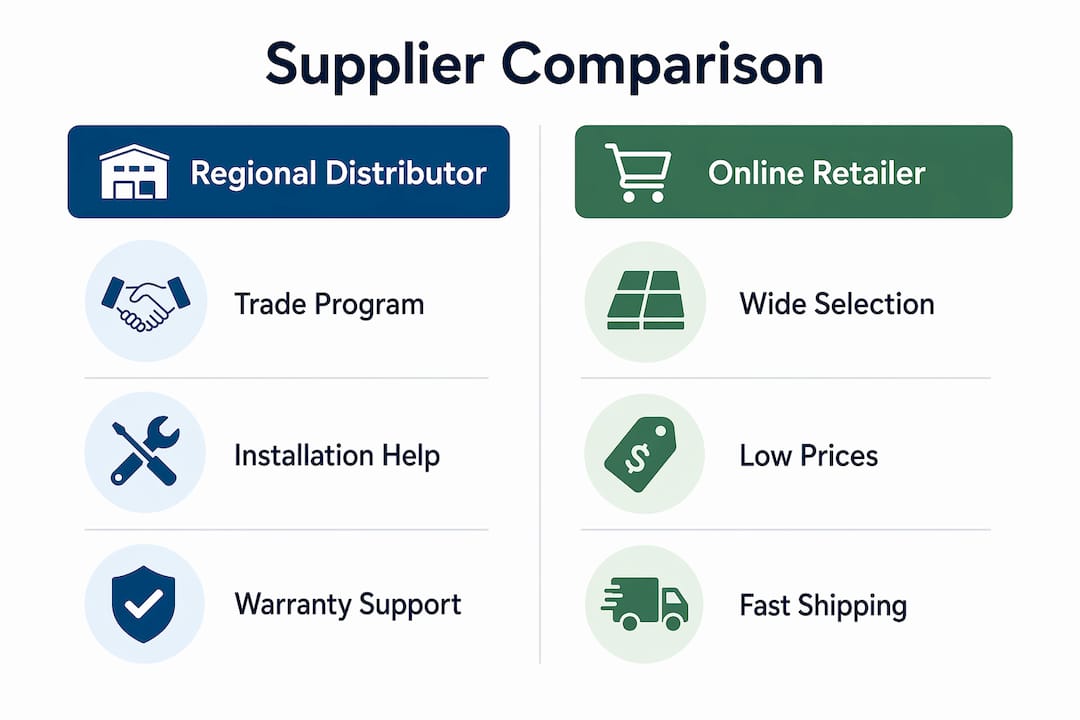
| Supplier category | Product range / brands | Pricing / value | Shipping & lead times | Showroom / samples | Trade / contractor programs | Installation coordination | Returns & warranty |
|---|---|---|---|---|---|---|---|
| Regional distributor (e.g., Quality Hardwoods of Michigan, Inc, River City Flooring) | Hardwood, LVP, laminate, tile, countertops; premium brand access | Mid to premium; trade discounts available | Local pickup fast; freight for out-of-area | Yes — in-person showroom, physical samples | Yes — dedicated contractor accounts, bulk pricing | Yes — installation referrals and coordination | Strong; manufacturer warranty registration support |
| National online discount retailer (e.g., FastFloors, EFLOORS, Floor & Decor) | Wide SKU count; major brands and private label | Entry to mid; frequent promotions | Free or low-cost nationwide shipping; 3–10 business days typical | Limited; sample programs online only | Partial — some offer pro accounts | Rarely — buyer arranges separately | Varies; return windows differ by supplier |
| Specialty hardwood wholesaler / mill (e.g., TrueHardwoods) | Hardwood-focused; exotic species, custom widths, unfinished options | Competitive at volume; premium for custom | Freight shipping; lead times longer for custom orders | Limited; samples available on request | Yes — volume pricing for contractors | No | Manufacturer warranty; species-specific guidance |
| Wholesale / bulk-only supplier | Commodity and mid-grade; fewer premium brands | Lowest per-unit cost at volume | Freight; palletized delivery | Rarely | Yes — minimum order quantities apply | No | Basic; limited support |
Trust signals to verify before buying: years in business, Better Business Bureau (BBB) rating, showroom access, and named brand partnerships. A supplier that has operated for a decade or more and carries recognizable brands is a lower-risk choice for a large project.
Stat to know: Community-driven alternative lists surface dozens of options quickly, but they rank by visitor votes and internal signals, not verified quality. Use them for discovery, then cross-check with BBB and direct references.
What each supplier type actually offers you
Regional distributor with trade program
At a glance: Full-service, high-touch model. Showroom, contractor accounts, installation coordination, and sourcing help for non-stock items.

Regional distributors are the closest thing to a one-stop shop for complex projects. They carry hardwood, luxury vinyl plank (LVP), laminate, tile, and often countertops. Many will research and source items they do not stock, which matters when you are chasing a discontinued species or a specific finish. Contractor accounts typically unlock tiered pricing and net terms, and the showroom means you can see and feel samples before ordering.
Pros: Installation referrals, warranty registration support, real customer service, sourcing flexibility. Cons: Prices are not always the lowest on commodity SKUs; geographic reach is limited for buyers outside the service area. Best for: Contractors managing multi-room renovations, builders spec’ing premium materials, homeowners who want design help and a single point of contact.
Warranty and samples: Most regional distributors can coordinate manufacturer warranty registration and will provide physical samples. Ask specifically whether samples are free or refundable against an order.
Payment options: Trade accounts with net terms are common; consumer purchases typically accept major credit cards and sometimes financing through third-party lenders.
Specialty hardwood wholesaler and mill
At a glance: Hardwood-only or hardwood-primary focus. Strong on species variety, custom widths, and unfinished stock.
If you need 5-inch white oak, reclaimed heart pine, or a custom stain match, this is the category to call first. Specialty wholesalers source directly from mills, which keeps pricing competitive at volume even when the material is unusual. The trade-off is that they are not set up for installation coordination, and lead times on custom or made-to-order items can stretch to several weeks.
Pros: Hard-to-find species, competitive volume pricing, deep product knowledge. Cons: Limited support beyond the material itself; freight shipping adds cost and time. Best for: Builders and designers sourcing premium or custom hardwood at scale; contractors who handle their own installation.
Warranty and samples: Manufacturer warranties apply; sample availability varies by supplier. Budget extra lead time for sample requests on custom items.
National online discount retailer
At a glance: Wide SKU count, low prices, nationwide shipping. Minimal service layer.
Sites like FastFloors, EFLOORS, and Floor & Decor built their audience on price and convenience. You can browse hundreds of SKUs, compare prices in minutes, and have material on a truck within a week for standard in-stock items. Floor & Decor also operates physical warehouse stores, which gives you a hybrid option: browse online, pick up in-store. The catch is that installation is entirely your problem, and if something goes wrong with a large order, customer service can be slow.
Pros: Lowest prices on commodity SKUs, fast shipping, easy online comparison. Cons: No installation coordination, limited design help, return logistics can be complicated for large orders. Best for: Homeowners replacing a single room with a standard product; contractors who already have installation crews and just need materials shipped fast.
Payment options: Major credit cards; Floor & Decor offers a Pro Premier account for contractors. Financing options vary by retailer.
Pro Tip: Order samples from two or three online retailers before placing a full order. Screens render color differently, and a $5 sample can save a $2,000 return.
Wholesale / bulk-only supplier
At a glance: Volume-first model. Lowest per-unit cost, but minimum order quantities apply and service is minimal.
Bulk suppliers work best when you know exactly what you want and need a lot of it. Pricing can be significantly lower than retail channels, but you are typically buying palletized quantities, and there is little room for customization or returns. These suppliers rarely have showrooms and do not coordinate installation.
Pros: Lowest per-unit cost at volume, straightforward ordering. Cons: Minimum order requirements, limited product variety, no service layer, freight-only delivery. Best for: Large-scale builders and commercial contractors with high-volume, repeatable material needs.
What does flooring actually cost, and how long will it take?
Pricing and lead times vary more than most buyers expect. Here is a realistic breakdown by category.
Typical price bands
- Entry-level (commodity LVP, laminate, basic tile): $1.50–$3.50 per square foot for material. Common at online discount retailers and bulk suppliers. Wear layers on LVP at this price point are typically 6–12 mil, which suits light residential use.
- Mid-range (prefinished hardwood, mid-grade LVP, quality laminate): $3.50–$7.00 per square foot. The sweet spot for most homeowners and contractors. Regional distributors and national retailers both compete here.
- Premium (wide-plank hardwood, thick-wear-layer LVP, exotic species): $7.00 and up per square foot. Specialty wholesalers and regional distributors with premium brand access are the right source at this tier. ASTM International standards for wear resistance (ASTM F2199 for LVP, for example) become worth asking about at this price point.
Shipping and lead times
- Online discount retailers: Free or low-cost nationwide shipping on in-stock items; typical delivery is 3–10 business days. Large orders ship freight and may require a loading dock or liftgate.
- Regional distributors: Local pickup is same-day or next-day for in-stock items. Out-of-area freight adds 5–15 business days depending on distance and carrier.
- Specialty wholesalers: Standard species ship in 1–2 weeks; custom or made-to-order items can take 4–8 weeks. Build this into your project schedule.
- Bulk suppliers: Palletized freight; lead times depend on inventory and carrier availability.
Pro Tip: Choose in-stock SKUs whenever possible. Switching from a made-to-order item to a stocked equivalent can cut your lead time by three weeks and often costs less.
How do you choose the right flooring supplier?
Decision checklist
Before you contact any supplier, answer these questions about your project:
- Project scope: How many square feet? Single room or whole house? Commercial or residential?
- Installation complexity: Are you handling installation yourself, or do you need referrals?
- Sample needs: Do you need physical samples to match existing flooring or finishes?
- Warranty concerns: Is this a rental property, high-traffic space, or a premium build where warranty terms matter?
- Trade pricing: Are you a contractor or builder who qualifies for a trade account?
- Return policy: What happens if the material arrives damaged or the color is off?
Questions to ask every supplier
- Do you offer contractor or trade pricing, and what are the requirements?
- What is your sample policy — free, refundable, or paid?
- What is your return policy for unopened boxes vs. opened material?
- Who backs the warranty — the manufacturer or you?
- Can you coordinate installation referrals, or is that entirely on me?
- What is your realistic lead time for this specific SKU right now?
- Do you have a showroom where I can see the product in person?
Red flags to watch for
- No physical showroom and no sample program for a premium-priced product.
- Vague answers on lead times (“it depends” with no follow-up).
- No trade references or BBB listing for a supplier asking for a large deposit.
- Contact details that change or go unanswered after the initial inquiry.
- Warranty language that points only to a third-party claims processor with no named manufacturer.
When comparing quotes, weight trade programs and installation coordination heavily for complex projects. A supplier who saves you $0.50 per square foot but leaves you to find your own installer and handle warranty claims alone is rarely the better deal on a full renovation.
Online retailers vs. regional distributors: when does each model win?
The project complexity of your job is the single best predictor of which procurement model will serve you better. Online retailers win on price and speed for low-complexity buys. Regional distributors win on everything else.
| Project type | Best procurement model | Why |
|---|---|---|
| Single-room replacement, standard product | Online discount retailer | Fast shipping, easy price comparison, no need for design help |
| Multi-room renovation, mixed materials | Regional distributor | Samples, design coordination, single point of contact |
| Custom or hard-to-find species | Specialty wholesaler | Direct mill access, species expertise, volume pricing |
| Large commercial or new construction | Regional distributor or bulk supplier | Trade accounts, volume pricing, installation coordination |
| Budget-driven, high-volume repeat orders | Bulk supplier | Lowest per-unit cost at scale |
Community-sourced discovery tools are a useful starting point for building a supplier list, but BBB ratings and years in business are the filters that separate reliable suppliers from risky ones. A supplier with a decade-plus track record and a verified BBB profile carries meaningfully less risk on a $15,000 flooring order than an unverified online storefront.
Pro Tip: Combine both models. Order samples from two or three online retailers to nail down your product choice, then buy from a regional distributor for installation coordination, warranty support, and the ability to return to a real showroom if something goes wrong mid-project.
Key Takeaways
For most complex projects, a regional distributor with a trade program beats a generic online discount retailer because it combines product depth, installation coordination, and warranty support in one relationship.
| Point | Details |
|---|---|
| Match supplier to project complexity | Simple single-room jobs suit online retailers; multi-room renovations need a regional distributor’s full-service model. |
| Verify trust signals before buying | Check BBB rating, years in business, showroom access, and named brand partnerships on every shortlisted supplier. |
| Build a shortlist of three | Compare at least one regional distributor, one online retailer, and one specialty wholesaler before committing to any order. |
| Ask the right questions | Confirm trade pricing, sample policy, return terms, warranty ownership, and current lead times on your specific SKU. |
| Quality Hardwoods of Michigan, Inc | A Michigan-based regional distributor with 40-plus years in business, showroom access, trade accounts, and installation coordination for contractors and homeowners. |
What most buyers get wrong when picking a flooring supplier
The conventional wisdom says “shop online for the best price.” For a single room with a standard product, that is probably right. For anything more complicated, it is the advice that leads to the most expensive mistakes.
The real cost of a flooring project is not just the material. It is the material plus the installation plus the time you spend managing logistics plus what happens when something goes wrong. A regional distributor who charges $0.75 more per square foot but coordinates your installer, handles warranty claims directly, and lets you walk in with a sample question on a Tuesday afternoon is almost always the better economic decision on a full renovation.
Three rules of thumb that hold up across most projects: First, always order 10% overage on material, regardless of what the calculator says. Cuts, waste, and future repairs make it worth it. Second, verify installation referral quality independently. Ask the supplier for two or three past customer references, not just a name on a list. Third, compare in-stock pricing against lead-time costs. A four-week wait for a made-to-order product can delay an entire construction schedule, and that delay has a real dollar cost that rarely shows up in the per-square-foot comparison.
Quality Hardwoods of Michigan, Inc is a good example of what a regional distributor with real depth looks like: over 40 years in business, a working showroom, contractor accounts, and a product range that covers hardwood, LVP, and laminate under one roof. That combination is harder to find than it sounds.
Quality Hardwoods of Michigan, Inc: showroom, trade programs, and real project support
Forty years in the flooring business is not a marketing line. It means Quality Hardwoods of Michigan, Inc has seen the product cycles, the supply chain disruptions, and the installation problems that trip up newer suppliers. For contractors and builders in Michigan, that track record translates into a supplier who can source non-stock items, coordinate installation referrals, and stand behind manufacturer warranties in a way that an anonymous online storefront cannot.
The product range covers luxury vinyl plank, laminate flooring, unfinished and prefinished hardwoods, stains, finishes, and abrasives. Trade and contractor accounts are available for builders and contractors who need volume pricing and net terms. The showroom lets you compare samples in person before committing to a large order, which eliminates the color-mismatch problem that plagues online-only purchases.
If you are a contractor or builder looking for a hardwood flooring partner in Michigan, contact Quality Hardwoods of Michigan, Inc directly to discuss trade pricing, current inventory, and installation coordination for your next project.
Useful sources and resources
- Quality Hardwoods of Michigan, Inc — flooring products overview: Full product range including hardwood, LVP, laminate, and finishing supplies.
- Engineered floors distributors in Michigan: Compares local distributor services to national online retailers; useful for Michigan-based buyers.
- Best flooring companies near me: Evaluation guide for selecting local flooring suppliers and what to check before buying.
- The ultimate guide to vinyl and laminate flooring: In-depth breakdown of product categories, wear layers, and selection criteria.
- 76 sites like QualityFlooring4Less.com (technofizi.net): Community-aggregated list of similar sites; useful for discovery, not vetting.
- River City Flooring profile (retailflooringstores.com): Example regional distributor profile showing services, brands, and design coordination.
- River City Flooring alternatives (Instya): Alternative-site list for regional distributors; useful for comparing supplier categories.
- Designer trade program overview (One Day Doors & Closets): Explains how trade and contractor programs are structured in home improvement; relevant context for evaluating flooring trade accounts.
- Quality Hardwoods of Michigan, Inc — flooring brands carried: Lists premium brand partnerships and product lines available through the showroom.
- Flooring articles and expert guides (Quality Hardwoods of Michigan, Inc): How-to guides and product selection resources for homeowners and contractors.
FAQ
What is the best flooring for the money?
Luxury vinyl plank (LVP) in the mid-range tier ($3.50–$7.00 per square foot) delivers the best combination of durability, water resistance, and cost for most residential projects. Wear layers on LVP at this price point are typically 6–12 mil, which suits light residential use and qualify for standard manufacturer warranties.
Who is cheaper, Floor & Decor or Home Depot?
Floor & Decor generally prices flooring materials lower than Home Depot on a per-square-foot basis, particularly for tile and hardwood, because its stores are warehouse-format and flooring-only. Home Depot’s advantage is convenience and a broader product mix beyond flooring.
What brand is comparable to LifeProof flooring?
Shaw Floorté and COREtec are the most direct comparisons to LifeProof LVP: both offer rigid-core construction, waterproof warranties, and similar wear-layer specifications. Quality Hardwoods of Michigan, Inc carries premium LVP brands with comparable performance specs, available for in-person comparison at their Michigan showroom.
What flooring is easiest on your knees?
Cork and thick-wear-layer LVP with an attached underlayment provide the most cushion underfoot and reduce joint fatigue compared to hardwood or tile. For standing workspaces or kitchens, a minimum 6mm total thickness with foam underlayment makes a noticeable difference.
How do I verify a flooring supplier before placing a large order?
Check the supplier’s BBB rating, confirm years in business, ask for two or three contractor references, and verify that the warranty is backed by a named manufacturer rather than a third-party processor. A supplier with a physical showroom and a verifiable track record carries significantly less risk on a large order than an unverified online storefront.