
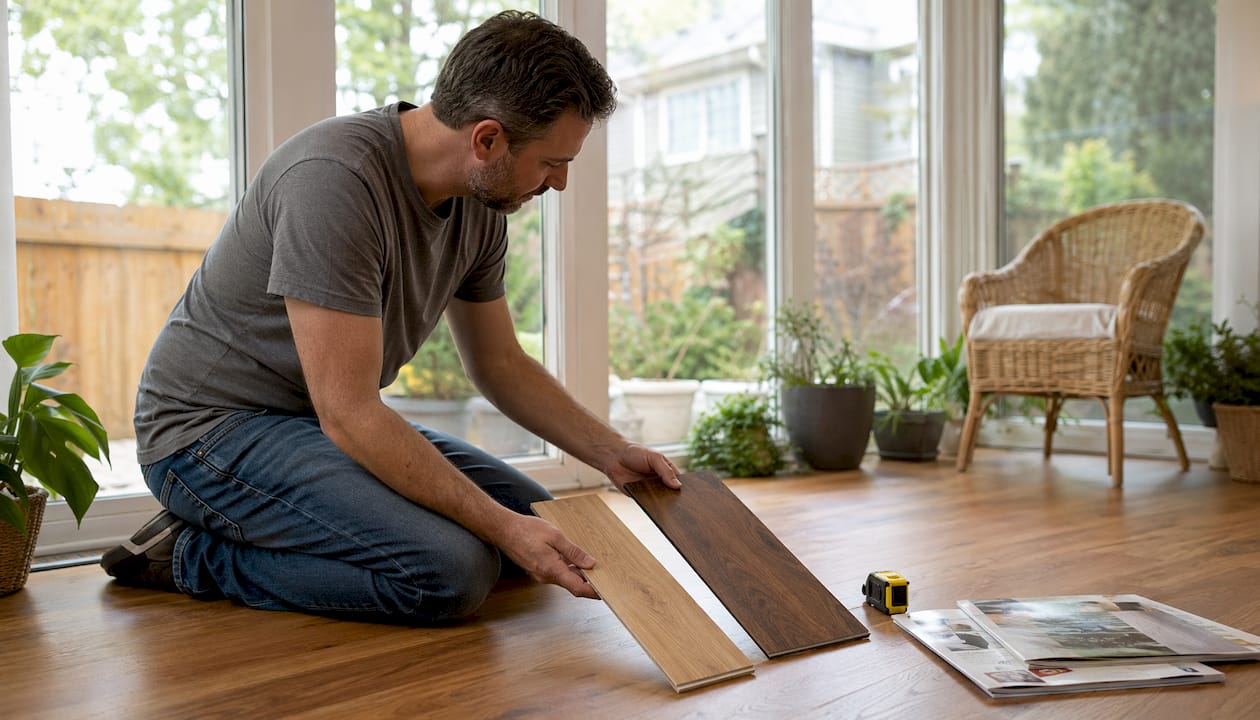
Hardwood delivers long-term resale value and the ability to refinish across decades, while laminate delivers lower upfront cost, superior scratch resistance, and easier DIY installation. That single tradeoff drives almost every decision in this comparison.
Pick hardwood if you:
- Plan to stay in the home 10+ years and want refinishability and resale return
- Are focused on natural materials, patina, and long-term home investment
- Have above-grade rooms with controlled humidity and working HVAC
Pick laminate if you:
- Need a budget-friendly floor for a rental, basement, or high-traffic room
- Have pets or young kids and want a surface that shrugs off scratches
- Want a DIY-friendly install without hiring a contractor
The National Wood Flooring Association and EPA guidance both support hardwood’s indoor air quality advantages. Quality Hardwoods of Michigan, Inc stocks both materials, so the sections below cover types, a side-by-side comparison, real cost ranges, health and environmental considerations, and a decision checklist.
Table of Contents
- What are the three main floor types and what do they mean for you?
- How do hardwood and laminate compare side by side?
- How do you choose the right floor for your home?
- What do hardwood and laminate actually cost over time?
- What does the research say about health, air quality, and the environment?
- Key Takeaways
- The case for thinking past the price tag
- Quality Hardwoods of Michigan, Inc can help you choose and source the right floor
- Useful sources and further reading
- FAQ
What are the three main floor types and what do they mean for you?
Understanding the construction of each floor type tells you almost everything about what it can and cannot do.
Solid hardwood is a single piece of wood milled to 3/4 inch thick. Because the wear layer is the full board, it can be sanded and refinished 4–6 times across a 75–100+ year service life. The catch: it must be nailed or stapled to a wood subfloor above grade, and it moves with humidity changes, so moisture-prone rooms are off-limits.
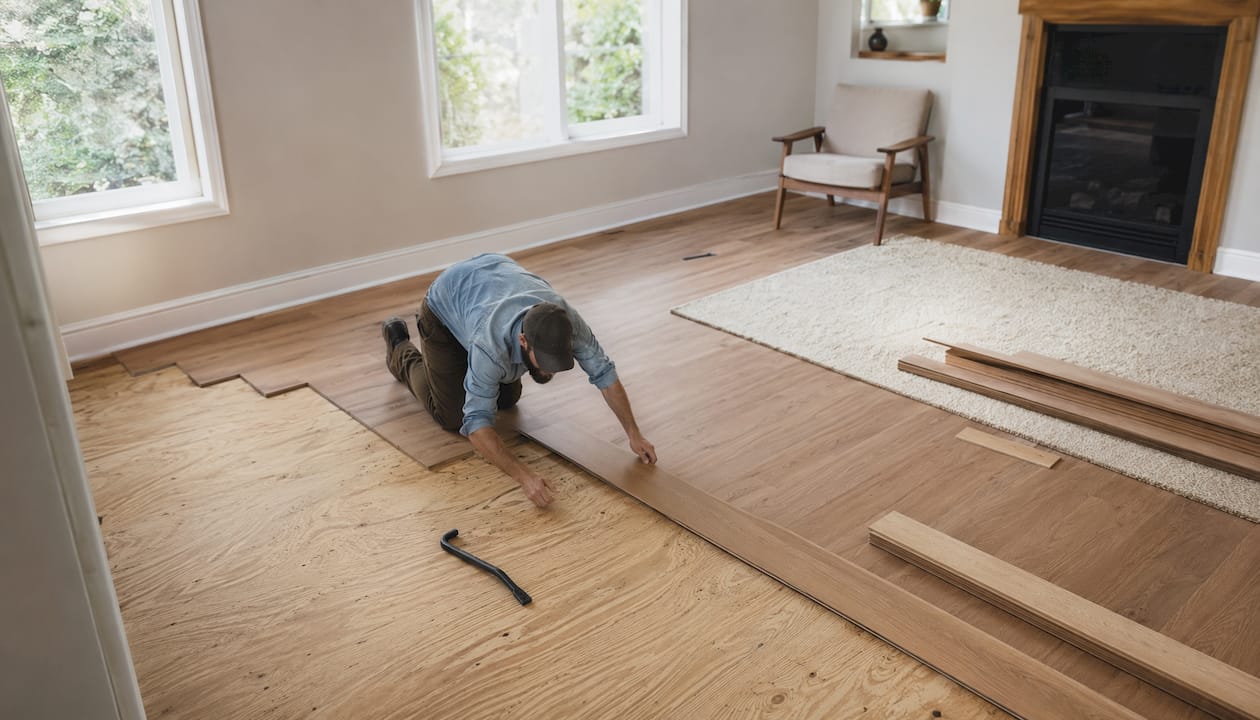
Engineered hardwood bonds a real wood veneer over a plywood or HDF core. That layered construction resists seasonal movement better than solid wood, making it suitable for concrete slabs and below-grade installations. A veneer of 4mm or more can be refinished 1–2 times; thinner veneers (0.5–1mm) cannot be refinished at all, so match the product to your plans before buying.
Laminate uses a photographic image layer printed on high-density fiberboard (HDF), topped with a clear wear layer. It looks convincingly like wood or stone, installs as a floating click-lock floor over virtually any subfloor, and costs a fraction of real wood. The tradeoff: once the wear layer is gone, the floor is done. No refinishing, no second life.
Pro Tip: All three floor types need to acclimate in the room for 48–72 hours before installation. Skip this step and you risk gapping or buckling as the material adjusts to your home’s humidity. For floating floors specifically, subfloor flatness matters more than most DIYers expect — any dip or high spot stresses the click-lock joints and shortens the floor’s life.
How do hardwood and laminate compare side by side?
| Dimension | Solid Hardwood | Engineered Hardwood | Laminate |
|---|---|---|---|
| Typical cost (materials) | $5–$15/sq ft | $4–$10/sq ft | $1–$5/sq ft |
| Installation cost (pro) | $3–$8/sq ft | $3–$6/sq ft | $2–$4/sq ft |
| Durability / scratch resistance | Moderate (species-dependent) | Moderate | High (AC3–AC5 wear layer) |
| Water/moisture tolerance | Low | Moderate | Low–Moderate (surface only) |
| Refinishability | Yes, 4–6 times | 1–2 times (thick veneer only) | No |
| Expected lifespan | 75–100+ years | 25–50 years | 15–25 years |
| Appearance / realism | Authentic grain, patina | Authentic grain | Photographic layer, improving |
| Maintenance needs | Low (sweep, occasional refinish) | Low | Low (no refinishing option) |
| Resale value | ~2.5% home value uplift | Moderate uplift | Minimal uplift |
| DIY friendliness | Low (nail-down, pro recommended) | Moderate | High (click-lock float) |
The biggest tradeoff the table reveals: laminate wins on upfront cost and scratch resistance, but hardwood wins on lifecycle cost and resale. A floor that costs $12/sq ft installed but lasts 100 years beats a $6/sq ft floor you replace every 20 years, assuming you stay long enough to see that math play out.
Room-by-room fit:
- Living rooms and bedrooms: Both work well. Hardwood adds warmth and resale appeal; laminate cuts cost without sacrificing looks.
- Kitchens: Engineered hardwood or laminate with tight seams. Solid hardwood is risky near sinks and dishwashers.
- Basements: Laminate or engineered hardwood on concrete. Solid hardwood should not go below grade.
- Rental units: Laminate is the practical call. AC3–AC5 wear ratings handle heavy tenant traffic, and replacement is cheap when the lease ends.
Quality Hardwoods of Michigan, Inc carries both laminate and multiple hardwood species, so you can compare real samples before committing to either.
How do you choose the right floor for your home?
Work through these questions in order and the right material usually becomes obvious.
- How long do you plan to stay? Less than 10–15 years and resale is not a priority? Laminate makes financial sense. Staying longer or selling in a competitive market? Hardwood’s resale premium and refinishability justify the higher upfront cost.
- Do you have pets or young kids? High-quality laminate with an AC4 or AC5 rating resists scratches and dents better than softer wood species. For a pet-heavy household, laminate or a harder hardwood species (hickory, white oak) are the practical choices.
- What is the moisture exposure? Bathrooms and laundry rooms: neither solid hardwood nor standard laminate. Kitchens and basements: engineered hardwood or laminate with verified waterproof claims. Above-grade, dry rooms: all three options are on the table.
- What is your budget per room? Laminate at $1–$5/sq ft for materials is the entry point. Engineered hardwood sits in the middle. Solid hardwood at $5–$15/sq ft is the premium tier, but the lifecycle cost per year can be lower over a long horizon.
- How important is resale value? If you are in the $400K+ market, real estate data consistently puts hardwood at the top of features buyers pay extra for.
- Are you installing yourself? Click-lock laminate is genuinely DIY-friendly. Solid hardwood nail-down is not — hire a pro. Engineered hardwood floating installations fall in between.
- What subfloor do you have? Concrete slab below grade rules out solid hardwood. Laminate and engineered hardwood both float over concrete with the right underlayment.
- What is your tolerance for future maintenance? Hardwood can be refinished when it looks tired. Laminate cannot — when the wear layer is gone, you replace the floor.
Questions to ask at the showroom or with your installer:
- What is the wear layer thickness on this engineered or laminate product?
- What AC rating does this laminate carry?
- Does the manufacturer warranty cover my installation method (floating vs. glue-down)?
- What subfloor prep is required, and who is responsible for it?
- What is the recommended cleaning product and maintenance schedule?
- Does this product carry FloorScore or CARB Phase 2 certification?
For a deeper look at how laminate stacks up in specific situations, the vinyl laminate guide at Quality Hardwoods of Michigan, Inc covers practical scenarios where laminate outperforms hardwood.
What do hardwood and laminate actually cost over time?
| Floor Type | Material Cost | Pro Install | Total Installed | Expected Lifespan |
|---|---|---|---|---|
| Solid hardwood | $5–$15/sq ft | $3–$8/sq ft | $8–$23/sq ft | 75–100+ years |
| Engineered hardwood | $4–$10/sq ft | $3–$6/sq ft | $7–$16/sq ft | 25–50 years |
| Laminate | $1–$5/sq ft | $2–$4/sq ft | $3–$9/sq ft | 15–25 years |
A simple lifecycle example: Take a 200 sq ft bedroom. Mid-range solid hardwood installed at $11/sq ft costs $2,200. Refinished twice over 50 years at roughly $1,000 each time, total spend is $4,200 across five decades, or about $84/year. Mid-range laminate installed at $4/sq ft costs $800. Replace it once at year 20 for another $800, and you’ve spent $1,600 over 40 years, or $40/year. Laminate wins on cost-per-year in that scenario. But push the horizon to 75 years with multiple laminate replacement cycles, and hardwood’s single installation plus refinishing can pull ahead.
The real cost question is not “which floor is cheaper?” but “how long are you staying?” Solid hardwood can be sanded and refinished 4–6 times across 75–100+ years, producing a lifecycle cost that beats repeated laminate replacements over a long enough horizon. The break-even point typically falls somewhere around 30–40 years, depending on material grades and local labor costs.
Refinishing solid hardwood typically runs $3–$5/sq ft for a professional sand-and-coat, far less than a full replacement. Laminate has no equivalent option.
What does the research say about health, air quality, and the environment?
Hardwood’s air quality advantage over carpet is well-documented. The National Wood Flooring Association notes that hardwood does not harbor allergens, dust mites, or microorganisms the way carpet fibers do. Tile and laminate share that smooth-surface benefit, but laminate’s grout-free surface actually edges out tile for particle accumulation in seams.

VOCs and off-gassing are where the materials diverge. Solid hardwood is a natural product; its primary VOC exposure comes from finishes and adhesives used during installation, not the wood itself. Laminate uses resins and adhesives in its HDF core, which can off-gas formaldehyde and other compounds, particularly in the weeks after installation. The good news: reputable laminate products now meet CARB Phase 2 and FloorScore emission standards, which set strict limits on formaldehyde off-gassing. Always check for those certifications before buying, especially for bedrooms or homes with young children.
For hardwood sourcing, look for FSC (Forest Stewardship Council) or SFI (Sustainable Forestry Initiative) certification. These verify responsible forest management and chain-of-custody tracking. Laminate uses wood fiber in its core, so similar certification questions apply to the manufacturer’s sourcing practices.
Moisture and the “waterproof” claim: Individual laminate planks are often water-resistant at the surface, but the HDF core swells irreversibly when moisture finds seams or gets trapped underneath. “Waterproof” marketing language varies by product and should be verified with the manufacturer’s actual documentation, not the packaging claim. Engineered hardwood handles incidental moisture better than solid wood but is not immune to prolonged exposure either.
For rooms where humidity fluctuates significantly, managing interior humidity levels protects both hardwood and laminate. The same principles that apply to humidity management in painted interiors apply to flooring: consistent humidity between 35–55% extends the life of any wood-based floor.
One undervalued hardwood quality: thermal and acoustic performance. Hardwood feels warmer underfoot than laminate and absorbs impact noise better, which matters in multi-story homes or open floor plans.
Key Takeaways
Hardwood wins on lifecycle cost and resale value when you stay long enough; laminate wins on upfront cost, scratch resistance, and DIY installation ease.
| Point | Details |
|---|---|
| Lifecycle cost favors hardwood long-term | Solid hardwood refinished 4–6 times over 75–100 years often costs less per year than replacing laminate every 15–25 years. |
| Laminate leads on scratch resistance | AC3–AC5 wear ratings make quality laminate more scratch-resistant than many softer hardwood species. |
| Hardwood adds ~2.5% resale value | Industry data puts hardwood at the top of features buyers pay extra for, with an average uplift around 2.5%. |
| Moisture is laminate’s real weakness | The HDF core swells irreversibly when moisture breaches seams; verify waterproof claims with manufacturer documentation. |
| Quality Hardwoods of Michigan, Inc stocks both | With 40+ years in the business, they carry hardwood, laminate, and engineered options so you can compare real samples before deciding. |
The case for thinking past the price tag
Most homeowners frame this as a cost question and stop there. That framing misses the more interesting decision.
Laminate has genuinely improved. The photorealistic image layers on today’s premium products fool most guests, and an AC4-rated floor in a busy household with two dogs is a reasonable, honest choice. Anyone who dismisses it as a cheap substitute has not looked at the category in a decade.
But the refinishability gap is real and it compounds. A hardwood floor you sand and recoat in year 25 looks new again. A laminate floor in year 25 just looks like a 25-year-old laminate floor. That difference is not about aesthetics alone — it is about what happens when you decide to sell. Buyers in the mid-to-upper price range notice, and real estate data consistently confirms they pay for it.
The decision I see homeowners get wrong most often: choosing laminate for a room they plan to renovate “eventually,” then staying in the house 15 more years. The lifecycle math shifts quietly over time. If there is any real chance you are staying a decade or more, the conversation about hardwood deserves more than a quick price comparison.
The middle path — engineered hardwood — is underused. It handles concrete slabs, tolerates moderate moisture, and delivers the look and feel of real wood. For most Michigan homes with mixed subfloor conditions, it is worth pricing before defaulting to laminate.
Quality Hardwoods of Michigan, Inc can help you choose and source the right floor
Forty years of flooring distribution means Quality Hardwoods of Michigan, Inc has seen every room condition, subfloor situation, and budget scenario Michigan homeowners bring through the door. The showroom lets you hold real samples side by side — not just look at photos — before committing to a material.
Whether you need laminate flooring for a rental or a budget renovation, solid hardwood for a long-term investment, or engineered hardwood as the middle ground, the team can match you to the right product and grade. Material-only sales, statewide delivery across Michigan, and product guidance for both DIY homeowners and contractors are all available. Browse the full flooring product catalog or call the showroom to request samples and a materials quote for your specific room dimensions.
Useful sources and further reading
| Source | Why consult it |
|---|---|
| National Wood Flooring Association | Authoritative guidance on hardwood health benefits and indoor air quality |
| This Old House — Laminate vs. Hardwood | Installation methods, DIY guidance, and subfloor prep requirements |
| Floor Critics — Laminate Review | AC wear ratings, cost ranges, and certification guidance for laminate |
| D and G Flooring — Hardwood vs. Laminate | Lifecycle cost comparisons and moisture vulnerability detail |
| Carpet One — Laminate vs. Hardwood | Engineered hardwood refinishing limits and product selection guidance |
| Greatmats — Laminate Over Hardwood | Practical guide to floating laminate over existing substrates |
| Quality Hardwoods of Michigan — Laminate Downsides | Honest breakdown of laminate limitations from a distributor perspective |
FAQ
Do high-end homes use laminate flooring?
Rarely. Buyers in the upper price range consistently prefer real hardwood, and real estate data shows hardwood commands an average resale premium of around 2.5%. Premium laminate is common in mid-range homes and rentals, but it does not carry the same buyer appeal as solid or engineered hardwood in luxury markets.
What is the healthiest flooring to put in your house?
Hardwood is generally the top choice for indoor air quality. The National Wood Flooring Association confirms it does not trap allergens, dust mites, or microorganisms the way carpet does. If you choose laminate, look for FloorScore or CARB Phase 2 certification to minimize formaldehyde off-gassing.
What are the negatives of laminate flooring?
The three main drawbacks: it cannot be refinished when worn, its HDF core swells irreversibly if moisture breaches the seams, and it adds little to resale value. For a full breakdown, the laminate flooring downsides guide at Quality Hardwoods of Michigan, Inc covers each limitation in detail.
Why do people put laminate over hardwood?
It avoids the cost and disruption of refinishing or replacing the existing hardwood. Floating laminate installs directly over most sound substrates, including existing hardwood, with no glue or nails required. The tradeoff is that the original hardwood is hidden rather than restored, which can affect resale value if buyers later discover real wood underneath.