
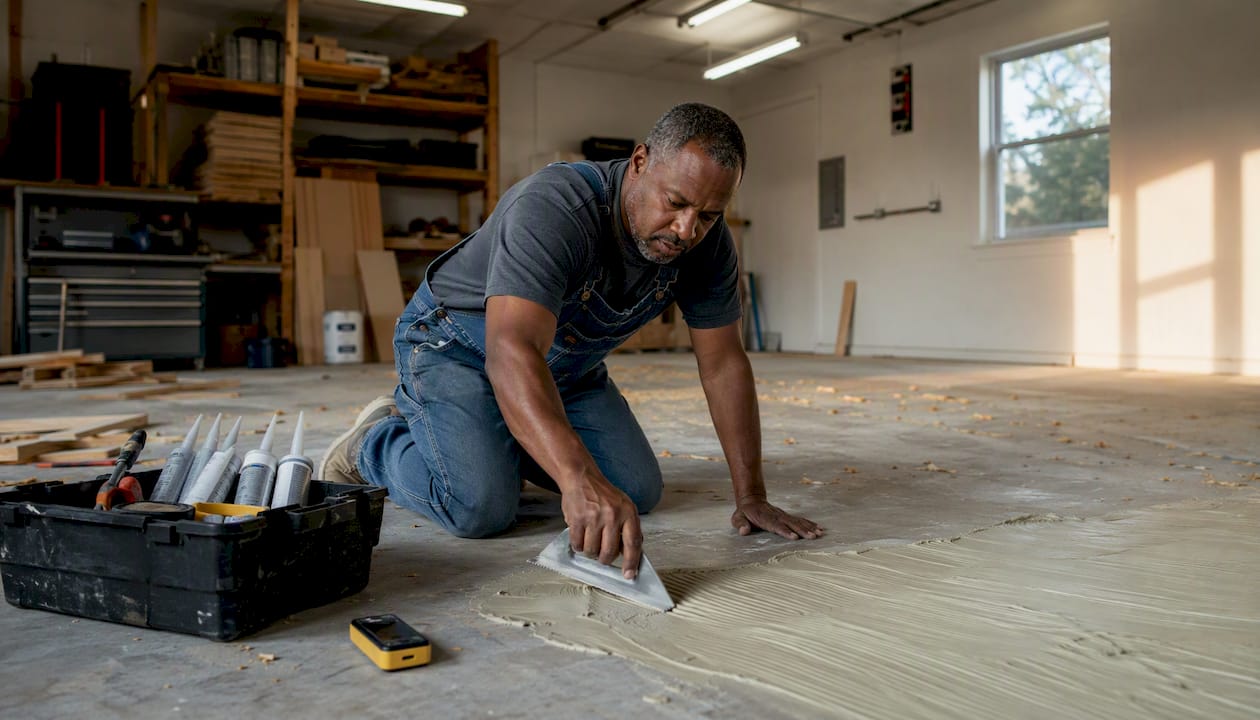
For wide-plank, engineered, or any installation over a concrete slab with moisture risk, choose an elastomeric moisture-control adhesive, either a modified silane (MS polymer hybrid) or a moisture-cure urethane. Water-based acrylics work only for dimensionally stable engineered boards in dry, above-grade interiors. That single rule eliminates most callbacks before the first plank goes down.
NWFA guidance reinforces this: adhesive selection should be driven by jobsite environment, subfloor type, and plank width, not by a single “best” product. Moisture testing under ASTM F1869 (calcium chloride MVER) and ASTM F2170 (in-slab relative humidity) should happen before any adhesive is chosen. Quality Hardwoods of Michigan, Inc has been helping Michigan contractors and homeowners navigate these decisions for over 40 years.
Quick selection guide by job type:
- Wide plank considered wide by manufacturers over concrete or plywood: Elastomeric moisture-control adhesive (MS hybrid or moisture-cure urethane); glue-down required or strongly recommended by most manufacturers
- Engineered flooring in a dry, above-grade room: Water-based acrylic acceptable if the manufacturer approves; elastomeric preferred for planks 5 inches and wider
- Below-grade or radiant-heated slab: Moisture-cure urethane with high elongation (400%+ rated products exist); document MVER and RH before installation
- Glue-plus-nail over plywood: Urethane or MS hybrid as the adhesive layer; fasteners handle the mechanical hold while the adhesive controls movement
Table of Contents
- What are the main adhesive types for hardwood floors?
- When should you glue down instead of nail or float?
- How do subfloor type and moisture affect your adhesive choice?
- How do you apply adhesive correctly for a strong bond?
- How do you read a technical data sheet to choose the right product?
- What does an NWFA-aligned installer checklist look like?
- Key Takeaways
- The adhesive decision most installers get wrong
- Quality Hardwoods of Michigan, Inc can help you get this right
- Useful sources and further reading
- FAQ
What are the main adhesive types for hardwood floors?
Four chemistry families cover the vast majority of hardwood flooring installation jobs. Understanding what each one does, and where it falls short, is the fastest way to avoid a mismatch.
Moisture-cure urethanes
These cure by reacting with ambient moisture in the air and substrate. The chemistry produces a permanently flexible bond with very high elongation, making it well-suited for radiant heat, exotic species, and wide planks that expand and contract significantly. SikaBond T55, for example, is a moisture-cured polyurethane rated at approximately 400% elongation, suitable for radiant heat and fast enough to allow sanding in roughly 12 hours. The trade-off: moisture-cure urethanes are sensitive to humidity during application. Too little ambient moisture slows cure; too much can cause foaming in some formulations. Cleanup requires solvent before the adhesive sets.
Modified silane (MS polymer) hybrids
MS hybrids combine the flexibility of silicone with the bonding strength of polyurethane, typically without isocyanates. They cure by moisture exposure but more tolerantly than pure urethanes. Many modern MS hybrids are zero-VOC or very low-VOC, making them the preferred choice in occupied buildings and schools. SikaBond T100, a one-component MS hybrid, claims unlimited subfloor moisture vapor protection under its TDS conditions and approximately 150% elongation. Always read the TDS: “unlimited” vapor protection is conditional on proper trowel coverage and substrate prep, not a blanket guarantee.
Water-based acrylics
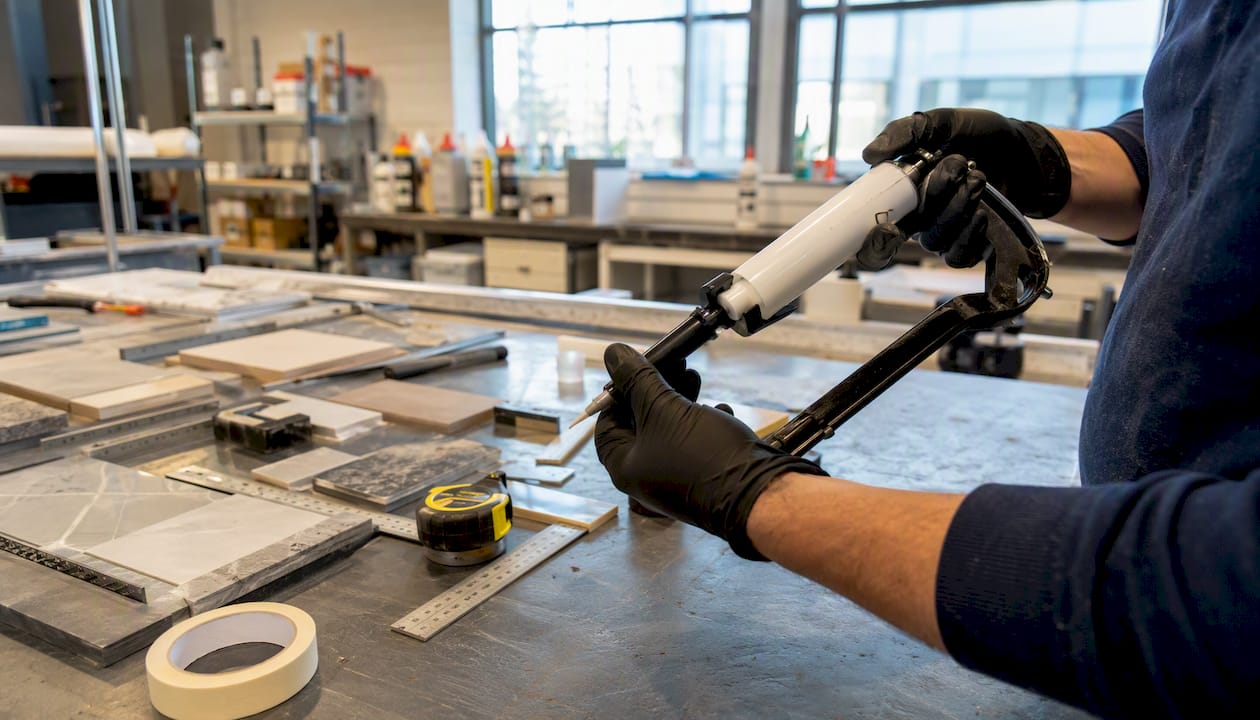
Fast cleanup, low odor, and low VOC make acrylics popular for above-grade residential jobs. The limitation is elongation: acrylics are more rigid once cured and offer minimal moisture vapor protection. Use them only where the manufacturer explicitly approves and the subfloor is dry, flat, and above grade. Applying an acrylic under a wide-plank solid floor over a slab is one of the most reliable ways to generate cupping complaints six months later.
Solvent-based and older chemistries
Largely phased out in most U.S. markets due to VOC regulations and health concerns. You may still encounter them in renovation work or in products marketed for specific exotic species. Check your state’s VOC limits before specifying any solvent-based product.
Adhesive comparison table
| Adhesive type | Best for | Substrate compatibility | Moisture / vapor protection | Working / open time | Trowel / coverage | VOC profile |
|---|---|---|---|---|---|---|
| Moisture-cure urethane | Solid, exotic species, radiant heat | Concrete, plywood | High; some products rated for elevated MVER | 30 min typical; solvent cleanup | V-notch or U-notch per TDS | Low to moderate; solvent-based cleanup |
| MS polymer hybrid | Engineered, wide plank, solid | Concrete, plywood, gypsum-based | High to very high; 3-in-1 systems available | 45–90 min; water cleanup on some | V-notch; 100% transfer required for 3-in-1 | Zero to very low VOC |
| Water-based acrylic | Dimensionally stable engineered | Above-grade plywood only | Low; no vapor retarder capacity | 20 min typical; water cleanup | Notched trowel per TDS | Very low VOC |
| Solvent-based | Specialty / exotic species only | Concrete, plywood | Moderate | Varies; solvent cleanup | Varies | High; check state limits |
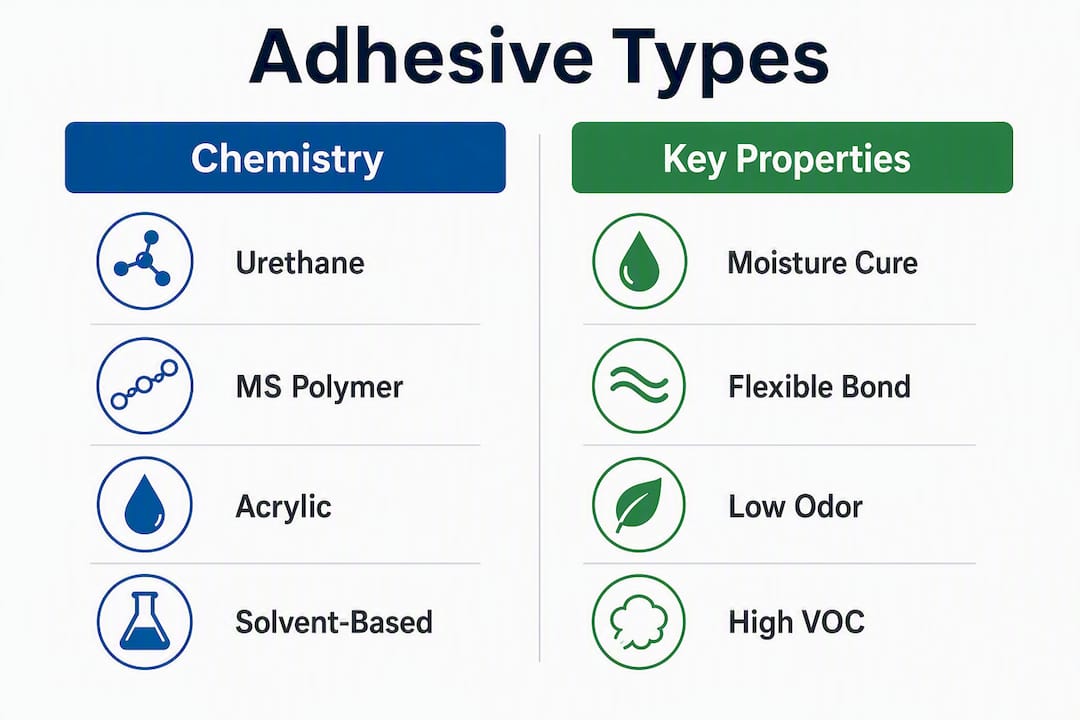
Modern hybrid adhesives can perform multiple functions simultaneously: bonding, moisture inhibition, and sound dampening. This 3-in-1 capability reduces the need for separate membranes, but only when coverage is correct.
When should you glue down instead of nail or float?
The method follows the product and the site, not personal preference. Getting this wrong is expensive: wide-plank flooring considered wide by manufacturers is often required by manufacturers to be glued down to prevent cupping, buckling, and hollow spots. Elastomeric adhesives are the only chemistry that handles the movement those planks generate.
Step-by-step decision process:
- Measure plank width. At a considered wide plank width, glue-down is almost always required or strongly recommended. Below 3", nail-only or float is typically fine over plywood.
- Check the manufacturer’s installation instructions. This is non-negotiable. Deviating from approved methods voids the product warranty, regardless of how experienced the installer is.
- Identify the subfloor. Concrete slab, especially on- or below-grade, means moisture risk. Nail-only is impossible over concrete without a wood sleeper system. Glue-down or glue-plus-nail is the path.
- Test for moisture. Run ASTM F1869 and ASTM F2170 before committing to any method. Results above the adhesive’s rated limits require mitigation or a different product.
- Assess room conditions. High humidity swings (basements, sunrooms, rooms over crawl spaces) favor elastomeric glue-down over floating, which can telegraph movement at joints.
- Pick the method. Glue-down for concrete or wide plank; glue-plus-nail for wide solid planks over plywood where the manufacturer allows; nail-only for narrower solid strips over plywood; float only where the manufacturer explicitly permits it and moisture is controlled.
Three real-world scenarios:
Basement engineered floor in Michigan: Below-grade concrete slab, 5" wide engineered plank. Moisture-cure urethane or MS hybrid with documented MVER and RH testing. Glue-down only. See hardwood flooring for Michigan basements for local guidance on below-grade moisture conditions.
Above-grade wide plank over plywood: 6" solid white oak, second floor, plywood subfloor. Glue-plus-nail with an elastomeric urethane or MS hybrid as the adhesive layer. The fasteners provide mechanical hold while the adhesive controls cupping between nails.
Radiant-heated slab: Engineered flooring, 4" wide, hydronic radiant heat. Moisture-cure urethane with approximately 400% elongation, confirmed compatible with radiant heat in the TDS. Glue-down; document slab temperature and moisture before and after system commissioning.
How do subfloor type and moisture affect your adhesive choice?
Moisture is where most hardwood floor failures start. The adhesive is the last line of defense, and choosing one without testing the slab first is guesswork that costs real money.
ASTM F1869 and ASTM F2170 explained
ASTM F1869 measures moisture vapor emission rate (MVER) from a concrete slab using a calcium chloride test, expressed in pounds per 1,000 sq ft per 24 hours. ASTM F2170 measures in-slab relative humidity (RH) using probes inserted into the slab. Manufacturers reference both when specifying limits and warranty conditions. A product like DriTac 7900 Super Grab, for instance, is warranted up to 12 lbs/1,000 ft²/24 hrs MVER and up to 85% RH when used as a full 3-in-1 system. When used as adhesive-only (without the full membrane coverage), those limits drop to 3 lbs/1,000 ft² and 75% RH. That gap illustrates exactly why coverage technique matters as much as product selection.
A common misconception: Many installers assume that buying a moisture-control adhesive automatically handles the slab. It does not. The adhesive delivers its rated moisture protection only when applied at the correct trowel size, with complete transfer, and over a properly prepared substrate. Skipping the moisture test and relying on the adhesive label alone is one of the most documented causes of flooring warranty denials.
Substrate types and what they require
Concrete slabs need moisture testing regardless of grade. On- and below-grade slabs almost always require a moisture-control adhesive or a separate vapor mitigation system. Primers may be required on porous or dusty concrete to improve adhesion and prevent bond failure.
Gypsum-based underlayments (common in multifamily construction) require specific adhesive compatibility. Not all urethanes bond well to gypsum; check the TDS explicitly. Some products require a primer coat.
Plywood and OSB are more forgiving on moisture but still need to meet subfloor flatness requirements: typically within 3/16" in 10 feet or 1/8" in 6 feet. Hollow spots from an unflat subfloor cannot be corrected by adhesive selection alone and frequently void warranties.
Mitigation options when moisture exceeds limits
When slab readings exceed the adhesive’s rated capacity, you have three paths: use a product with a higher rated limit (and document it), install a separate vapor mitigation system before the adhesive, or choose a different flooring product rated for higher moisture exposure. Primers and surface consolidators address weak or dusty surfaces but are not moisture barriers. Keep all test results and product documentation for warranty support.
How do you apply adhesive correctly for a strong bond?
Technique determines whether the adhesive delivers its rated performance or just looks like it does. The difference shows up at the six-month inspection.
Trowel selection and coverage
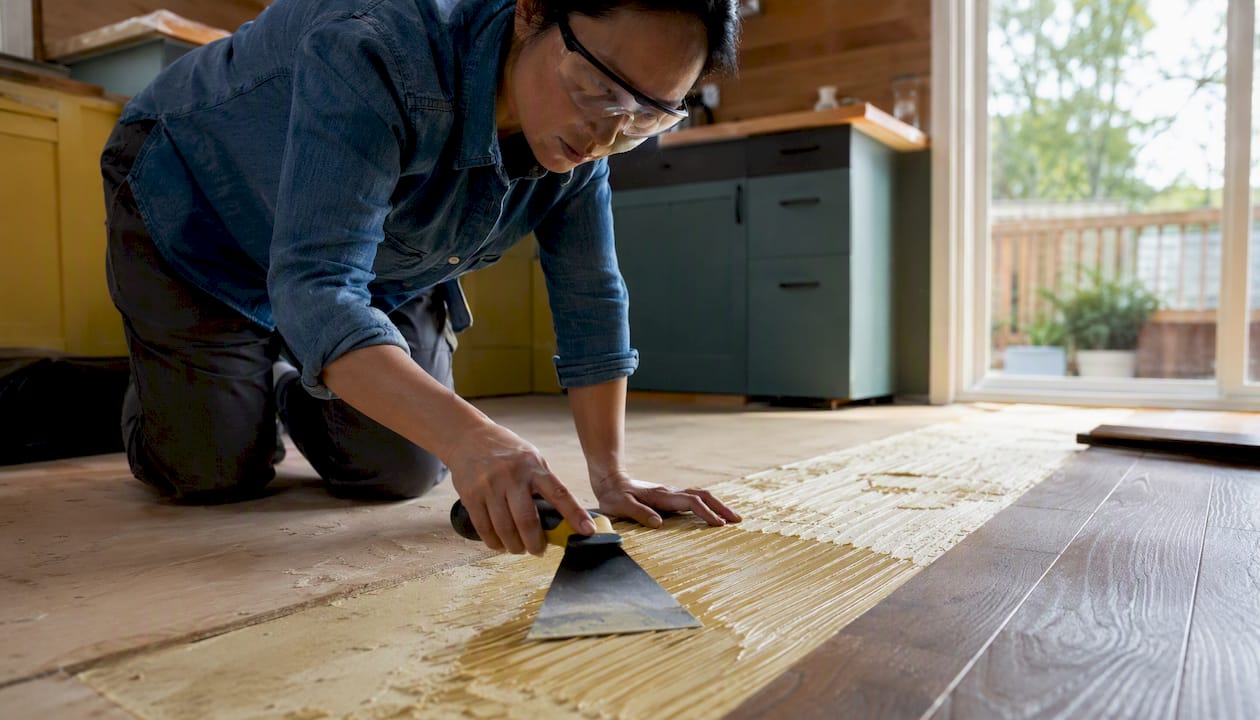
The trowel size is specified in the TDS for a reason: it controls adhesive thickness and, for 3-in-1 systems, membrane continuity. Using a worn or undersized trowel reduces coverage and breaks the vapor barrier. Replace trowel blades regularly; a notch that has worn down even slightly changes the spread rate.
For 3-in-1 systems, near-100% adhesive transfer to the plank back is required to achieve the advertised moisture protection and warranty coverage. Check transfer by lifting a plank within the first few minutes of installation: the back should be fully coated, with no bare spots.
Wet-set technique and seating
- Spread adhesive in sections no larger than you can cover before the open time closes
- Seat planks firmly into wet adhesive with a slight rocking motion to collapse air pockets
- Roll the floor with a 100-lb roller after each section to improve contact
- Apply weight or strapping to any bowed planks and leave until the adhesive reaches green strength
- Check transfer on the first 3–4 planks of every new section; adjust technique if bare spots appear
Environmental conditions
Adhesive open time and cure rate both change with temperature and humidity. Most products are rated for application between 65°F and 85°F with 30–65% relative humidity. Cold slabs slow cure significantly; hot, dry conditions shorten open time and can cause skinning before planks are seated. Acclimate the flooring to the room before installation.
Pro Tip: For wide planks, prioritize a product with strong green grab (initial tack) alongside high elongation. Strong green grab holds the plank in position before full cure, preventing the creep that causes hollow spots on large-format boards. A product that feels “slippery” when you first set a plank is a warning sign on anything wider than 5 inches.
Cleanup and tool care matter too. Modified silane and urethane adhesives cure permanently once set. Clean tools and squeeze-out immediately with the manufacturer’s recommended solvent or cleaner. Cured MS or urethane adhesive is extremely difficult to remove and can damage the subfloor surface if you try to grind it off later.
How do you read a technical data sheet to choose the right product?
A TDS is a one-page filter. If a product’s TDS does not answer every question below for your specific job, call the manufacturer’s technical services line before buying.
TDS checklist: fields that matter
| TDS field | What to look for | Why it matters |
|---|---|---|
| Approved substrates | Concrete, plywood, gypsum-based, OSB | Mismatched substrate voids the warranty |
| MVER limit (ASTM F1869) | lbs/1,000 ft²/24 hrs | Must exceed your tested slab reading |
| RH limit (ASTM F2170) | % RH | Must exceed your in-slab probe reading |
| Elongation / elasticity | % elongation at break | Higher = more movement accommodation |
| Open time | Minutes at rated temp/humidity | Determines section size you can safely spread |
| Cure time | Hours to foot traffic, full cure | Affects scheduling and when to roll/sand |
| VOC content | g/L | Check against state limits and occupancy |
| Recommended trowel | Notch size and shape | Non-negotiable for coverage and warranty |
| System vs. adhesive-only limits | Separate MVER/RH ratings | 3-in-1 system limits are higher; adhesive-only limits are lower |
The system-vs.-adhesive-only distinction is the one most installers miss. A product may be warranted to 12 lbs MVER as a 3-in-1 system but only 3 lbs as adhesive-only. If you are not achieving 100% transfer, you are operating under the lower limit whether you know it or not.
Contact the manufacturer’s technical services team for any job involving exotic species, gypsum substrates, below-grade installations, or slab readings near the product’s rated limit. Document that conversation: date, representative name, and the recommendation given. That record protects both the installer and the homeowner if a warranty claim arises later. For engineered flooring questions specific to product construction and adhesive compatibility, Quality Hardwoods of Michigan, Inc’s team can point you to the right TDS before you order.
What does an NWFA-aligned installer checklist look like?
The checklist below reflects NWFA guidance on installation readiness. Run through it before the first trowel hits the floor.
Pre-installation
- Confirm subfloor flatness: 3/16" in 10 ft, 1/8" in 6 ft. Grind high spots; fill low spots with appropriate leveler.
- Complete ASTM F1869 and ASTM F2170 moisture testing. Record results with date, test location, and ambient conditions.
- Acclimate the flooring to the room’s expected service conditions. Do not skip this step for wide-plank or exotic species.
- Confirm adhesive selection against TDS: substrate approved, MVER/RH limits exceed test results, elongation appropriate for species and width.
- Verify trowel size matches TDS specification. Have replacement blades on hand.
During installation
- Spread in manageable sections; do not exceed open time.
- Check adhesive transfer on first planks of each new section.
- Roll with a 100-lb roller after each section.
- Apply weight to bowed planks; document any boards requiring correction.
- Keep room temperature and humidity within the adhesive’s rated range throughout cure.
Documentation to retain
- Moisture test results (both ASTM methods)
- Adhesive product name, lot number, and TDS version
- Trowel size used and coverage verification notes
- Acclimation log (start date, end date, room conditions)
- Any technical services consultation records
Common mistakes that generate callbacks: Using the wrong trowel notch size (the single most frequent coverage failure); skipping moisture testing and discovering the problem at the warranty claim stage; failing to check adhesive transfer on early planks; applying adhesive over a subfloor that has not been flattened to spec; and ignoring the TDS open-time limit in hot weather, which causes skinning and weak bonds before the plank is even seated.
Quality Hardwoods of Michigan, Inc’s 40-plus years serving Michigan contractors and homeowners means the team has seen every one of these mistakes and can help you avoid them before the job starts. Matching the right adhesive to the right substrate is exactly the kind of guidance available at the showroom or by phone.
Key Takeaways
Elastomeric moisture-control adhesives, matched to a properly tested and flattened subfloor, are the foundation of every durable hardwood floor installation.
| Point | Details |
|---|---|
| Choose elastomeric for wide plank or slabs | MS hybrid or moisture-cure urethane is required for planks 5" and wider or any concrete slab with moisture risk. |
| Document ASTM moisture tests | Run both ASTM F1869 and ASTM F2170 before selecting an adhesive; retain results for warranty support. |
| Require near-100% adhesive transfer | 3-in-1 systems deliver their rated moisture protection only with complete transfer to the plank back. |
| Read the TDS before buying | Check approved substrates, MVER/RH limits, elongation, open time, and trowel size before committing to a product. |
| Quality Hardwoods of Michigan, Inc | Over 40 years of Michigan flooring expertise; contact the team for adhesive selection guidance, local pickup, or statewide delivery. |
The adhesive decision most installers get wrong
Most of the adhesive failures I see documented in the field come down to one thing: installers treating the adhesive label as a guarantee rather than a conditional specification. A product rated for “unlimited moisture vapor protection” is not a magic membrane. It is a system that delivers that protection when the trowel is correct, the transfer is complete, the substrate is flat, and the moisture was tested beforehand. Skip any one of those steps and the rating is meaningless.
The other underappreciated factor is green grab. On a 7-inch white oak plank, the difference between an adhesive with strong initial tack and one that feels slippery is the difference between a floor that stays flat during cure and one that develops hollow spots you cannot fix without tearing it up. Wide-plank installers should ask specifically about green grab when evaluating products, not just elongation and VOC numbers.
My honest recommendation: for anything wider than 5 inches or anything over a concrete slab, do not let price drive the adhesive decision. The adhesive is a small fraction of the total job cost and the largest single variable in long-term performance. Spend the extra $15 per gallon on the right chemistry, document your moisture tests, and call technical services if anything about the substrate is unusual. That is the framework that holds up when a warranty claim comes in two years later.
Quality Hardwoods of Michigan, Inc can help you get this right
Choosing the right adhesive is straightforward when you have the right distributor behind you. Quality Hardwoods of Michigan, Inc stocks moisture-control adhesives, trowels, and related installation supplies alongside its full hardwood and engineered flooring inventory. The team can match your specific subfloor conditions, plank width, and species to the correct adhesive chemistry before you order, saving you the cost of a wrong product on a large job.

Local pickup is available at the showroom, and statewide delivery covers contractors and homeowners across Michigan. Whether you need a single product recommendation or full documentation support for a warranty-sensitive installation, the team is available by phone or in person. Explore the full product range, including flooring and installation supplies, or stop by the showroom to talk through your project with someone who has seen the same Michigan basement slabs and wide-plank challenges you are dealing with. Contact Quality Hardwoods of Michigan, Inc directly to get a quote or confirm product availability before your installation date.
Useful sources and further reading
The sources below back the guidance in this article and are worth bookmarking for any hardwood flooring project:
- Selecting the Right Adhesive, Hardwood Floors Magazine: Practical breakdown of adhesive chemistry, coverage, and moisture considerations from a trade publication
- NWFA Technical Guidelines: The National Wood Flooring Association’s installation and adhesive standards; the authoritative reference for warranty-compliant work
- NWFA main site: General resource for finding certified installers, training, and technical publications
- SikaBond T100 product page: TDS and application guidance for the MS hybrid product referenced in this article
- SikaBond T55 product page: TDS for the moisture-cure urethane with 400% elongation discussed in the types section
- DriTac 7900 Super Grab product page: Documented MVER and RH limits for adhesive-only vs. 3-in-1 system use
- Titebond technical guidance: Manufacturer technical services reference on adhesive transfer requirements
- Quality Hardwoods of Michigan, Inc subfloor guide: Local resource on subfloor flatness tolerances and preparation steps
For unusual substrates, exotic species, or slab readings near a product’s rated limit, contact the manufacturer’s technical services line and retain a record of the consultation.
FAQ
What is the best adhesive for hardwood floors?
For most installations, an elastomeric moisture-control adhesive (MS polymer hybrid or moisture-cure urethane) is the strongest choice, particularly for wide planks or concrete subfloors. NWFA guidance stresses that the right adhesive depends on jobsite environment, subfloor type, and plank width rather than a single universal answer.
Do you need to glue down 5-inch hardwood flooring?
Yes, in most cases. Manufacturers commonly require or strongly recommend glue-down for planks 5 inches and wider to prevent cupping, buckling, and hollow spots. Always check the specific product’s installation instructions, as deviating voids the warranty.
What glue do professional flooring installers use?
Professionals typically use moisture-cure urethane or MS polymer hybrid adhesives for demanding jobs, particularly wide-plank or slab installations. For above-grade engineered floors in dry interiors, water-based acrylics are sometimes used when the manufacturer approves.
What is the difference between adhesive-only and a 3-in-1 system?
A 3-in-1 system uses the adhesive as both the bond layer and a continuous vapor membrane, requiring near-100% transfer to the plank back. Products like DriTac 7900 Super Grab are warranted to higher MVER and RH limits as a 3-in-1 system (up to 12 lbs/1,000 ft²/24 hrs) than when used as adhesive-only (3 lbs/1,000 ft²/24 hrs).
Recommended
- Install Hardwood Vinyl LVP | Quality Hardwoods of Michigan
- Hardwood Floor Finishes: Which One Is Best for Your Home? | Quality Hardwoods of Michigan
- Engineered vs Solid Hardwood Flooring: Which Is Right for Your Home? | Quality Hardwoods of Michigan
- How to Acclimate Hardwood Flooring Before Installation | Quality Hardwoods of Michigan