

A flooring warranty transfer is the process of passing the remaining warranty coverage on a flooring product from the original homeowner to the new owner when a property is sold. Not all warranties transfer automatically, and the rules vary significantly depending on the type of warranty involved. Here is what you need to know before you list your home or sign a purchase agreement.
What typically transfers:
- Manufacturer product warranties (material defects, finish wear, structural integrity of the plank)
- Builder warranties under the standard “1-2-10” coverage model, subject to notification requirements
- Some third-party structural warranties, depending on the provider
What usually does not transfer:
- Installer workmanship warranties, which are personal contracts tied to the original installation crew
- Warranties voided by improper maintenance, unauthorized modifications, or missed registration deadlines
Understanding the flooring warranty transfer process matters in real estate because a transferable warranty can affect negotiations, buyer confidence, and even sale price. The Magnuson-Moss Warranty Act governs how limited warranties must be disclosed, requiring that all transfer terms, fees, and deadlines be clearly stated before a sale. Ignoring those terms does not make the warranty disappear quietly; it voids coverage the buyer was counting on.
Table of Contents
- 1. Manufacturer product warranties: usually transferable with conditions
- 2. Installer workmanship warranties: almost never transferable
- 3. Builder warranties: transferable but deadline-driven
- 4. What happens when a warranty is non-transferable or unclear
- 5. How transfer deadlines and fees work in practice
- 6. What documentation you need to transfer a flooring warranty
- 7. How warranty transfers affect sellers during a home sale
- 8. How buyers should verify warranty transfer status before purchase
- 9. Common misconceptions about flooring warranty transfers
- 10. Best practices for managing flooring warranty transfers
- Quality Hardwoods of Michigan, Inc: flooring you can stand behind at resale
- Key Takeaways
- FAQ
1. Manufacturer product warranties: usually transferable with conditions
Manufacturer warranties cover defects in the flooring material itself, things like finish failure, wear-through, or plank delamination. Most of these transfer to the new owner upon sale, but “transferable” does not mean automatic.
Typical coverage items:
- Manufacturing defects in material or finish
- Wear-through of the surface layer (often rated in mils or years)
- Structural integrity of the plank or tile
Transfer conditions manufacturers commonly require:
- A completed transfer form submitted within a typical deadline after closing
- A transfer fee that may be required by the manufacturer, which varies widely
- Proof of original purchase and installation date
- The original warranty registration number
Miss the filing window and the warranty terminates, regardless of how many years of coverage remain. Some manufacturers also prorate coverage over time, meaning the buyer inherits a reduced benefit even when the transfer is completed correctly.
2. Installer workmanship warranties: almost never transferable
Workmanship warranties cover the quality of the installation itself, not the product. If the installer left gaps, used the wrong adhesive, or failed to account for moisture, a workmanship warranty is what gets that fixed. The problem for buyers is that these warranties are personal contracts between the original homeowner and the installation crew. They do not attach to the property.

When a home sells, the installer’s obligation to the original client ends. A new owner has no standing to file a workmanship claim under that original agreement. This is one of the most common points of confusion in real estate transactions involving flooring.
What this means practically:
- Buyers should inspect installation quality before closing, not after
- Sellers cannot offer workmanship warranty coverage as a selling point unless the installer has issued a written, explicitly transferable guarantee
- If installation defects surface post-sale, the buyer’s only recourse is typically the manufacturer warranty (if the defect qualifies) or legal action
For buyers purchasing a home with recently installed hardwood flooring, asking the seller for the installer’s contact information and original work order is worth doing, even if the warranty itself does not transfer.
3. Builder warranties: transferable but deadline-driven
Builder warranties on new construction follow a well-established structure in the industry. The standard “1-2-10” model covers one year of workmanship, two years of mechanical systems, and ten years of structural defects. Most builder warranties transfer to the new owner when the home is sold, but the transfer is not passive.
Key transfer requirements for builder warranties:
- Formal written notification to the warranty provider before or shortly after closing
- Submission of transfer paperwork within the deadline specified in the warranty document
- Payment of any applicable transfer fee
- Confirmation in writing that the transfer is complete
State law adds another layer. Florida’s statute §553.837, signed in 2024, requires every builder of a newly constructed residential home to provide a mandatory, transferable warranty of at least one year. The warranty transfers automatically during that first year with no forms or fees required. Texas extends implied warranties to subsequent buyers for latent defects. Pennsylvania, by contrast, does not extend implied warranties to subsequent buyers without privity of contract, meaning express written transfer provisions are the only reliable path to coverage there.
Builder warranties and manufacturer warranties on individual flooring components are separate instruments. A builder warranty covering structural defects does not automatically extend to the flooring product warranty. Each must be addressed independently during the sale.
4. What happens when a warranty is non-transferable or unclear
Not every flooring warranty fits neatly into “transfers” or “does not transfer.” Some fall into a gray zone that creates real problems at closing.
Common scenarios:
- Non-transferable by explicit terms: The warranty document states coverage ends with the original purchaser. Nothing the seller or buyer does will change this.
- Conditional transfer with missed deadline: The warranty was transferable, but the seller did not file the paperwork within the required window. Coverage is forfeited.
- Missing documentation: The original warranty certificate, purchase receipt, or registration number cannot be located. Without these, most manufacturers will not process a transfer.
- Unclear language: The warranty document is silent on transferability. Courts in some states have ruled that silence does not automatically mean non-transferable, but pursuing that argument is expensive and uncertain.
- Voided by modifications: Unauthorized changes to the floor, such as refinishing a floor the manufacturer did not approve for sanding, can void coverage before a transfer is even attempted.
When documentation is missing, buyers should request the flooring brand and product line from the seller, then contact the manufacturer directly to ask about transfer eligibility. Some manufacturers can locate original registrations by address or installation date.
5. How transfer deadlines and fees work in practice
The mechanics of a flooring warranty transfer are straightforward once you know what to look for. The challenge is that most homeowners do not read warranty documents until they are already in escrow.

Most manufacturer warranties require the transfer form to be filed within 30–60 days after closing. Transfer fees typically range from $25 to $500, depending on the manufacturer and remaining coverage term.
Pro Tip: Request written transfer confirmation from the manufacturer before closing, not after. A letter or email stating the new owner’s name and the warranty’s remaining term is the only document that protects the buyer if a claim arises later.
6. What documentation you need to transfer a flooring warranty
Gathering the right paperwork is where most warranty transfers stall. Sellers often discover at closing that they cannot locate documents they assumed were stored somewhere safe.
Documents typically required:
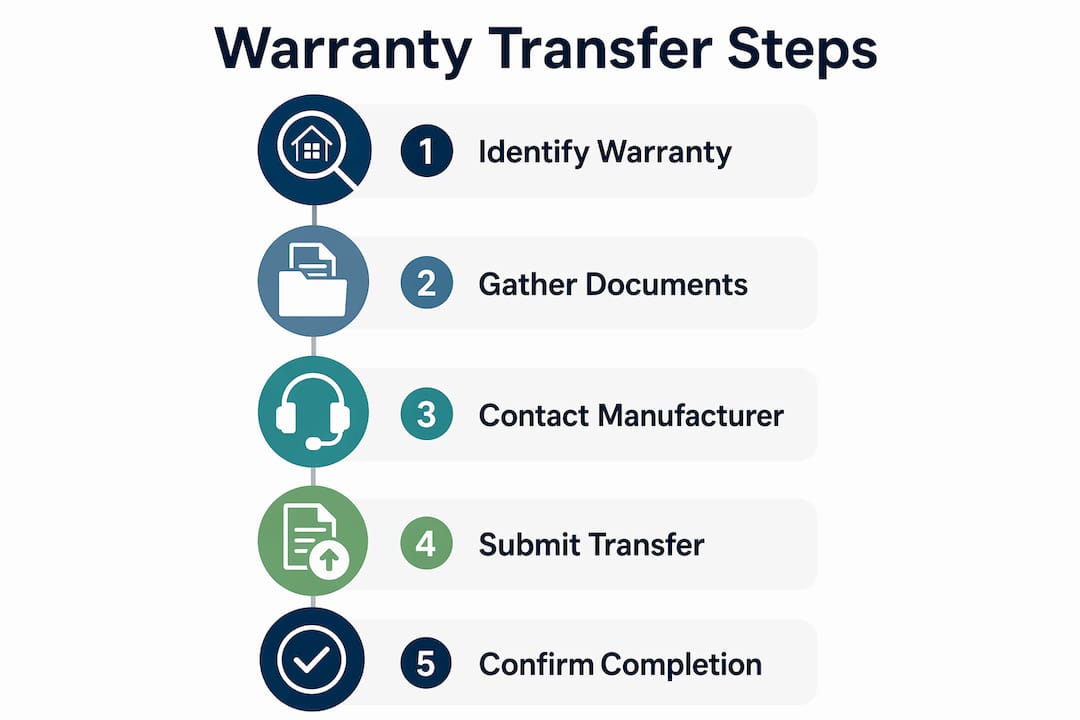
- Original warranty certificate or registration confirmation
- Proof of purchase (receipt or invoice from the flooring retailer or installer)
- Installation date and installer’s name or company
- Copy of the home sale agreement or closing disclosure
- Completed manufacturer transfer form (available on the manufacturer’s website or by request)
Some manufacturers also require photos of the floor’s current condition or a signed statement that the floor has been maintained according to their care guidelines. Vinyl plank flooring, for example, often carries specific maintenance requirements around cleaning products and humidity levels. Failing to meet those conditions can give a manufacturer grounds to deny a transfer even when the paperwork is otherwise complete.
Buyers purchasing vinyl flooring should ask sellers specifically about care history, not just warranty documents. The two are connected.
7. How warranty transfers affect sellers during a home sale
A transferable flooring warranty is a genuine marketing asset, not just a legal formality. Sellers who can hand buyers a complete warranty package, with documentation, transfer confirmation, and remaining coverage terms, are offering something concrete that reduces buyer risk.
Sellers are advised to compile all installation documents and warranty certificates into a clear disclosure package before listing. This signals to buyers that the home has been maintained and that the flooring investment is protected.
Seller responsibilities in a warranty transfer:
- Locate and organize all flooring warranty documents before listing
- Verify with each manufacturer whether the warranty is transferable and what the process requires
- Initiate the transfer process during escrow, not after closing
- Disclose any warranties that are non-transferable or have already expired
A non-transferable warranty is not necessarily a deal-breaker, but failing to disclose it can be. Buyers who discover post-sale that a warranty they believed was in place has no legal standing have grounds for a dispute. Clear disclosure avoids that entirely.
8. How buyers should verify warranty transfer status before purchase
Buyers carry more responsibility here than most realize. Sellers are not always aware of the fine print in their own warranty documents, and real estate agents rarely specialize in flooring warranty terms.
Before closing, buyers should:
- Ask the seller for all flooring warranty documents, not just a verbal assurance
- Contact the manufacturer directly to confirm the warranty is still active and transferable
- Confirm the transfer deadline and initiate the process during escrow
- Get written confirmation of the transfer from the manufacturer before funds are released
If the seller cannot produce documentation, buyers can sometimes recover it by contacting the flooring retailer or installer with the property address and approximate installation date. Some manufacturers maintain registration databases searchable by address.
One detail worth checking: some warranties can only be transferred once. If the current seller is not the original owner, the warranty may have already been transferred once and may not be eligible for a second transfer. Ask directly.
9. Common misconceptions about flooring warranty transfers
Several assumptions circulate in real estate transactions that are simply wrong.
“The warranty stays with the house automatically.” Not true for most flooring warranties. Manufacturer warranties require active transfer steps, and workmanship warranties do not transfer at all.
“If the floor looks fine, the warranty doesn’t matter.” Flooring defects often appear years after installation, particularly in engineered hardwood or laminate exposed to humidity fluctuations. A warranty that covers those defects has real financial value.
“The home warranty covers the floors.” Home warranties are service contracts covering systems and appliances. They are not the same as manufacturer warranties on flooring products, and each must be addressed independently during a sale.
“A transferable warranty means full coverage.” Some warranties are prorated. After several years, the buyer may only receive partial credit toward replacement materials, with labor excluded entirely.
10. Best practices for managing flooring warranty transfers
Confusion between product warranties and workmanship warranties is one of the most common causes of post-sale disputes in real estate transactions involving flooring. Clear documentation and proactive communication with manufacturers before closing are the two steps that prevent most of those disputes from happening.
Quality Hardwoods of Michigan, Inc has worked with contractors, builders, and homeowners across Michigan for over 40 years. The guidance below reflects what actually works when warranty transfers need to go smoothly.
Warranty transfer checklist for sellers:
- Pull all flooring warranty documents at least 60 days before listing
- Identify each warranty type: manufacturer, installer, or builder
- Contact each manufacturer to confirm transferability and current transfer requirements
- Initiate transfer paperwork during escrow, not at or after closing
- Obtain written confirmation of each completed transfer
- Assemble a single warranty disclosure package to hand to the buyer at closing
For buyers:
- Never accept verbal assurances about warranty status
- Verify active coverage directly with the manufacturer before closing
- Confirm whether the warranty has already been transferred once (which may affect eligibility)
- Check that maintenance requirements have been met, since violations can void coverage
Understanding hardwood flooring warranty types before you buy or sell gives you a clear picture of what coverage actually exists and what steps are needed to preserve it.
Quality Hardwoods of Michigan, Inc: flooring you can stand behind at resale

When you install flooring backed by a manufacturer warranty worth transferring, you start the resale process in a stronger position. Quality Hardwoods of Michigan, Inc carries hardwood, luxury vinyl plank, and laminate flooring lines that come with manufacturer warranties designed to hold up over time, not just through the first owner’s tenure.
With over 40 years serving Michigan homeowners, contractors, and builders, Quality Hardwoods of Michigan, Inc can help you choose flooring products with clear, documented warranty terms from the start. That means less scrambling at closing and more confidence for the buyers you are trying to impress. Visit the showroom or browse the full product range to find flooring that protects your investment through every ownership.
Key Takeaways
Flooring warranty transfers require active steps from sellers, and missing deadlines or documentation typically voids coverage the buyer was counting on.
| Point | Details |
|---|---|
| Manufacturer warranties transfer with conditions | Transfer forms must typically be filed within 30–60 days of closing, with fees ranging from $25 to $500. |
| Workmanship warranties do not transfer | Installer warranties are personal contracts and end with the original homeowner. |
| Builder warranties follow the 1-2-10 model | Coverage for workmanship, systems, and structure usually transfers but requires formal notification. |
| Documentation is non-negotiable | Original warranty certificate, purchase receipt, and a completed transfer form are required by most manufacturers. |
| Quality Hardwoods of Michigan, Inc | Carries flooring lines with manufacturer warranties worth transferring, backed by 40+ years of Michigan expertise. |
FAQ
Are flooring warranties transferable?
Most manufacturer product warranties on flooring are transferable to a new owner, but they require paperwork, fees, and must be filed within a set deadline, typically 30–60 days after closing. Installer workmanship warranties are generally not transferable.
How does a warranty transfer work for flooring?
The seller or buyer contacts the manufacturer, completes a transfer form, pays any applicable fee (typically $25–$500), and receives written confirmation that coverage has shifted to the new owner. The process must usually be completed within 30–60 days of the closing date.
How much does a flooring warranty transfer cost?
Transfer fees vary by manufacturer and remaining coverage term, typically ranging from $25 to $500. Some manufacturers charge nothing, while others require both a fee and a formal inspection before approving the transfer.
Do builder warranties transfer to a new owner?
Yes, most builder warranties under the standard 1-2-10 model transfer to the new homeowner, but formal notification and timely paperwork are required. State law also affects transferability: Florida mandates automatic transfer in the first year, while Pennsylvania does not extend implied warranties to subsequent buyers without a written transfer provision.
What happens if the warranty transfer deadline is missed?
Missing the transfer window typically voids the remaining warranty coverage for the new owner, even if years of coverage remain on the original term. Some manufacturers may grant exceptions, but most treat the deadline as a hard cutoff.