
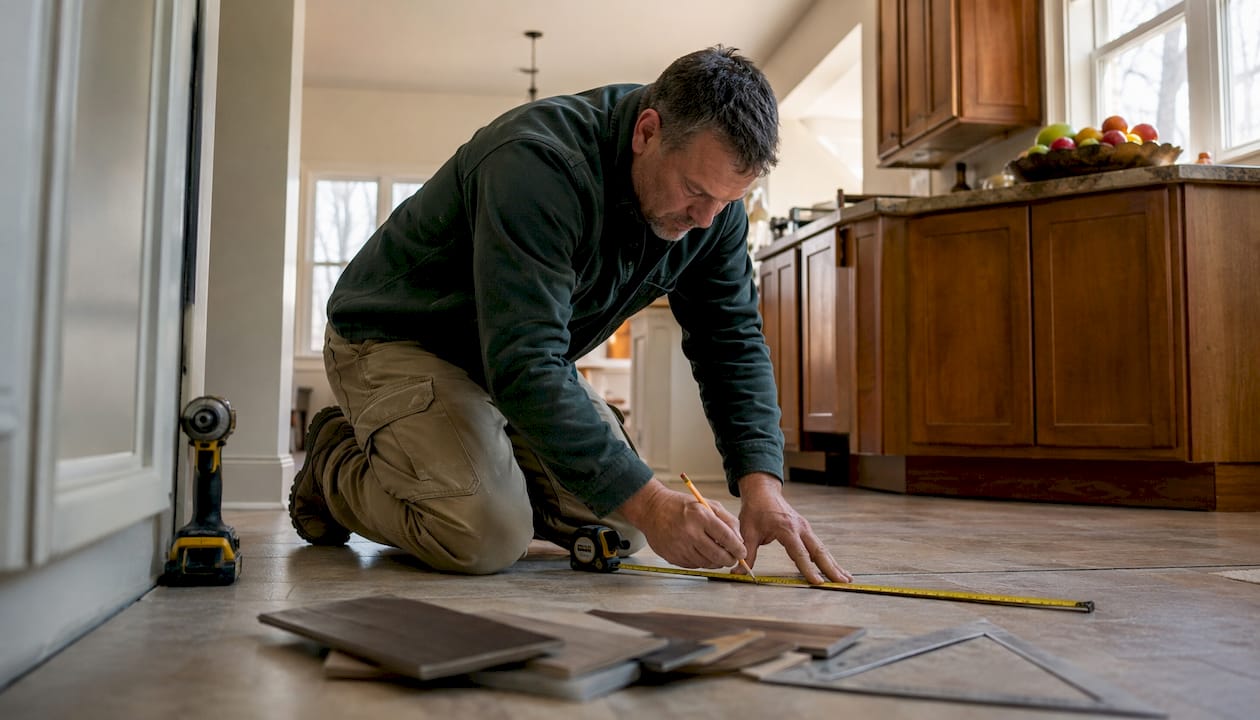
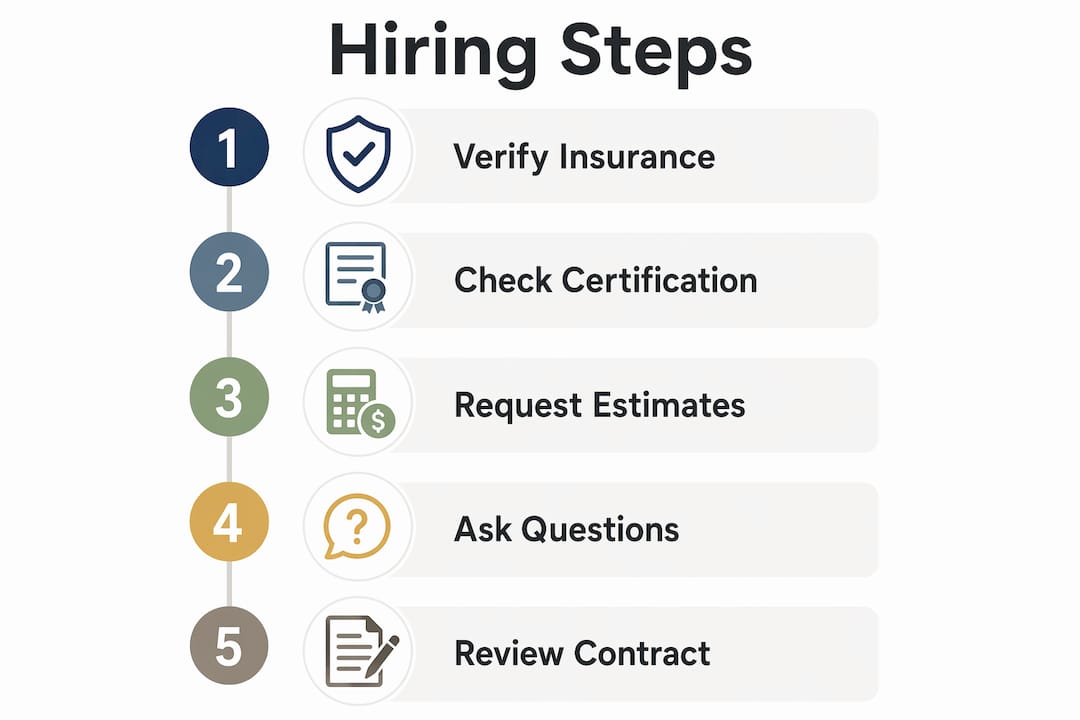
Get at least two written estimates from insured installers who have hands-on experience with your specific material — hardwood, engineered, LVP, or laminate — then verify insurance, check references, and confirm a written workmanship warranty before signing anything. That sequence is the whole job.
Three non-negotiables before you hire anyone:
- Insurance and licensing. Request a certificate of insurance (COI) showing general liability and workers’ compensation. Licensing requirements vary by state, so check with your Michigan municipality before you start.
- Material-specific experience. An installer who specializes in LVP is not automatically qualified for solid hardwood sanding and finishing. Confirm they have done your material before.
- Written scope and warranty. A verbal promise is worthless. Get itemized scope, payment schedule, and a workmanship guarantee in writing.
Table of Contents
- What should a qualified flooring installer provide?
- Where do you find and screen flooring installers in Michigan?
- What questions should you ask during the estimate?
- How do you compare written estimates fairly?
- What should you expect during installation?
- How do you verify licensing, insurance, and warranty claims?
- When is professional installation worth it versus DIY?
- Key Takeaways
- Why the hiring checklist reflects real Michigan project outcomes
- Quality Hardwoods of Michigan, Inc: materials, installers, and local expertise in one place
- Useful sources and further reading
- FAQ
What should a qualified flooring installer provide?
A professional installer brings more than labor. The deliverables below separate a qualified contractor from someone who just owns a nail gun.
- Itemized written estimate covering materials, removal, subfloor prep, finish work, trim, transitions, and disposal
- Material-specific methods — acclimation periods for hardwood, moisture testing before any wood install, and proper adhesive or click-lock technique for LVP
- Realistic timeline with start and finish dates, including acclimation days built into the schedule
- Dust control and cleanup — especially critical for sanding and finishing solid hardwood, which requires different vacuum systems and finishing protocols than LVP work
- Workmanship warranty in writing, separate from the product manufacturer’s warranty
- Proof of insurance before work begins, not after
Acclimation is worth calling out specifically. Improper acclimation increases the risk of seasonal gapping and buckling in hardwood floors — problems that show up months after installation and are expensive to fix. A qualified installer builds acclimation time into the project schedule, not as an afterthought.
Pro Tip: For hardwood projects, ask whether the installer holds NWFA (National Wood Flooring Association) certification. NWFA-certified installers have passed practical and written exams covering acclimation, moisture diagnostics, and finishing techniques — a hard credential that generic contractor listings won’t show you.
Where do you find and screen flooring installers in Michigan?
Discovery channels worth your time:
- Local dealer referrals — flooring distributors like Quality Hardwoods of Michigan, Inc work with vetted installers regularly and can point you toward crews familiar with specific products
- Manufacturer certified-installer lists — product brands maintain lists of trained installers; certified installers often carry additional manufacturer support and can simplify warranty claims
- Trade associations (NWFA member directory)
- Verified review platforms with documented licensing checks
- Contractor referrals from builders or remodelers you already trust
Screening workflow — run this before the in-person estimate:
- Call or email: ask about years in business, materials they install regularly, and whether they carry general liability and workers’ comp
- Request portfolio photos of recent projects using your material type
- Ask for two or three references from similar projects (same material, comparable room size)
- Confirm they will provide a written estimate with itemized scope
Quick accept/reject checklist:
- Proof of insurance available on request? ✓
- At least three years installing your material type? ✓
- Recent project photos that match your scope? ✓
- Willing to provide client references? ✓
- Provides written estimate, not just a verbal quote? ✓
For finding local hardwood contractors in Michigan specifically, starting with a materials partner who already knows the local installer pool saves significant time.

What questions should you ask during the estimate?
The estimate visit is your interview. Ask these directly.
Competence questions:
- How many projects have you completed with this exact material?
- What is your acclimation plan, and how many days does it add to the schedule?
- How do you test subfloor moisture before installation?
- What dust-control system do you use for sanding and finishing? (Hardwood-specific)
- How large is your crew, and will the same crew be on-site every day?
Contract and logistics questions:
- What does your payment schedule look like? (A demand for full payment upfront is a red flag.)
- Who handles furniture moving, old flooring removal, and disposal?
- What is your change-order process if scope shifts mid-project?
- What does your workmanship warranty cover and for how long?
For a deeper list of flooring interview questions, review the material-specific guidance before your estimate appointment.
Red flags that should end the conversation:
- Vague scope with no line items (“we’ll handle everything” with nothing in writing)
- Cash-only payment or full payment demanded before work starts
- No proof of insurance or unwillingness to provide a COI
- Refusal to give references
- A bid dramatically lower than others with no explanation
Material-specific experience is the check most homeowners skip. Ask the installer to walk you through exactly what they will do with your material — a competent pro answers without hesitation.
How do you compare written estimates fairly?
Price alone is a poor filter. Two estimates at different price points can represent very different scopes.
Common cost drivers to look for in every estimate:
- Material cost and quantity (confirm square footage matches your measurements)
- Removal and disposal of existing flooring
- Subfloor leveling or moisture remediation
- Sanding, staining, and finish coats (hardwood)
- Trim, transitions, and thresholds
- Site access complexity (stairs, tight rooms, furniture moving)
| Estimate line item | Why it matters |
|---|---|
| Subfloor prep | Skipping this causes uneven floors and voids warranties |
| Acclimation days | Missing this causes buckling and gapping in hardwood |
| Disposal fees | Often added as a surprise charge if not itemized upfront |
| Workmanship warranty | Duration and coverage vary widely — get it in writing |
| Change-order policy | Protects you if scope expands mid-project |
A well-drafted contract includes clear scope, payment schedule, disposal terms, change-order policy, and a workmanship warranty. If any of those are missing from an estimate, ask for them before you sign.
For guidance on sourcing and comparing free flooring quotes in Michigan, the process is straightforward once you know what line items to require.
What should you expect during installation?
Your responsibilities before day one:
- Move furniture out of the work area (confirm with the installer whether they handle this)
- Remove fragile items and wall hangings in adjacent rooms
- Confirm the flooring material has been delivered and is on-site for acclimation
What the installer handles:
- Site protection (covering adjacent surfaces, doorways, HVAC vents)
- Subfloor inspection and prep
- Acclimation verification before installation begins
- Installation, finishing, and trim work
- Cleanup and debris removal (confirm this is in the contract)
Site preparation responsibilities are frequently misunderstood. Make them explicit in the contract — same-day surprises about who moves the furniture or hauls away old flooring add cost and delay.
Typical timelines: a single room runs one to two days for LVP; hardwood installation with sanding and finishing adds two to four days for curing. Whole-house projects can run a full week or more depending on subfloor conditions.
How do you verify licensing, insurance, and warranty claims?
Follow these steps before you sign the contract.
- Request the COI. Ask for a certificate of insurance naming you as an additional insured. Confirm it shows general liability (minimum $1 million per occurrence is standard) and workers’ compensation.
- Verify the business license. Check with your Michigan city or county licensing office. Licensing requirements vary by municipality, so confirm what applies to your location.
- Ask about manufacturer or NWFA certification. Request documentation. NWFA certification covers acclimation, moisture diagnostics, and finishing — relevant for any hardwood project.
- Get the workmanship warranty in writing. Confirm what it covers, how long it lasts, and the process for filing a claim.
- Call one reference. Ask specifically about how the installer handled any problems that came up.
| Document to request | What to confirm |
|---|---|
| Certificate of insurance | General liability + workers’ comp, current dates |
| Business license or registration | Valid for your Michigan municipality |
| NWFA or manufacturer certification | Relevant to your material type |
| Written workmanship warranty | Coverage scope and duration |
| Client reference contact | From a project similar to yours |
When is professional installation worth it versus DIY?
For floating LVP over a level, dry subfloor, a careful DIYer can get a decent result. That is roughly where the DIY case ends.
Solid hardwood, engineered hardwood with site-finishing, patterned installs, or any project involving subfloor leveling or moisture remediation requires specialist tools and judgment that most homeowners do not have. The risks from getting it wrong are concrete.
- Buckling and cupping from improper acclimation or moisture testing
- Uneven finish from incorrect sanding sequence or grit progression
- Warranty voiding — most manufacturers require professional installation to preserve the product warranty
- Higher lifecycle cost from repairs or full replacement within a few years
A professional installer brings calibrated moisture meters, drum sanders, dustless finishing systems, and years of reading subfloor conditions — tools and pattern recognition that protect a significant investment. Skipping the pro to save on labor often costs more in repairs than the labor savings were worth.
Manufacturer and industry guidance consistently recommends professional installation for complicated layouts, uneven subfloors, or hardwood requiring acclimation and finish work. The skill and equipment differences between hardwood sanding and LVP installation are significant enough that you should confirm your installer has done both if your project involves both materials.
Key Takeaways
Hiring a qualified flooring installer in Michigan comes down to three non-negotiables: verified insurance, material-specific experience, and a written scope with a workmanship warranty.
| Point | Details |
|---|---|
| Insurance and licensing first | Request a COI showing general liability and workers’ comp before any other step. |
| Match installer to material | Confirm the installer has recent, documented experience with your specific flooring type. |
| Written contract is mandatory | Scope, payment schedule, disposal, change-order policy, and warranty must all be in writing. |
| Read reviews carefully | How an installer responds to negative reviews signals accountability as much as the rating itself. |
| Quality Hardwoods of Michigan, Inc | Connects Michigan homeowners and contractors with vetted installers and carries 40+ years of local product expertise. |
Why the hiring checklist reflects real Michigan project outcomes
Michigan’s climate creates real installation stakes. Seasonal humidity swings in the Great Lakes region are among the widest in the country, and hardwood floors that were not properly acclimated or moisture-tested show it within one heating season. Gaps, cupping, and squeaks are not random — they trace back to skipped steps during installation.
The checklist in this guide reflects what actually goes wrong on Michigan projects: crews that skip moisture testing, contracts that leave subfloor prep undefined, and installers who quote hardwood jobs without owning a drum sander. Quality Hardwoods of Michigan, Inc has spent over 40 years supplying materials to contractors and homeowners across the state, and the patterns are consistent. The jobs that go smoothly are the ones where the installer was vetted on material experience, the scope was written down, and the homeowner knew what to ask before the estimate visit.
Working with a local materials partner simplifies the whole process. When your installer sources product from the same distributor you do, acclimation schedules, product specs, and warranty requirements are already aligned.
Quality Hardwoods of Michigan, Inc: materials, installers, and local expertise in one place
Quality Hardwoods of Michigan, Inc has extensive experience supplying Michigan contractors and homeowners, enabling them to identify installers who reliably perform quality work and honor their commitments. Rather than searching review sites and hoping for the best, you can start with a materials partner who already has those relationships.

Whether your project is solid hardwood, engineered, vinyl plank flooring, or laminate, the team at Quality Hardwoods of Michigan, Inc can match you with the right product and connect you with qualified local installers who have experience with that material. Installation coordination and warranty support come with the relationship, not as an add-on.
Request a written estimate or schedule a showroom consultation at qualityhardwood.com to get started.
Useful sources and further reading
- 9 Questions to Ask When Hiring Your Flooring Installer — covers NWFA certification, acclimation, and how to read reviews
- Why Hire a Flooring Contractor — manufacturer perspective on professional vs. DIY installation
- How to Find and Hire the Right Flooring Contractor — material-matching and screening guidance
- How to Hire a Flooring Contractor: A Complete Guide — contract checklist and site prep responsibilities
- 5 Tips on How to Hire a Flooring Contractor — tool and skill differences between hardwood and LVP installers
- Flooring Contractors Near Me — licensing verification by state and local municipality
Always check the manufacturer’s installation instructions for your specific product before finalizing your installer’s scope. Requirements for acclimation, subfloor flatness tolerances, and moisture limits vary by product and affect warranty coverage.
For estimates and installer referrals in Michigan, contact Quality Hardwoods of Michigan, Inc.
FAQ
What insurance should a flooring installer carry?
A qualified installer should carry general liability insurance and workers’ compensation. Request a certificate of insurance before work begins and confirm both coverages are current.
Is NWFA certification required for hardwood installers?
It is not legally required, but NWFA certification is a meaningful credential. Certified installers have passed practical and written exams covering acclimation, moisture testing, and finishing techniques.
How do I compare flooring estimates when prices differ significantly?
Check whether the scope matches line by line — subfloor prep, disposal, acclimation days, and warranty terms often explain price gaps. A lower bid that omits subfloor leveling is not a better deal.
What are the biggest red flags when hiring a flooring installer?
Vague written scope, full upfront payment demands, no proof of insurance, and refusal to provide references are the clearest disqualifiers. An unusually low bid with no explanation of what was excluded is equally concerning.
Can Quality Hardwoods of Michigan, Inc help me find a local installer?
Yes. Quality Hardwoods of Michigan, Inc works with vetted local installers across Michigan and can connect you with crews experienced in your specific material, whether hardwood, engineered, LVP, or laminate.