

Hardwood flooring is solid natural wood milled to a finished plank, while laminate is a synthetic product made of fiberboard topped with a photographic wood layer and a protective wear coat. These two materials sit at the center of most flooring store conversations, and the hardwood vs laminate retail customer questions that come up most often share a common thread: homeowners want to know which choice fits their budget, their lifestyle, and their long-term plans. The right answer depends on four factors: cost, durability, installation method, and how long you plan to own the home. Quality Hardwoods of Michigan, Inc has fielded these questions for over 40 years, and the answers are more specific than most general guides let on.
How do cost factors compare between hardwood and laminate flooring?
Cost is the first question most homeowners ask, and the gap is significant. Laminate runs $2.50–$8.00 per square foot installed, while hardwood ranges from $8.00–$20.00 per square foot. That spread means a full 1,000-square-foot installation can cost $5,500–$12,000 more with hardwood before you factor in finishing.
Hardwood also carries an additional site-finishing cost of $2–$4 per square foot when you choose unfinished planks that need sanding and staining on-site. Prefinished hardwood skips that step, but it still costs more than laminate at every price tier. For a single room, the difference is manageable. Across a whole home, it becomes a major budget decision.
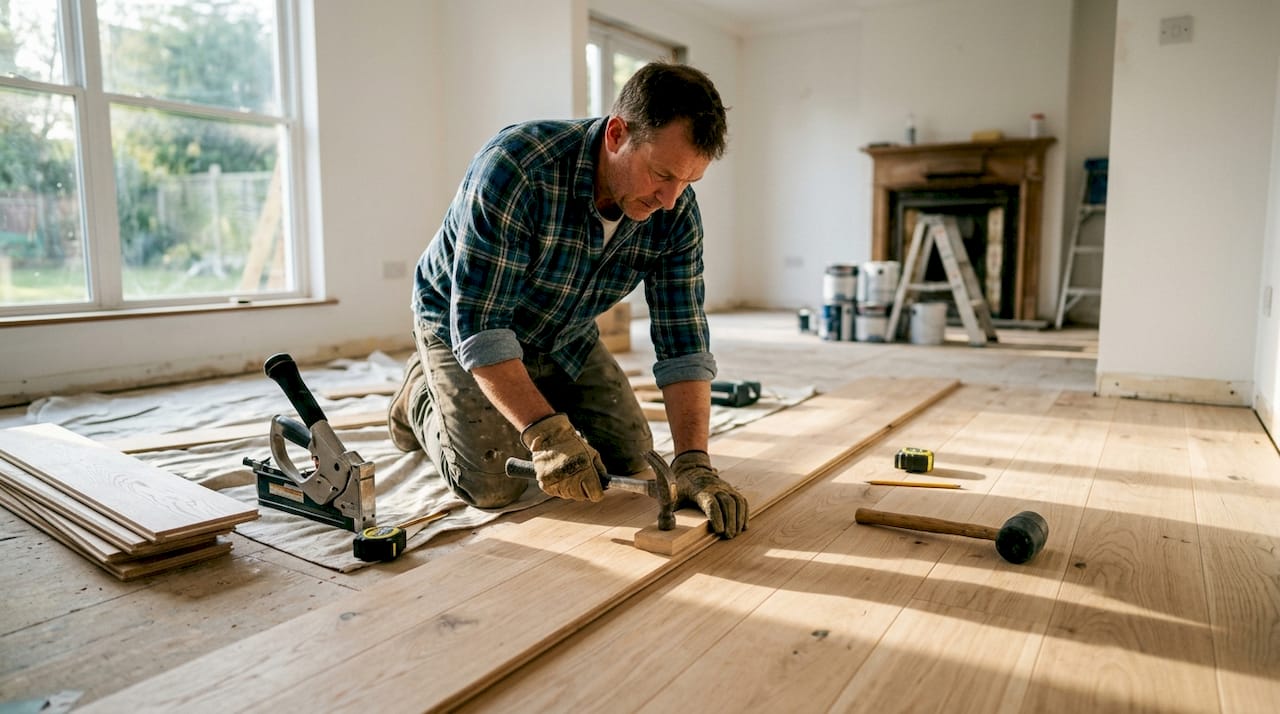
Long-term costs tell a different story. Refinishing hardwood costs $3–$8 per square foot and restores the floor without replacement. Replacing damaged laminate costs roughly the same per square foot, but you also deal with waste disposal and the disruption of a full tear-out. Over a 30-year ownership period, hardwood’s refinishing option often makes it the more cost-effective choice.
Pro Tip: Get quotes for both prefinished hardwood and laminate before committing. The installed price gap is often smaller than the material-only sticker price suggests, especially when you factor in labor savings on prefinished products.
| Material | Installed cost per sq ft | Site finishing | Refinishable |
|---|---|---|---|
| Laminate | $2.50–$8.00 | Not required | No |
| Hardwood (prefinished) | $8.00–$20.00 | Not required | Yes |
| Hardwood (unfinished) | $8.00–$20.00 | $2–$4 extra | Yes |
What are the durability and maintenance differences customers ask about?
Lifespan is where hardwood pulls far ahead. Hardwood lasts 50–100+ years with multiple refinishing cycles, while laminate averages 15–25 years and cannot be refinished. That gap matters most if you plan to stay in your home for decades.
Scratch resistance is more nuanced. Laminate’s wear layer resists surface scratches better than most hardwood species. That makes it a popular choice for households with dogs or heavy foot traffic. The catch is that once laminate is damaged, you replace it. There is no sanding it back to life.
Hardwood can be sanded and refinished 3–7 times over its lifespan. Each sanding removes roughly 1/32 inch of wood, so the number of refinishes depends on plank thickness. A standard 3/4-inch solid hardwood plank supports the full refinishing range. Engineered hardwood supports fewer cycles due to its thinner wear layer.
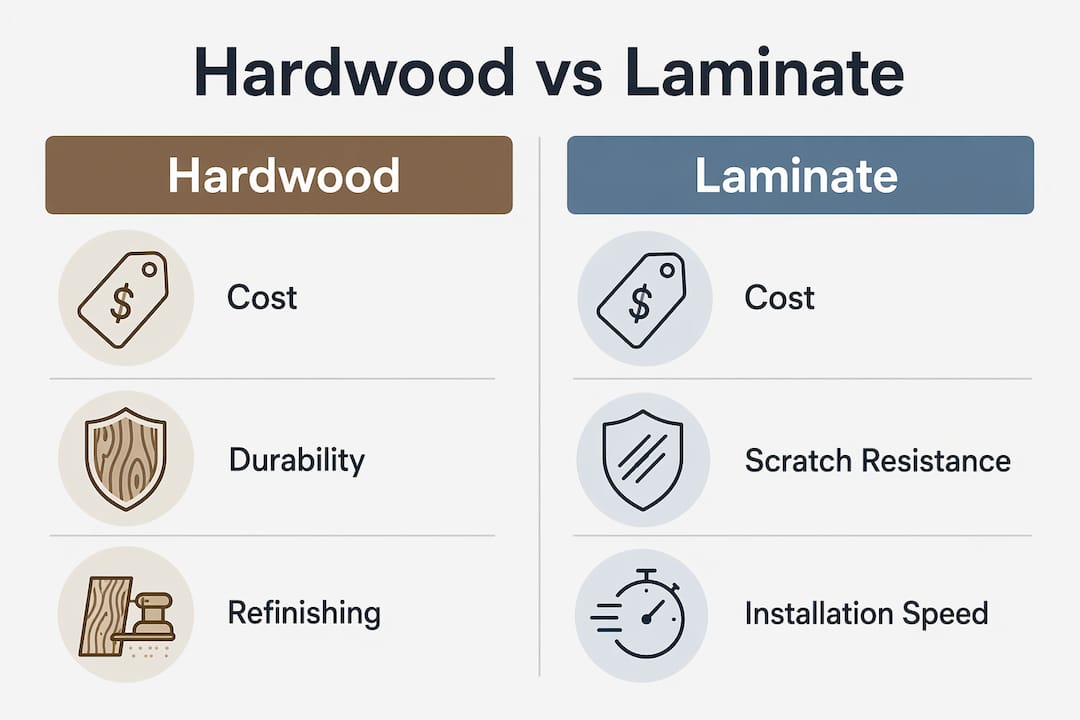
Moisture is laminate’s biggest vulnerability. Laminate is not fully waterproof; water that seeps through plank edges or subfloor gaps causes swelling and warping. Hardwood also reacts to moisture, but it can often be dried, sanded, and refinished after minor water events. Laminate damaged by moisture typically needs full replacement.
Key durability facts homeowners should know:
- Laminate resists surface scratches better than most hardwood species.
- Hardwood can be refinished when scratched, stained, or worn; laminate cannot.
- Moisture damage to laminate is usually permanent and requires replacement.
- Hardwood’s lifespan of 50–100+ years far exceeds laminate’s 15–25 year average.
- Pet owners get better scratch resistance from laminate but lose the repair option.
Pro Tip: If you have large dogs, look for laminate with an AC4 or AC5 wear layer rating. These commercial-grade ratings indicate significantly higher scratch and abrasion resistance than standard residential laminate.
How do installation methods differ between hardwood and laminate?
Installation method affects both your project timeline and your total cost. Hardwood and laminate require different approaches, and knowing the difference helps you plan accurately.
- Nail-down hardwood installation requires a wood subfloor, a pneumatic flooring nailer, and professional-level skill. This is the traditional method for solid hardwood and produces the most stable result. DIY is possible but not recommended without prior experience.
- Glue-down hardwood installation works on concrete subfloors and is common for engineered hardwood. It requires adhesive, careful spreading technique, and proper drying time. Most homeowners hire a professional for this method.
- Laminate floating floor installation uses a click-lock system where planks connect to each other without fastening to the subfloor. This is the most DIY-friendly method in flooring. Many homeowners complete a room in a single day.
- Subfloor preparation is non-negotiable for both materials. Laminate requires an extremely flat subfloor; even minor unevenness causes plank gapping or squeaking after installation. Hardwood tolerates slightly more variation but still needs a clean, dry, structurally sound base.
- Acclimation applies to both materials. Hardwood needs 3–5 days to acclimate to your home’s humidity before installation. Laminate typically needs 48 hours. Skipping this step causes expansion and buckling after the floor is laid.
Laminate installation tolerates imperfect subfloors better than hardwood in terms of minor height variation, but it still demands flatness. The floating system compensates for slight irregularities, not structural problems. If your subfloor has soft spots, rot, or significant height changes, fix those before any flooring goes down.
What are the resale value implications of hardwood vs laminate?
Resale value is one of the most misunderstood topics in flooring decisions. The short answer: hardwood adds measurable value in most markets, and laminate does not hurt you but rarely helps.
Hardwood typically adds $3–$5 per square foot in resale value. That return is real but not guaranteed. It depends heavily on your neighborhood, your home’s price tier, and buyer expectations in your local market.
“Hardwood resale value benefits are highly market-dependent. Entry and mid-level neighborhoods may not reward hardwood upgrades as much as wealthier areas.”
Laminate’s resale impact is neutral to slightly positive for mid-range homes. Buyers in most markets accept quality laminate without discounting the home. They do not pay a premium for it either. The calculus changes in luxury markets, where buyers expect hardwood and may negotiate down if they find laminate instead.
Factors that shape resale value from flooring:
- Neighborhood price tier: higher-end markets reward hardwood more consistently.
- Condition: well-maintained laminate beats worn hardwood in buyer perception.
- Home age and style: older homes with original hardwood carry a heritage premium.
- Buyer demographics: families with young children sometimes prefer laminate’s durability.
The practical advice: assess room-specific factors and your ownership timeline before deciding. If you plan to sell within five years, research what comparable homes in your zip code are selling with. Your real estate agent is a better source on this than any general guide.
Which retail customer questions reveal the most important decision factors?
The questions homeowners ask at a flooring counter tend to cluster around five practical concerns. Each one points to a real decision criterion.
Moisture and room suitability. “Can I put this in my kitchen or bathroom?” Laminate handles light moisture better than solid hardwood but is not rated for wet areas. Neither material is the right choice for a bathroom floor. Luxury vinyl plank is the correct answer for fully wet rooms. For kitchens with normal spill exposure, quality laminate with tight locking joints performs well.
Pet and scratch resistance. “I have two dogs. Which one holds up better?” Laminate wins on initial scratch resistance. Laminate’s wear layer resists scratches that would mark most hardwood species. But a deep gouge in laminate means replacing planks, which often creates a color mismatch as the product ages. Hardwood can be spot-repaired or fully refinished to match.
Refinishing and lifecycle. “How many times can I refinish it?” Hardwood supports 3–7 refinishing cycles depending on plank thickness. Laminate supports zero. This single fact drives most long-term value comparisons between the two materials. If you want a floor that grows with the home, hardwood is the answer.
Installation timeframe. “How long will my house be torn up?” Laminate installs faster. A skilled DIYer can complete 500 square feet in a day. Hardwood installation, especially nail-down with site finishing, can take several days plus drying time for stains and topcoats.
Budget and ownership plans. “What makes more sense if I’m only here for five years?” Laminate is the financially sound choice for short ownership windows. The lower upfront cost and acceptable resale neutrality make it practical. Hardwood makes more sense when you plan to stay long enough to benefit from its lifespan and refinishing value. Quality Hardwoods of Michigan, Inc recommends reviewing common laminate questions before your final decision if laminate is your leading option.
Key Takeaways
The best flooring choice between hardwood and laminate depends on your budget, ownership timeline, and room conditions, not on which material is objectively superior.
| Point | Details |
|---|---|
| Cost gap is real | Laminate saves $5,000–$12,000 on a 1,000-square-foot install compared to hardwood. |
| Hardwood lasts longer | Hardwood lasts 50–100+ years with refinishing; laminate averages 15–25 years with no repair option. |
| Installation complexity varies | Laminate floats and suits DIY; hardwood nail-down or glue-down typically needs professional installation. |
| Resale value is market-dependent | Hardwood adds $3–$5 per square foot in resale value, but only in markets where buyers expect it. |
| Room conditions drive the decision | Moisture exposure, subfloor quality, and ownership duration matter more than material preference alone. |
What I’ve learned from 40 years of flooring conversations
The hardwood vs laminate debate sounds like a material question. After decades of talking with homeowners, I can tell you it is actually a lifestyle question.
The most common mistake I see is homeowners choosing based on aesthetics alone. They fall in love with a wood look and buy without asking about their subfloor, their pets, or how long they plan to stay. That is how you end up with beautiful laminate that squeaks after six months because the subfloor had a half-inch dip nobody caught.
The second mistake is treating laminate as a budget compromise. Quality laminate at the AC4 wear layer rating is genuinely durable and looks excellent for 15–20 years. For a homeowner who moves every seven years, it is often the smarter financial decision. Hardwood is not always the right answer, and I say that as someone who sells both.
My honest advice: walk into a flooring conversation with three facts ready. Know your subfloor material, know your moisture exposure by room, and know your ownership timeline. Those three answers will narrow your choice faster than any comparison chart. A good retailer should be asking you those questions before showing you a single sample.
— Mike Solomich
Quality Hardwoods of Michigan, Inc is ready to help you choose
Choosing between hardwood and laminate gets easier when you have an experienced team walking you through the options for your specific home and budget.
Quality Hardwoods of Michigan, Inc has served Michigan homeowners and contractors for over 40 years with a full inventory of hardwood, laminate, and luxury vinyl flooring. Whether you are planning a single-room update or a whole-home renovation, the team offers product guidance and professional flooring installation in Salem, MI and surrounding areas. Stop by the showroom or reach out to schedule a consultation and get a clear, project-specific recommendation before you buy.
FAQ
Is laminate flooring good for kitchens and high-traffic areas?
Laminate handles light moisture and heavy foot traffic well, making it a practical choice for kitchens. Avoid it in bathrooms or laundry rooms where standing water is common.
Can hardwood flooring be refinished multiple times?
Hardwood can be sanded and refinished 3–7 times over its lifespan, depending on plank thickness. Each refinishing cycle removes roughly 1/32 inch of wood.
Which flooring is better for homes with pets?
Laminate offers better initial scratch resistance than most hardwood species, making it popular in pet households. However, deep damage to laminate requires plank replacement, while hardwood can be refinished.
Does hardwood flooring increase home resale value?
Hardwood typically adds $3–$5 per square foot in resale value, but the return depends on your local market and neighborhood price tier. Mid-range markets show less premium than luxury markets.
How long does laminate flooring last compared to hardwood?
Laminate averages 15–25 years and cannot be refinished. Hardwood lasts 50–100+ years with proper care and multiple refinishing cycles.