

A flooring warranty is considered void when an installer fails to follow the manufacturer’s required installation procedures, giving the manufacturer legal grounds to deny any claim tied to that job. Understanding what does flooring warranty void mean for installers is not optional knowledge. It is the difference between a protected project and a costly dispute that lands squarely on your shoulders. The industry distinguishes between two separate warranties: the manufacturer’s product warranty and your own workmanship warranty. Both can be compromised by installation errors, and both affect your reputation and your client’s wallet.
What installer actions commonly void a flooring warranty?
A bad installation can void the manufacturer warranty entirely, even when the product itself contributed to the problem. Wrong adhesive, no moisture testing, or insufficient acclimation all result in claim denial. That means the client gets nothing, and the liability points back to you.
The most common warranty void reasons installers trigger include:
- Skipping manufacturer installation instructions. All installation instructions are available as PDFs on manufacturers’ websites. Using an old printed copy from a previous job is not acceptable.
- Ignoring subfloor preparation. Uneven, dirty, or wet subfloors cause failures that manufacturers will not cover. Flatness tolerances are specified in writing for every product.
- Skipping moisture testing. Moisture is the single most common cause of hardwood and engineered floor failures. No test, no defense.
- Improper acclimation. Flooring materials must reach equilibrium with the job site environment before installation. Rushing this step causes cupping, gapping, and buckling.
- Using the wrong adhesive or fasteners. Manufacturers specify approved products. Substituting a cheaper or more convenient option voids coverage immediately.
- Failing to leave expansion gaps. Every floating floor requires perimeter gaps. Skip them, and the floor buckles. The manufacturer will deny the claim.
- Ignoring temperature and humidity requirements. Hardwood warranties require maintaining indoor humidity between 35% and 55%. Installing in a space that cannot hold those conditions puts the warranty at risk from day one.
Pro Tip: Before you start any job, pull the current installation guide directly from the manufacturer’s website. Printed manuals go out of date. Technical bulletins issued after printing can supersede the original instructions, and using outdated guidance is treated the same as ignoring instructions entirely.
Each of these errors is preventable. The pattern behind most denied claims is not a defective product. It is an installer who moved too fast or skipped a step that felt minor at the time.

How do manufacturer warranties differ from installer workmanship warranties?
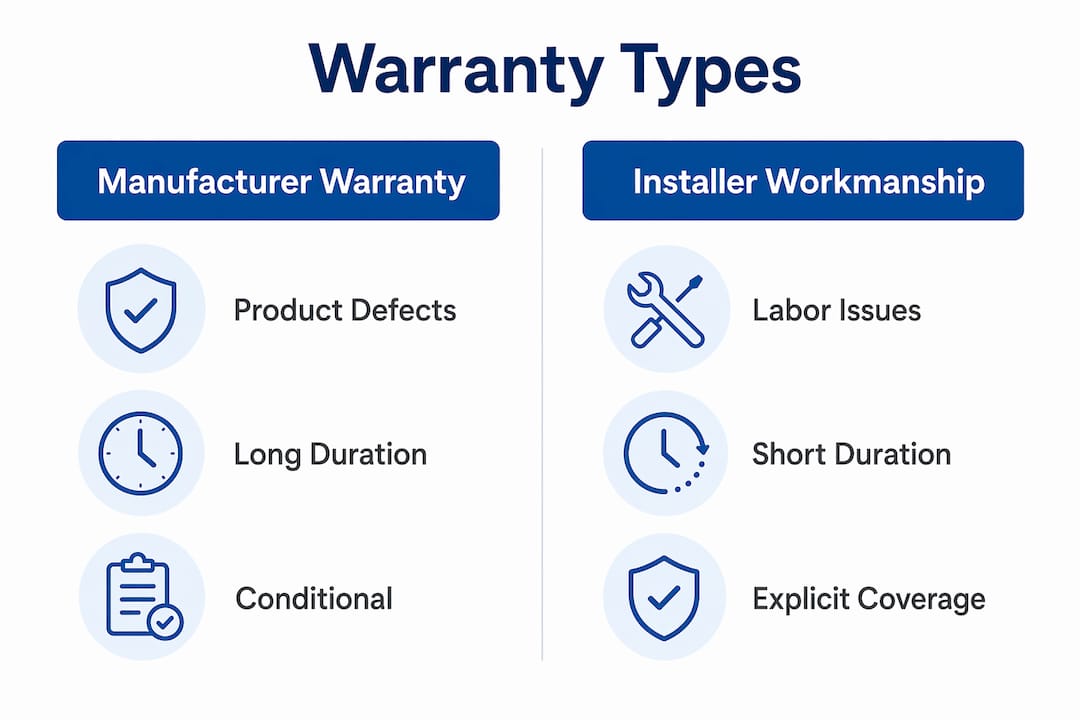
Manufacturer warranties and installer workmanship warranties are legally distinct, and confusing them creates serious problems on job sites. The manufacturer’s warranty covers product defects, finish failures, and structural issues with the flooring material itself. Your workmanship warranty covers the labor you performed and the installation decisions you made.
Workmanship warranties typically last 1–2 years, while manufacturer warranties on hardwood or luxury vinyl products can run 15, 25, or even 50 years depending on the product tier. That gap in duration matters. A client who calls you three years after installation with a cupping problem is outside your workmanship warranty. Whether the manufacturer covers it depends entirely on whether you installed the floor correctly.
The manufacturer’s warranty is conditional. It activates only when installation meets the manufacturer’s published specifications. If you deviated from those specs, even in a minor way, the manufacturer can deny the claim and point to your installation as the cause. That shifts the dispute to you, even if your workmanship warranty has expired.
| Coverage type | What it covers | Typical duration |
|---|---|---|
| Manufacturer warranty | Product defects, finish wear, structural integrity | 15–50 years depending on product |
| Installer workmanship warranty | Labor errors, installation technique, workmanship | 1–2 years |
| Combined protection | Full coverage when both are active and installation is compliant | Overlapping period only |
Installer warranties act as a shield by explicitly defining what labor issues are covered, which reduces homeowner attempts to push labor claims onto the manufacturer. Providing a written workmanship warranty is not just good practice. It is a legal boundary that protects you. Contractors who work with professional flooring installation partners understand that clearly defined warranty scopes prevent the most common post-job disputes.
What documentation protects installers from voided warranties?
Documentation is the only evidence you can present when a warranty claim dispute arises. Manufacturer warranty claims are often denied due to installation-related non-compliance and lack of documentation. A well-documented job gives you a defensible position. A job with no records gives the manufacturer every reason to deny.
Here is the documentation process that protects you on every project:
- Download the current installation guide. Go to the manufacturer’s website before the job starts. Manufacturer websites have the latest installation guidance that supersedes printed manuals. Save the PDF with the job file.
- Record subfloor moisture readings. Use a calibrated moisture meter and log readings across multiple points in the room. Note the date, tool used, and readings taken.
- Photograph subfloor conditions. Take photos before and after subfloor prep. Show flatness, cleanliness, and any remediation work you performed.
- Document acclimation time and conditions. Record when materials arrived on site, the ambient temperature and humidity during acclimation, and how long acclimation lasted.
- Log materials and products used. Write down the adhesive brand and product number, fastener type and spacing, and any underlayment used. Keep receipts.
- Provide a written workmanship warranty. Give the client a signed document that states what your warranty covers, for how long, and what it excludes. This separates your liability from the manufacturer’s.
Pro Tip: Take a photo of your moisture meter reading next to a visible room identifier, like a window or door frame. That single photo can resolve a dispute that would otherwise cost you thousands in legal fees or replacement materials.
The Magnuson-Moss Warranty Act provides additional legal protection. Under this federal law, manufacturers cannot void a warranty solely because a third-party installer performed the work. The manufacturer must prove that the installation caused the specific failure. That proof requirement is exactly why your documentation matters. Without it, the manufacturer’s claim of installer error goes unchallenged. You can find additional guidance on installation best practices that support warranty compliance across hardwood, LVP, and laminate projects.
What are common misconceptions about voided flooring warranties?
The most damaging myth in the flooring trade is that manufacturers can void a warranty simply because you, as a third-party installer, performed the work. That is not legally accurate.
Common misconceptions installers should stop believing:
- “Using a third-party installer automatically voids the warranty.” The Magnuson-Moss Warranty Act prohibits this. Legitimate denial requires a factual basis beyond simply using an independent contractor.
- “If the product failed, the manufacturer has to cover it.” Not if the installation was non-compliant. Manufacturers can and do deny claims when they can show the failure resulted from installation error rather than a product defect.
- “Warranty void language in contracts is always enforceable.” Legal professionals clarify that threats to void a warranty are often intimidation tactics. Manufacturers must provide evidence-based denials, not blanket refusals.
- “Consequential damages are always covered.” Most flooring warranties exclude consequential damages. That means water damage to a subfloor caused by a failed floor installation is typically not covered, even if the floor itself is.
A manufacturer who denies a warranty claim must demonstrate that the installation failure, not the product, caused the specific defect being claimed. Without that evidence, the denial does not hold up legally. Installers who document their work correctly are in a far stronger position than those who rely on the manufacturer’s goodwill.
When a claim is denied and you believe the denial is unjustified, consult a construction attorney who specializes in contractor disputes. The Magnuson-Moss Warranty Act gives you real legal standing, but only if you can show your installation met the manufacturer’s specifications. That is, again, a documentation problem. Installers who review common flooring questions before client conversations are better prepared to set accurate expectations from the start.
Key Takeaways
A flooring warranty becomes void when installation deviates from manufacturer specifications, and documentation is the installer’s only reliable defense against a denied claim.
| Point | Details |
|---|---|
| Warranty void defined | A warranty is void when installation does not meet manufacturer specifications, giving grounds for claim denial. |
| Two separate warranties | Manufacturer warranties cover product defects; installer workmanship warranties cover labor for 1–2 years. |
| Top void triggers | Skipping moisture testing, improper acclimation, wrong adhesives, and missing expansion gaps all void coverage. |
| Documentation is your defense | Moisture readings, photos, and material logs are the evidence that protects you in a dispute. |
| Legal protection exists | The Magnuson-Moss Warranty Act prevents manufacturers from voiding warranties based solely on third-party installation. |
What I’ve learned about warranty disputes after years in the field
The installers who get burned by warranty disputes are almost never the ones who did sloppy work. They are the ones who did decent work but kept no records. That distinction matters more than most contractors realize until it is too late.
I have seen jobs where the floor clearly had a manufacturing defect, and the installer still lost the dispute because they could not prove their moisture readings or acclimation period. The manufacturer pointed to the absence of documentation as evidence of non-compliance. Without records, you cannot argue otherwise. The burden of proof shifts to you the moment a claim is filed.
The other thing I tell every installer I work with: give your clients a written workmanship warranty on every single job. Not because you expect problems, but because it draws a clear line between what you are responsible for and what the manufacturer covers. Clients who understand that line do not call you three years later demanding you pay for a finish failure that falls under the manufacturer’s coverage period.
Professionalism in this trade is measured by how you handle the jobs that go sideways. A contractor with thorough records, a clear workmanship warranty, and knowledge of the Magnuson-Moss Warranty Act walks into any dispute from a position of strength. One without those things is guessing. The flooring industry rewards the ones who treat paperwork as seriously as they treat the installation itself.
— Mike Solomich
Quality Hardwoods of Michigan, Inc supports installers who need compliant materials
Sourcing flooring products that come with clear installation documentation makes warranty compliance significantly easier from the start.

Quality Hardwoods of Michigan, Inc has served contractors and builders across Michigan for over 40 years. The product range includes vinyl flooring options in LVP, LVT, and sheet formats, along with a full selection of laminate flooring built for professional installation. Every product comes with manufacturer documentation that supports your warranty compliance process. Contractors can contact Quality Hardwoods of Michigan, Inc directly for product guidance, installation specifications, and sourcing support that keeps your projects on the right side of every warranty requirement.
FAQ
What does it mean when a flooring warranty is voided?
A voided flooring warranty means the manufacturer has determined that installation did not meet their specifications, and they will not cover claims for defects or failures on that job. The denial is based on non-compliance with published installation requirements.
Can an installer void a warranty by using the wrong adhesive?
Yes. Using an adhesive not approved by the manufacturer is one of the most direct ways to void a flooring warranty. Manufacturers specify approved products, and substituting them gives grounds for claim denial.
Does the Magnuson-Moss Warranty Act protect installers?
The Magnuson-Moss Warranty Act prevents manufacturers from voiding a warranty solely because a third-party installer performed the work. The manufacturer must prove the installation caused the specific failure, not just that an independent contractor was used.
How long does an installer workmanship warranty typically last?
Installer workmanship warranties typically last 1–2 years and cover labor errors and installation technique. This is separate from the manufacturer’s product warranty, which can run 15–50 years depending on the product.
What documentation should installers keep to protect against denied claims?
Installers should keep moisture meter readings, subfloor photos, acclimation records, a log of materials used, and a copy of the manufacturer’s installation guide downloaded at the time of the job. This documentation is the primary defense in any warranty dispute.